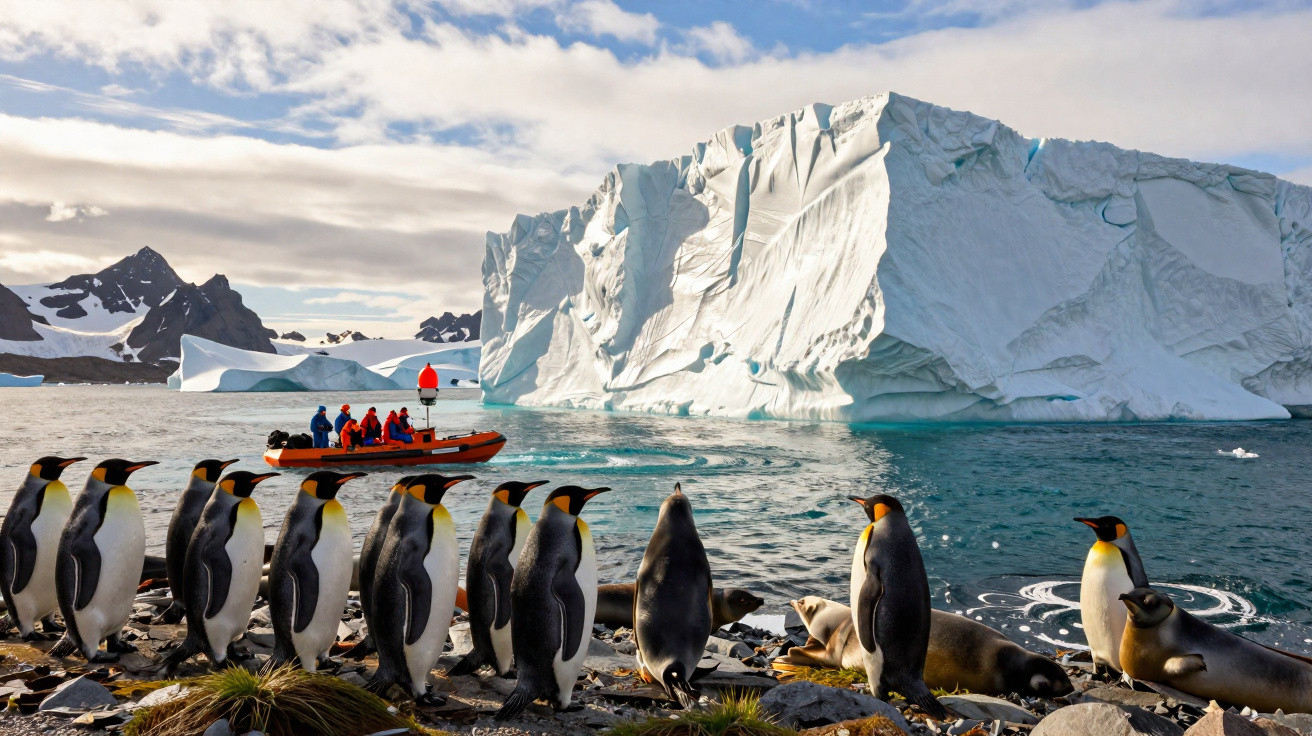
The world's largest iceberg appears to be on course for a remote group of islands in the South Atlantic, threatening wildlife in a region whose rich biodiversity is greater even than that of the Galapagos.
A23a is currently about 280 kilometres away and could collide with South Georgia and its surrounding islands. If the enormous iceberg runs aground, millions of penguins and seals could be at risk, along with rare marine species found nowhere else on Earth.
"Icebergs are inherently dangerous. I would be extraordinarily happy if it just completely missed us," Simon Wallace, captain of the South Georgia government vessel Pharos, told BBC News.
A23a and the threat to South Georgia wildlife
A giant iceberg has threatened animals in the region before. In 2004, after an iceberg called A38-B split in two, one part remained grounded off South Georgia for months, cutting penguins and seals off from feeding grounds.
A23a covers more than twice the area of Greater London. It calved from the Filchner-Ronne Ice Shelf in 1986, but its first decades of freedom were uneventful: it remained anchored to the seabed until gradual melting allowed it to begin creeping towards the Southern Ocean in 2020.
It broke free in 2023, only to become caught in a swirling vortex of water last year. After spending the preceding months travelling in circles, the vast iceberg set off across Antarctic waters again in December.
These ocean vortices, called Taylor columns, are created by underwater mountains. The circulating currents they produce can prevent icebergs from escaping, but A23a, which weighs roughly a trillion tonnes, managed to break free. Scientists are still watching it closely.
How A23a’s journey affects melting and marine life
As icebergs melt, they can substantially alter the amount of carbon and nutrients in the water, with consequences for food chains and aquatic life beneath the surface.
A23a’s stop-start journey has considerably slowed its melting. That includes more than three decades grounded in the Weddell Sea, where its own size and weight held it against the ocean floor.
After A23a began moving again in 2023, British Antarctic Survey (BAS) scientists aboard the research vessel Sir David Attenborough were able to examine it more closely than usual. They also gathered samples to investigate how meltwater affects ecosystems.
"We are interested to see if it will take the same route the other large icebergs that have calved off Antarctica have taken," said BAS oceanographer Andrew Meijers in December. "And more importantly what impact this will have on the local ecosystem."
A23a’s route through iceberg alley
The BAS team expects winds and currents to carry A23a into the Southern Ocean along the Antarctic Circumpolar Current, bringing it nearer to the area known as ‘iceberg alley’.
"South Georgia sits in iceberg alley so impacts are to be expected for both fisheries and wildlife," marine ecologist Mark Belchier told BBC News.
Given A23a’s size, the effects of its melting when it reaches warmer waters are difficult to forecast. Previous research has shown, for example, that an increase in iron from melting glaciers can raise phytoplankton levels, trapping some atmospheric CO₂.
"We know that these giant icebergs can provide nutrients to the waters they pass through, creating thriving ecosystems in otherwise less productive areas," explains BAS biogeochemist Laura Taylor, who is examining the samples collected in 2023.
"What we don't know is what difference particular icebergs, their scale, and their origins can make to that process."
This article has been updated from an earlier version published in December 2024.












Comments
No comments yet. Be the first to comment!
Leave a Comment