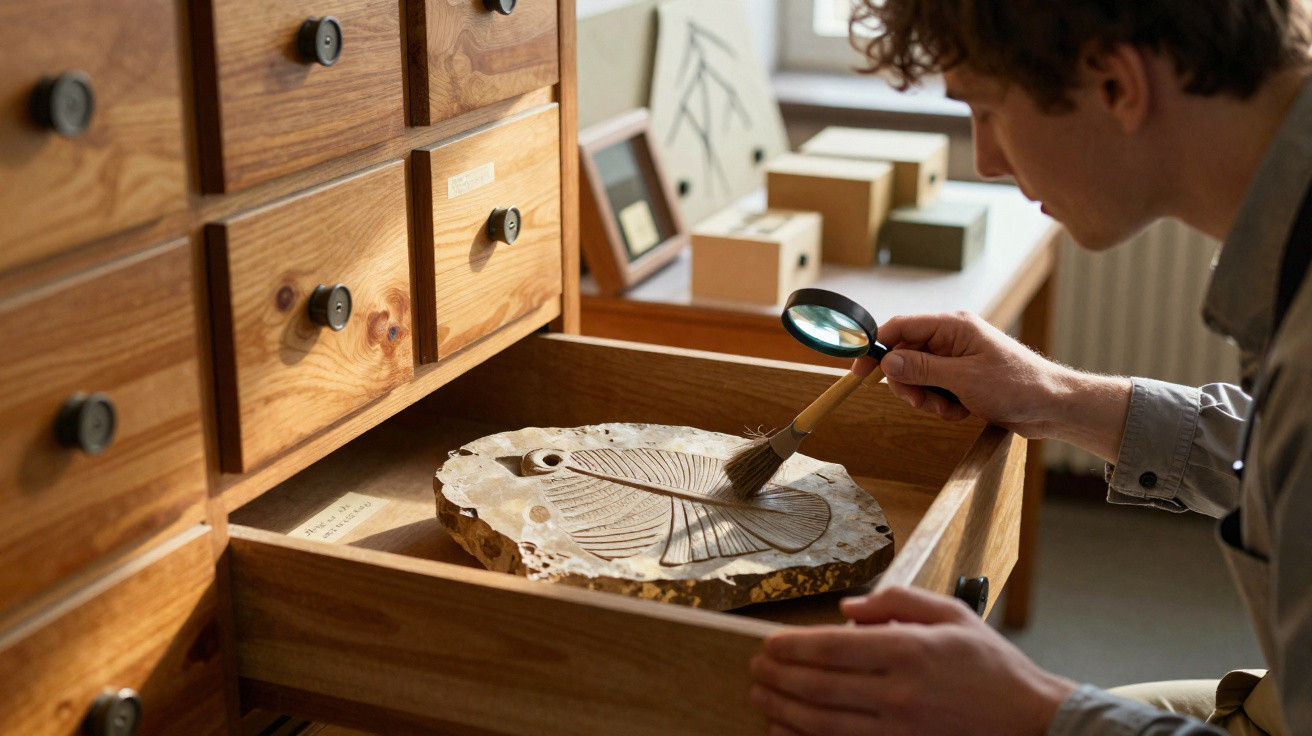
A fossil kept in a drawer at London’s Natural History Museum since 1885 has proved to be a significant discovery.
Bought from a Victorian fossil dealer and catalogued with little fanfare, the skull has now been identified as a new species that fills a 50-million-year gap in the history of one of the world’s best-known fish.
The species, Macropoma gombessae, is the oldest known member of Latimeriidae, the family that includes the modern coelacanth. It provides the clearest view yet of how the fish evolved during a period that had been a blank in the scientific record.
The coelacanth’s ‘living fossil’ problem
Coelacanths have a reputation that can be misleading. In 1938, fishermen pulled a living specimen from the Indian Ocean, astonishing scientists who believed the species had become extinct alongside the dinosaurs.
Since then, the fish have been called “living fossils”, a label implying that they have changed very little since giant reptiles roamed the Earth.
Yet their fossil record has long been incomplete. A frustrating 50-million-year gap covered the Early Cretaceous, a period for which no good example could be found.
Species from the Upper Cretaceous closely resembled today’s coelacanth, but what preceded them remained uncertain.
“Coelacanths are famously known as ‘living fossils,’ having changed relatively little over hundreds of millions of years. However, key stages in their evolutionary history have remained elusive – until now,” said study co-author Professor David Martill of the University of Portsmouth.
Macropoma gombessae overlooked for 140 years
The Macropoma gombessae fossil has an unusual history. The British Museum purchased it from John Starkie Gardner in 1885, after which it remained in the collection for almost 140 years without being properly described.
Its skull was found in cliffs near Folkestone, Kent, preserved in a slab of grey mudstone from the Gault Formation.
A fresh examination changed matters when Jack Norton, then a master’s student at Portsmouth, and his supervisor Samuel Cooper took another look.
“It’s incredibly exciting that such an important specimen has been hiding in plain sight for over a century,” said Norton.
“Only now that we have the technology available to examine these fossils in minute detail at the Natural History Museum do we understand its significance.”
Fossil fills a gap in time
The Gault Formation dates from the Albian stage, approximately 100 to 113 million years ago, placing the fish within the long-standing gap in the fossil record.
Researchers describe it as the first clear, confirmed coelacanth fossil from the Early Cretaceous. Previously, the only evidence available to scientists was spiral-shaped fossil droppings, which could have come from many different fish species.
The specimen’s skull also differs from those of later coelacanths. Rather than simple bumps, it has long ridges and small oval pits, while one section appears unusually narrow and elongated.
Its most striking feature lies above the eyes: larger pores sit between the bones, instead of smaller pores being embedded within them.
A fish adapted to dark waters
The enlarged pores offer clues about the fish’s environment. Fish use these sensory canals to detect vibrations in water, helping them locate food in murky or dim conditions.
Studies of modern cichlids in Lake Malawi show that species with larger pores tend to hunt in deeper, darker surroundings.
The Gault Formation represents a muddy, shallow sea around 90 to 350 metres deep, where visibility was poor. A fish with particularly sensitive hunting abilities would have had a clear advantage there.
That distinguishes M. gombessae from other Cretaceous coelacanths, which researchers generally find in clear, carbonate-rich reef environments such as the English Chalk.
The continuing value of old collections
“It’s really exciting that Jack and Sam – who are both early in their careers – identified this specimen as a new species,” said Emma Bernard, a fossil fish curator at the museum.
“This shows the scientific value of museum collections and why it is important to continue holding specimens in trust for society while also continuing to research them. Who knows what else technology will reveal about these specimens in years to come?”
Martill agreed, saying the discovery also demonstrates the importance of future scientists.
“What’s so wonderful about this finding is that it was a curious student who recognised its importance, which shows the value of the next generation of scientists and the vast scientific potential of museum collections worldwide,” he said.
When examined using modern methods, specimens collected generations ago can still transform scientists’ understanding of evolution.
Naming Macropoma gombessae
The species name honours local fishermen who have known the fish for generations. In the Comoros, the coelacanth is called “gombessa”, a word that once meant “worthless fish” before scientists recognised its importance.
Gombessas still swim somewhere off the coast of the Comoros today, unaware that a long-dead relative kept in a London museum drawer has helped rewrite part of their history.












Comments
No comments yet. Be the first to comment!
Leave a Comment