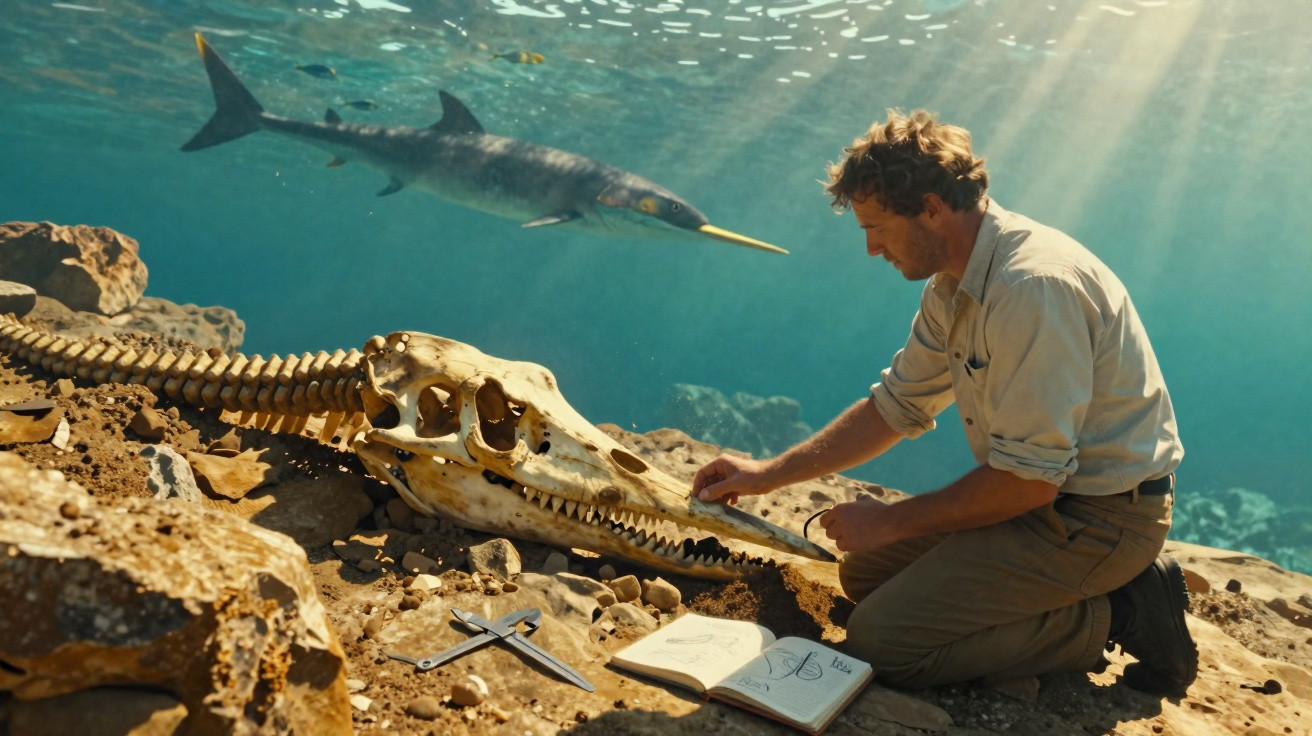
A marine reptile with a razor-sharp snout, skewer-like teeth and enormous eyes has joined the ichthyosaur family tree.
The newly described species, Xiphodracon goldencapensis – meaning “Sword Dragon from Golden Cap” – sheds fresh light on how these fast-swimming predators diversified after the end-Triassic extinction.
Its fossilised skeleton was discovered in 2001 on England’s UNESCO-listed Jurassic Coast, close to the towering cliffs of Golden Cap in Dorset.
Following excavation, the skeleton travelled across the Atlantic, where it spent years in the Royal Ontario Museum’s collections in Canada.
Though recognised as “something interesting”, the specimen was not examined straight away.
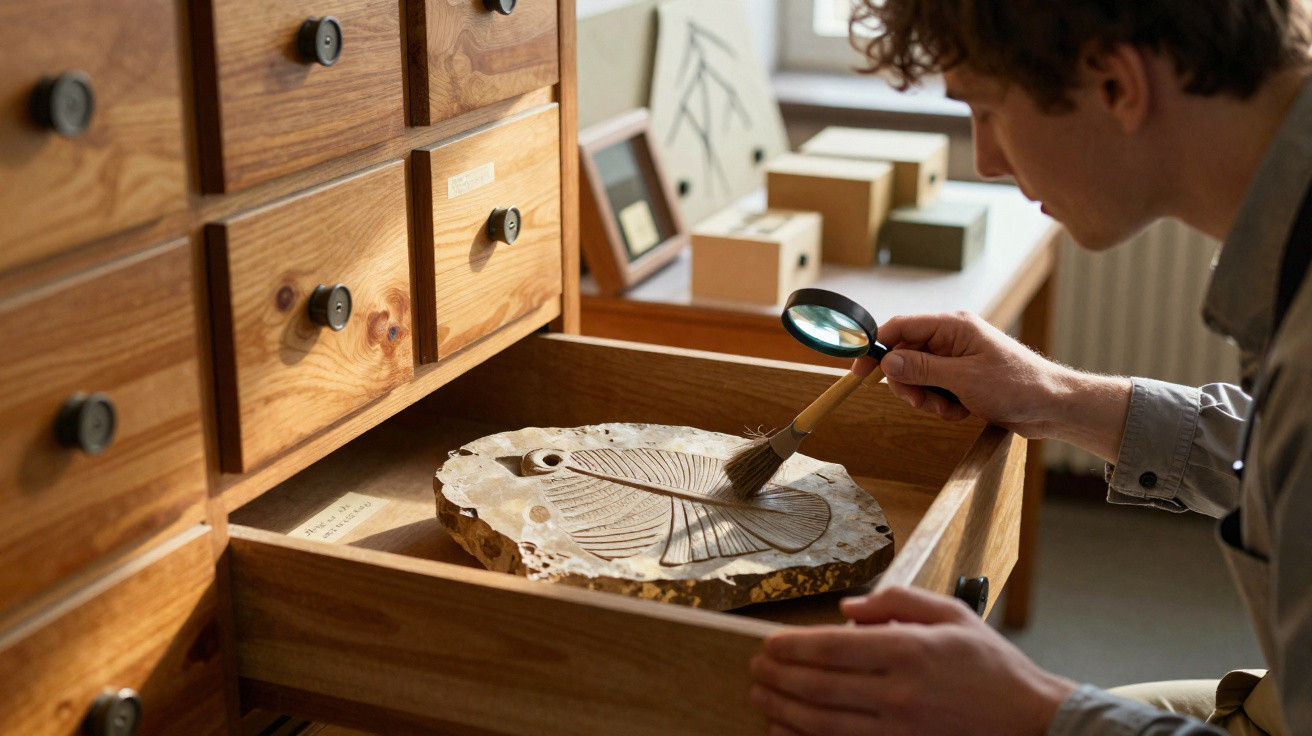
Dr Dean Lomax of the University of Manchester and his colleagues have now prepared and described it, bringing a discovery made more than two decades ago into scientific view.
Xiphodracon goldencapensis anatomy
Freed from the rock, the fossil revealed a compact hunter about three metres long – roughly the size of a bottlenose dolphin. It dates from the Pliensbachian stage of the Early Jurassic, around 193 to 184 million years ago.
Its skull is particularly striking. A huge eye socket points to keen vision in low light, while fine, sharp teeth line a long, sword-like snout.
“I remember seeing the skeleton for the first time in 2016. Back then, I knew it was unusual, but I did not expect it to play such a pivotal role in helping to fill a gap in our understanding of a complex faunal turnover during the Pliensbachian,” explained Dr Lomax.
“This time is pretty crucial for ichthyosaurs as several families went extinct and new families emerged, yet Xiphodracon goldencapensis is something you might call a ‘missing piece of the ichthyosaur puzzle’.”
Together, its large eyes, slender but piercing teeth and streamlined, tapered head suggest an agile predator moving through dim water and seizing schools of fish and squid with rapid, precise strikes.
Unusual skull features discovered
The fossil’s striking outline is not its only distinction: it also preserves structures seldom seen so clearly.
Among them is a distinctive lacrimal bone, which borders the nostril, with unusual prong-like projections. Delicate prefrontal features are preserved too.
“This skeleton provides critical information for understanding ichthyosaur evolution, but also contributes to our understanding of what life must have been like in the Jurassic seas of Britain,” explained Dr Erin Maxwell, a co-author and ichthyosaur expert at the State Museum of Natural History Stuttgart.
“The limb bones and teeth are malformed in such a way that points to serious injury or disease while the animal was still alive, and the skull appears to have been bitten by a large predator – likely another much larger species of ichthyosaur – giving us a cause of death for this individual. Life in the Mesozoic oceans was a dangerous prospect.”
The clearly preserved sutures allow anatomists to follow the boundaries and contact points of skull bones that normally collapse over geological time.
A dark mass was found between the ribs, tantalisingly close to where stomach contents might have been. The material could not be clearly identified, however, so the Sword Dragon’s final meal remains unknown.
The fearsome-looking rostrum gave rise to the genus name Xiphodracon – “xiphos” for sword and “dracon” for dragon – while goldencapensis connects the species to its Dorset home.
The name therefore refers both to the animal’s weapon-like snout and to the cliffs that guard so many secrets of Britain’s marine reptiles.
Rebuilding seas after catastrophe
The fossil’s significance extends beyond its remarkable skull: its age matters too. Super-predator ichthyosaurs inhabited the oceans at the end of the Triassic.
These giants, probably resembling the recently reported Ichthyotitan, approached 25 metres in length, putting them on a par with blue whales.
Then, around 201.4 million years ago, the end-Triassic extinction struck. The giants vanished from the record, and smaller, more agile ichthyosaurs repopulated Jurassic seas.
Palaeontologists have found numerous Early Jurassic ichthyosaurs in deposits laid down before the Pliensbachian, as well as many others in layers formed afterwards.
The faunas on the two sides of that interval often appear taxonomically distinct, with little overlap. Xiphodracon goldencapensis falls squarely within the gap, helping to connect a patchwork account of evolution.
The Sword Dragon also complicates that neat story. Its anatomy adds detail to a picture of Jurassic ichthyosaurs pursuing varied lifestyles, with different diets, swimming speeds and preferred habitats.
Breaking the ichthyosaur mould
Ichthyosaurs are often described simply as “dolphin-like reptiles”, a label that can obscure their diversity. Xiphodracon goldencapensis shows just how specialised these hunters could become.
Its enormous eye sockets offer clues about its visual ecology, while its piercing teeth point towards its choice of prey. The narrow, elongated snout suggests hydrodynamic precision rather than brute force.
Taken together, these features support the idea that ichthyosaurs occupied different niches in Early Jurassic seas. Some used strong jaws to tackle tough prey; others, including the Sword Dragon, were adapted for speed and soft-bodied quarry.
“Thousands of complete or nearly complete ichthyosaur skeletons are known from strata before and after the Pliensbachian,” noted ichthyosaur expert and co-author Professor Judy Massare, of the State University of NY at Brockport, USA.
“The two faunas are quite distinct, with no species in common, even though the overall ecology is similar. Clearly, a major change in species diversity occurred sometime in the Pliensbachian. Xiphodracon helps to determine when the change occurred, but we still don’t know why.”
Rediscovering lost marine worlds
The Dorset coast has produced marine reptile treasures since the days of Mary Anning, but it continues to yield surprises.
Finds such as Xiphodracon goldencapensis also demonstrate the value of museums. Collections assembled over centuries regularly contain important material that has received too little study.
Once such specimens undergo modern preparation and examination, they can reshape the boundaries of evolutionary knowledge.
In this case, the reward is twofold. The Sword Dragon fills a gap in the timeline of ichthyosaur evolution after a mass extinction, while its distinctive skull features broaden the known morphological range of Early Jurassic forms.
Lessons from Xiphodracon goldencapensis
Because neither the body outline nor the tail fluke was preserved, its swimming style must be inferred rather than directly observed. The unidentified mass in its gut also leaves its diet partly speculative, although its teeth and eyes strongly suggest squid and fish.
The unusual lacrimal bone prompts questions about sensory adaptations around the snout and eye. Comparing it with those of close relatives may help researchers find answers.
For now, Xiphodracon goldencapensis is a sharp-snouted reminder that Jurassic seas were far from uniform.
After the Triassic titans disappeared, evolution did more than reduce ichthyosaurs in size: it also diversified them. From a cliff above England’s Channel coast, a Sword Dragon has emerged to show just how inventive those oceans could be.











Comments
No comments yet. Be the first to comment!
Leave a Comment