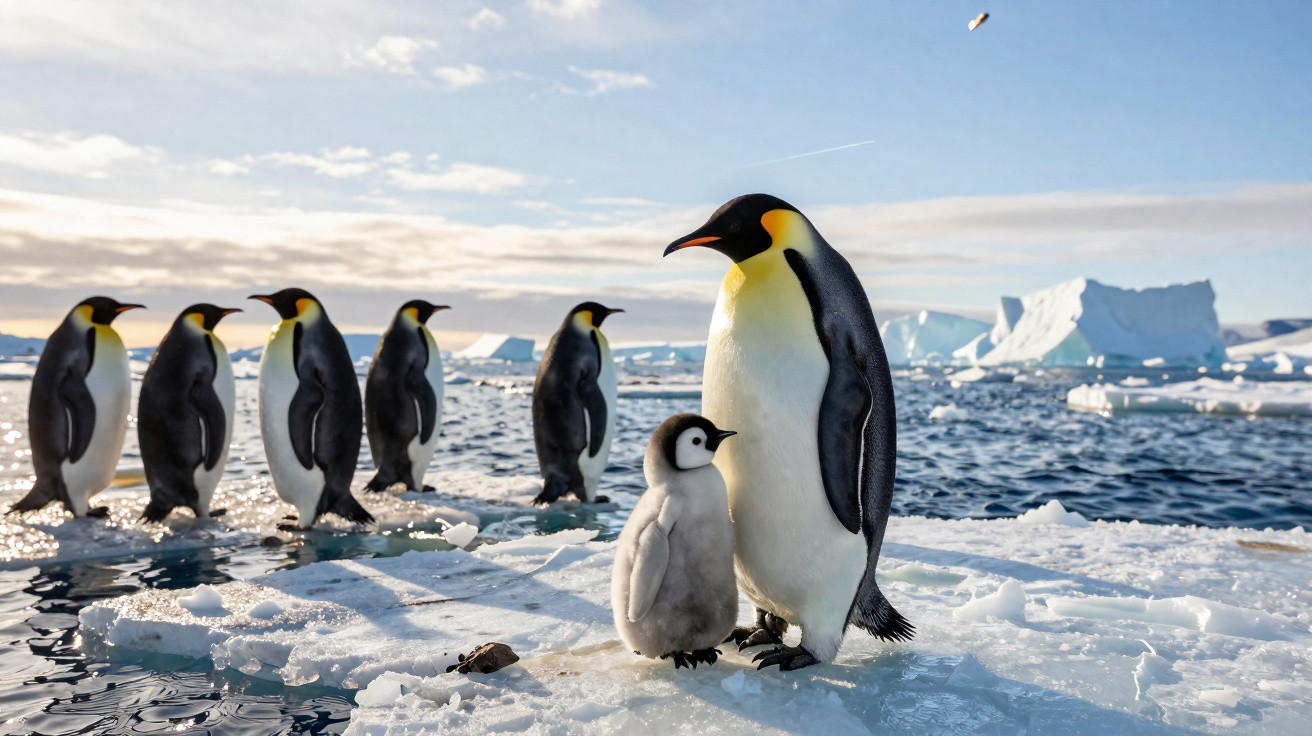
Antarctica’s emperor penguin populations have fallen by almost a quarter as global warming reshapes their icy habitat, according to research released on Tuesday. The study warned that the losses were much worse than previously thought.
Emperor penguin population decline
Scientists used satellites to monitor sixteen colonies of the world’s largest penguin species across the Antarctic Peninsula, Weddell Sea and Bellingshausen Sea. Together, the colonies account for almost a third of the global emperor penguin population.
Their findings were "probably about 50-percent worse" than even the most pessimistic computer-modelled estimate of current populations, said Peter Fretwell, who monitors wildlife from space at the British Antarctic Survey (BAS).
Researchers know climate change is causing the losses, but the pace of the decline is particularly alarming.
Published in Nature Communications: Earth & Environment, the study found that the monitored colonies declined by 22 percent over the 15 years to 2024. An earlier estimate had put the reduction across Antarctica as a whole at 9.5 percent between 2009 and 2018.
Rising temperatures are thinning the ice beneath the penguins and making it less stable at their breeding grounds. Some colonies have lost every chick in recent years after the ice gave way, sending hatchlings into the sea before they were old enough to withstand the freezing water.
Fretwell said the research suggests penguin numbers have been falling since monitoring started in 2009, even before global warming was having a major impact on the sea ice that forms over open water next to land in the region.
He said climate change was nevertheless the likely cause, as warming creates other difficulties for the penguins, including heavier rainfall and greater encroachment by predators.
"Emperor penguins are probably the most clear-cut example of where climate change is really showing its effect," Fretwell told AFP.
"There's no fishing. There's no habitat destruction. There's no pollution which is causing their populations to decline.
"It's just the temperatures in the ice on which they breed and live, and that's really climate change."
'Worrying result' for emperor penguins
A 2020 study estimated that there are around a quarter of a million breeding pairs of emperor penguins, also known as Aptenodytes forsteri, all of them in Antarctica.
A male keeps an emperor penguin egg warm through winter until the chick hatches, while his female breeding partner spends two months fishing. On her return to the colony, she feeds the hatchling by regurgitating food, after which the parents take turns to forage.
Chicks need to develop waterproof feathers before they can survive independently, a process that usually begins in mid-December.
Emperor penguin satellite monitoring
The new study uses high-resolution satellite images taken in October and November, before winter darkness descends on the region. Fretwell said future research could use other satellite techniques, such as radar or thermal imaging, to assess populations during the darker months and extend monitoring to the other colonies.
"We really do need to look at the rest of the population to see if this worrying result transfers around the continent," he said, although he added that the colonies studied were considered representative.
Fretwell said there was hope that the penguins might move farther south to colder areas in future, but it was unclear "how long they're going to last out there".
Computer models have projected that the species will be close to extinction by the end of the century unless humans sharply cut planet-heating emissions. The latest research suggests the outlook could be worse still.
"We may have to rethink those models now with this new data," Fretwell said.
He emphasised, however, that there was still time to lessen the threat to the penguins.
"We've got this really depressing picture of climate change and falling populations even faster than we thought but it's not too late," he said.
"We're probably going to lose a lot of emperor penguins along the way but if people do change, and if we do reduce or turn around our climate emissions, then then we will save the emperor penguin."
© Agence France-Presse













Comments
No comments yet. Be the first to comment!
Leave a Comment