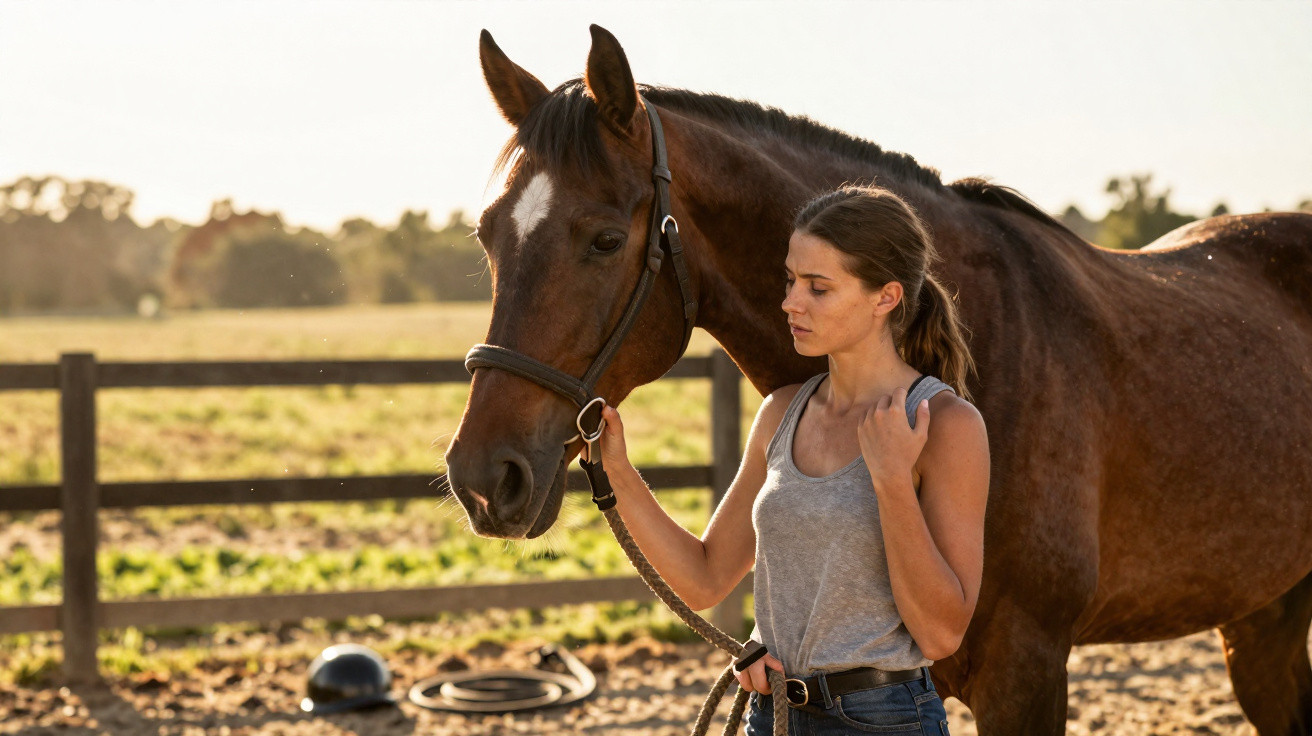
A new French study suggests that horses pick up more than our posture and voices. They also detect chemical signals released when we are afraid and adjust their behaviour in response. The findings offer a different perspective on equestrian safety and the relationship between humans and animals.
How researchers measured horses’ response to “invisible fear”
Scientists from the French Horse and Riding Institute (IFCE) and the research institute INRAE worked with 43 mares accustomed to human contact. They wanted to establish whether horses respond to smells associated with human fear when there is no eye contact, voice or touch to guide them.
First, the researchers collected sweat samples from volunteers. The participants wore cotton pads under their arms while watching specially selected videos for 20 minutes:
- A horror film designed to provoke fear.
- Funny clips intended to produce joy.
- Neutral videos without strong emotional content.
The soaked pads were frozen at –80°C to keep the sensitive scent molecules stable. To prevent contamination, the volunteers had as little contact with the samples as possible.
The researchers later used nose nets to position the pads directly in front of the horses’ nostrils. Crucially, the animals could neither see nor hear a person during this stage. That ruled out the influence of gestures, facial expressions and voices, leaving smell as their only source of information.
Each horse then took part in several standardised tests:
- An approach test involving a person standing motionless.
- A grooming session in which the horse was touched and brushed.
- A startle test involving the sudden opening of an umbrella.
- An encounter with an unfamiliar object.
Throughout the tests, the researchers continuously recorded heart rate and collected saliva samples to measure cortisol, a stress marker. This allowed them to link behavioural changes and physical responses directly to the different smells.
What happens when horses smell fear sweat
The results were clear: the smell of human fear noticeably changed the horses’ behaviour, even when there was no objective threat.
When human fear sweat was “in the air”, the animals became more alert and wary, and were more inclined to avoid contact with people.
In the approach test, the horses were less likely to come towards the person, despite knowing them. During grooming, they were less accepting of touch, tensed up or moved slightly away. Familiar signs of internal tension also appeared more often:
- Ears turned backwards or moving constantly.
- Visible tension in the neck and shoulder muscles.
- Small backward steps.
- A fixed gaze on stimuli in the surroundings.
Their responses in the startle tests were stronger too. The horses flinched more violently, jumped sideways more quickly or took longer to settle again. The researchers describe a form of “emotional contagion”: a person feels afraid, and the horse picks up that state through smell.
Exposure to fear-related odours caused a measurable rise in the animals’ heart rates. Their salivary cortisol levels, however, remained largely stable. This points to a rapid, short-term alarm response rather than prolonged stress. For a time, the horse becomes more alert and ready to flee, without immediately entering a sustained state of stress that could harm its health.
Emotional contagion between humans and animals
The study provides experimental evidence for something many riders recognise instinctively: when a person is not in the right emotional state, a horse responds more sensitively. Experts have generally attributed this effect to body language, muscle tension or unsteady handling of the reins. The findings add another dimension: chemistry.
Unlike humans, horses have a functioning organ known as the vomeronasal organ. This auxiliary part of the sense of smell can detect certain chemical signals that people do not consciously perceive, including molecules associated with emotional states.
Sweat is not merely “wet”: it also carries emotions, and horses apparently can read these subtle differences.
The animals do not need to learn this through painstaking training. The researchers believe horses interpret the signals instinctively. That makes sense for a prey animal: survival in the wild depends on using every available warning signal. Fear in another nearby living creature may indicate danger, so becoming more cautious is the safer response.
A British behaviour expert who was not involved in the study puts the findings in context: horses assess risks in their environment using a whole range of information, including sounds, movements and smells. The scent of fear fits naturally into that picture.
What the findings mean for riders, trainers and vets
The research has clear practical implications at the stables. Approaching a horse while frightened or highly tense can unknowingly increase the likelihood of a difficult situation. Even someone who appears outwardly “cool” may give themselves away through their body’s scent.
Typical situations where this may matter include:
- Beginner riders who are afraid of their first canter.
- Riders trying to regain confidence after a fall.
- Vet visits involving injections, treatments or endoscopy.
- Loading a horse into a trailer when its owner and helpers are themselves stressed.
In each case, it is worth paying attention to the person as well as the horse. Breathing more calmly, preparing mentally and allowing plenty of time can reduce the risk of the animal becoming ready to flee.
How people can influence their effect on horses
For years, trainers and veterinary behaviour specialists have recommended better self-management when handling horses. The new study gives scientific support to that approach. Useful strategies include:
- Breathing techniques: Deep, calm breathing has been shown to reduce a person’s own tension.
- Routines: Consistent preparations before riding can provide reassurance, such as grooming in the same order each time.
- Realistic goals: Avoid demanding training on days when you feel completely unsettled.
- Support: Have an experienced person alongside you if you are still uncertain after a frightening incident.
Riding schools can also use the findings. Mental training, short relaxation exercises before mounting and clear explanations of how horses perceive their surroundings could become part of lessons. This can help pupils understand why simply “pulling yourself together” is not enough when fear is already deeply embedded in the body.
New research questions: can horses smell us “into calm” too?
The French researchers now want to investigate how horses respond to other emotions, such as sadness or anger. Another unanswered question is whether animals release smells that affect humans unconsciously in return. Many horse owners say they feel calmer more quickly at the stables, and chemistry may play a part in that too.
It would also be interesting to establish whether horses differ in the strength of their responses. Some appear more relaxed, while others seem more sensitive. Genetics, living conditions and training could all interact here. Horses routinely exposed to stressed people might develop different response patterns from animals at calm teaching establishments.
What riders can take from the horse study
People who work with horses should no longer regard their emotions as an entirely private matter. Fear rarely has no effect: it shows in a rider’s seat and hands and, as the study suggests, even in their smell.
The clearer and calmer the person, the easier it is for the horse to trust them.
Before a challenging ride or a critical vet appointment, simple preparations can help: arrive in good time, spend a few minutes breathing consciously and picture a realistic sequence of events. Many riders may also find it reassuring to know that their horse is not “being silly” for no reason when they themselves feel tense. The animal is simply responding to information we send out without noticing.
Taking this subtle chemical communication seriously can improve everyday safety around horses. It also places the animal more firmly at the centre of the relationship as a feeling, perceptive individual – exactly where it belongs.












Comments
No comments yet. Be the first to comment!
Leave a Comment