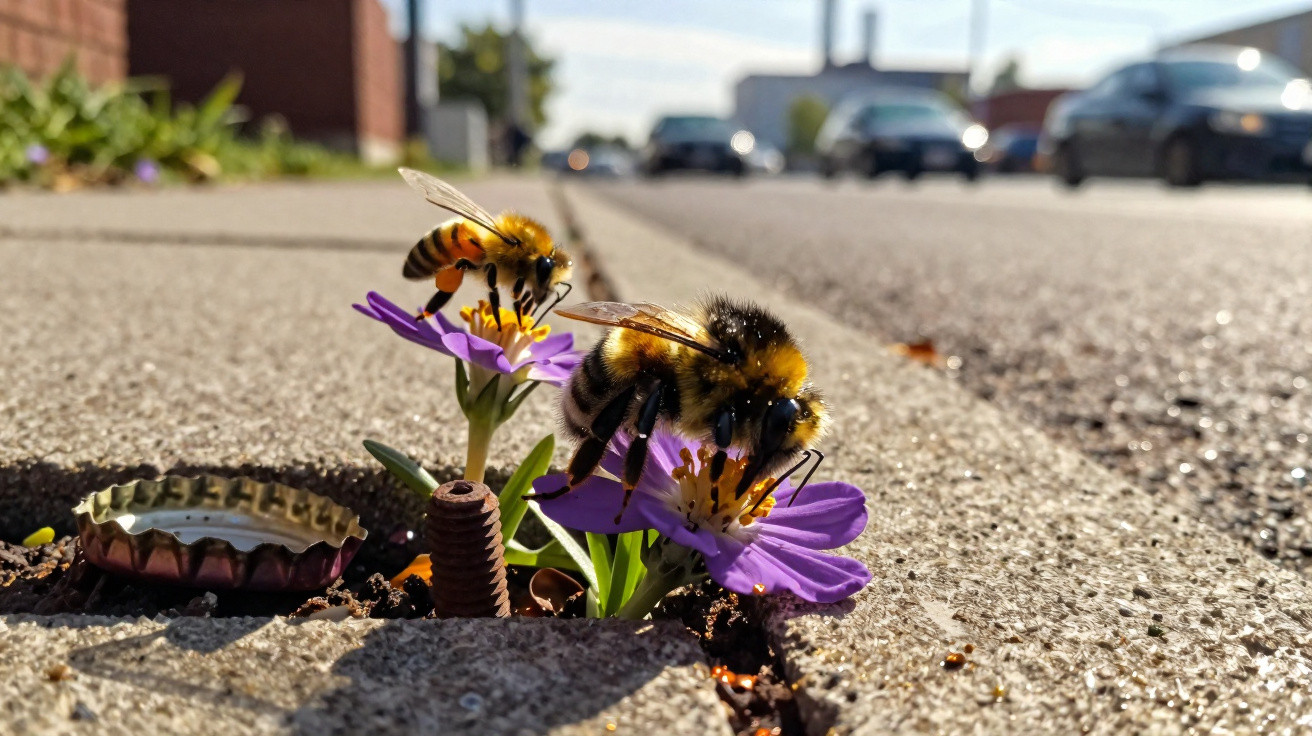
A bumblebee spends the day travelling between flowers, collecting pollen and nectar to sustain its colony and helping to pollinate countless flowering plants along the way.
Yet those valuable supplies can come with an unwanted addition: tiny traces of toxic metals attached to pollen, dust and soil may also be carried back to the nest.
Lead, cadmium and arsenic are highly harmful to wildlife. Even small amounts can affect animals’ cognition and ability to reproduce.
For bumblebees, the consequences can include trouble finding food, caring for offspring and keeping their colonies in good condition.
Recent research has found that bumblebees are exposed to far more toxic metals than honeybees living in the same conditions.
Two familiar bees
Researchers from the University of Cambridge’s Department of Zoology found substantially higher concentrations of toxic heavy metals in bumblebees than in honeybees.
Although both types of bee forage across the same landscape, the pollen carried by bumblebees contained between two and seven times more heavy metals than that carried by honeybees.
The bumblebees themselves also carried metal concentrations roughly three times higher. The team measured arsenic, cadmium, chromium, cobalt, lead and tin in samples of pollen and adult bees.
The study was conducted in Cambridgeshire, a rural area where soil metal contamination is generally relatively low.
Why bumblebees face greater exposure to heavy metals
The difference is linked to the ways the two bee types live and forage. Honeybees generally nest above ground, either in hollow trees or in managed hives.
Their colonies are very large, often comprising between 30,000 and 60,000 bees.
When searching for food, honeybees can travel up to around 9.7 kilometres, allowing them to reach many different flowers over a broad area.
They gather substantial quantities of pollen from numerous plant species, so contamination from a single source can be diluted.
A riskier way of life
Bumblebees live quite differently. They usually nest underground, in soil or leaf litter, and their colonies are much smaller, often containing just 50 to 500 individuals.
They generally forage no more than about 1.6 kilometres from their nest, leaving them with fewer alternatives if local soil or plants contain heavy metals.
Bumblebees also tend to collect pollen from a narrower range of flowers, while some plants take up more metals than others.
Their hairy bodies present another risk: they pick up more dust particles carrying metal pollution.
Low metal levels are still harmful
Dr Sarah Scott carried out the research at the University of Cambridge and is now based at Newcastle University.
“Most metal levels we found were not high enough to kill bees, but even low levels can still harm bee health and colony success in subtle but important ways, such as affecting their ability to forage and reproduce,” said Dr Scott.
Exposure to heavy metals can damage bees’ ability to learn, remember and navigate, making it difficult for them to locate flowers or return to their nests.
Metals can also reduce breeding success and cause offspring to develop abnormally.
The far reach of pollution
Metal contamination is commonly associated with industrial sites, mining facilities and cities, but it can spread beyond those places.
Wind can transport contaminated air into rural areas, while sewage sludge, fertiliser and agricultural products may also add to metal contamination.
The study’s senior author was Professor Lynn Dicks of the University of Cambridge’s Department of Zoology.
“Even in areas that we usually consider safe or lower risk for heavy metals – typically rural areas, away from industrial or mining areas – bees can pick up toxic metals,” said Professor Dicks.
“Bumblebee colonies tend to have fewer workers available to perform tasks, so the loss of individuals can have a big impact on overall colony function.”
Some food is better than none
Honeybees have frequently been used as indicators of environmental contamination, but the findings suggest they may not represent the exposure experienced by other bee species.
Bumblebees appear considerably more vulnerable, so research looking only at honeybees could miss important risks.
Despite concerns about pollution, the researchers say people should keep creating places where bees can find food.
“Bees play a critical role in both biodiversity and food security, so we’d still encourage people to plant flowers to help them, even if you live in an area more likely to be contaminated,” said Dr Scott.
“At the end of the day, bees still need food. Even if it carries traces of heavy metals, having some food is better than having no food.”
The full study appeared in the journal Ecological Entomology.














Comments
No comments yet. Be the first to comment!
Leave a Comment