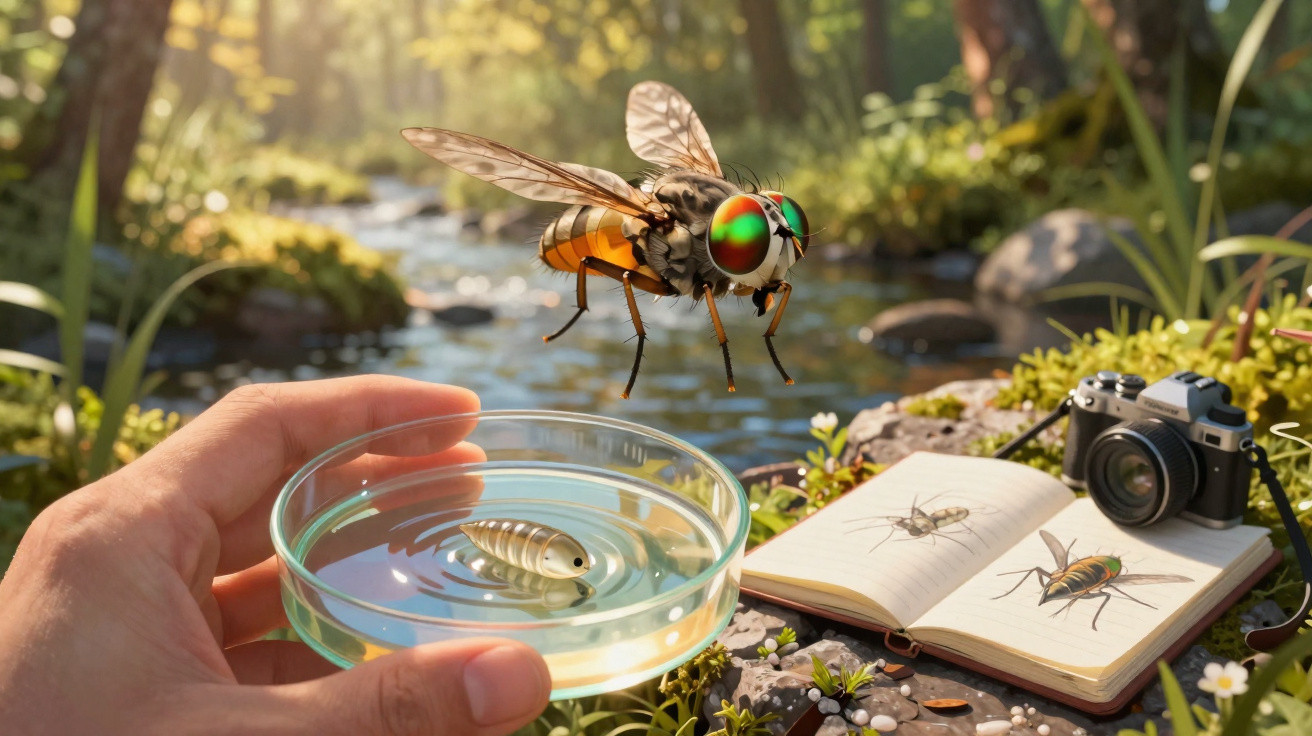
A small blood-feeding fly leads two remarkably different lives. At first, it has wings and sharp eyesight, using its early days to scan the landscape for a deer to land on. Once it finds one, it tears off its wings and settles in permanently.
Biologists already knew that the fly shed its wings. A new study has revealed that it gives up something else when it settles on a host, something much less visible and far harder to replace.
A deer ked with a double life
The deer fly, or ked, is part of a family of blood-drinking flies with widely varying relationships to flight. Some never grow wings, while others, including the deer ked, fly only until they find a host, then give up flight for good.
After choosing a host, the ked never takes to the air again. It breaks off its wings and becomes an ectoparasite – an animal that lives on another creature’s body – moving through hair and feeding on blood for months.
Such divided lives are unusual in the animal kingdom, and they caught the attention of Dr Roger Santer, a sensory biologist at Aberystwyth University in Wales. He wanted to find out what happens inside the fly’s eyes when it swaps the sky for fur.
Vision comes at a cost to a deer fly
Eyes are expensive to run. A fly relies on light-catching cells that fire continuously, and a blowfly’s eyes alone can consume nearly a tenth of the oxygen used by its entire body.
When an animal no longer needs that much power, evolution tends to reduce it, making energy available for survival and breeding instead. Decades of research have shown senses being scaled back when their costs exceed their usefulness.
Cave fish living in permanent darkness, for instance, have lost their eyes over generations. The deer ked encounters a less extreme version of this trade-off, but it takes place within a single insect’s lifetime.
Deer fly study captures both life stages
To compare the two phases, Santer’s team worked with colleagues at the University of Florence, who collected keds in the hills of Tuscany, Italy. The winged flies were caught while looking for hosts, whereas the wingless flies were taken from red deer killed by hunters.
A ked does not shed its skin during this transition, so the outer structure of its eyes cannot be remodelled. Instead, the researchers examined the eyes from the inside, measuring the activity of opsins – the light-catching proteins involved in colour and motion vision.
They did this by counting how active each vision gene was in winged and wingless flies. An active gene produces plenty of these proteins, while a quiet gene produces only a trickle.
A hunter’s full visual kit
The winged flies had fully equipped eyes. They carried the same five opsins as the tsetse fly, an African bloodsucker that uses sight to find hosts. These proteins help the insect detect colour, movement and the stabilising cues that keep a fly level.
That equipment matches the deer ked’s behaviour. Trapping experiments show that, while hunting, the flies are strongly attracted to dark objects and the colour blue. Tsetse flies use the same cues to guide them towards a meal.
The team found none of this surprising. A fly that needs to spot a deer from a distance should have good eyesight, and the winged ked does. What remained unknown was how much of that vision survived after the wings were discarded.
Deer ked vision turned down by half
Before this study, nobody had examined what happens to a deer ked’s eyes after it stops flying. All five vision genes remained switched on in the wingless parasites, but their activity was reduced to around half the level seen in flying keds.
The reduction was remarkably consistent. Genes associated with ultraviolet, blue and motion vision all declined by roughly the same amount, producing an even cut across the group. Only the green-sensing gene lagged behind, and its decline was less clear-cut.
“The fly might be sacrificing sight to conserve energy,” said Santer. Gene activity is not the same as eyesight, however, and the researchers did not directly test the flies’ vision.
The two groups were also collected in different seasons. Even so, the wingless ked probably sees a dimmer world.
Deer fly throws nothing away
Reducing vision is different from abandoning it altogether, as some of the deer ked’s relatives have done. The sheep ked, a cousin that never flies, has permanently lost some of these genes, according to its genome.
Some bat flies go further still, ending up with reduced eyes or no eyes at all. The deer ked, by contrast, retains its complete visual toolkit: every gene, including those it may rarely use.
There are two possible explanations. Its eyes may still be valuable because a ked knocked off its host must find another on foot. Alternatively, the fly may be unable to switch the genes off and remain stuck with costly eyes it hardly uses.
What the deer fly findings could change
The clearest result is also the newest: a deer ked does not blind itself when it settles on a host. It retains its entire visual system and turns it down by only half. This is the first measurement of how its eyes respond to the loss of flight.
Deer keds bite people, deer and other mammals, and may carry disease. Understanding more clearly how they locate a host could help improve traps used to monitor and curb them.
If the visual toolkit is dead weight, it may help explain why so few other fly species lead this double life. Either way, the deer ked offers biologists a rare example of an animal retuning its eyes halfway through life.






Comments
No comments yet. Be the first to comment!
Leave a Comment