Cancer affects animal species in very different ways. Some almost never develop the disease, whereas others grow tumours at a remarkably young age.
This difference is a focus of comparative oncology. Researchers are keen to understand how turtles, whales and naked mole-rats resist cancer.
At the other extreme is a small, brightly coloured pet lizard. Its tendency to develop tumours has attracted the interest of biologists at the University of Nottingham (UoN).
Why leopard geckos get cancer
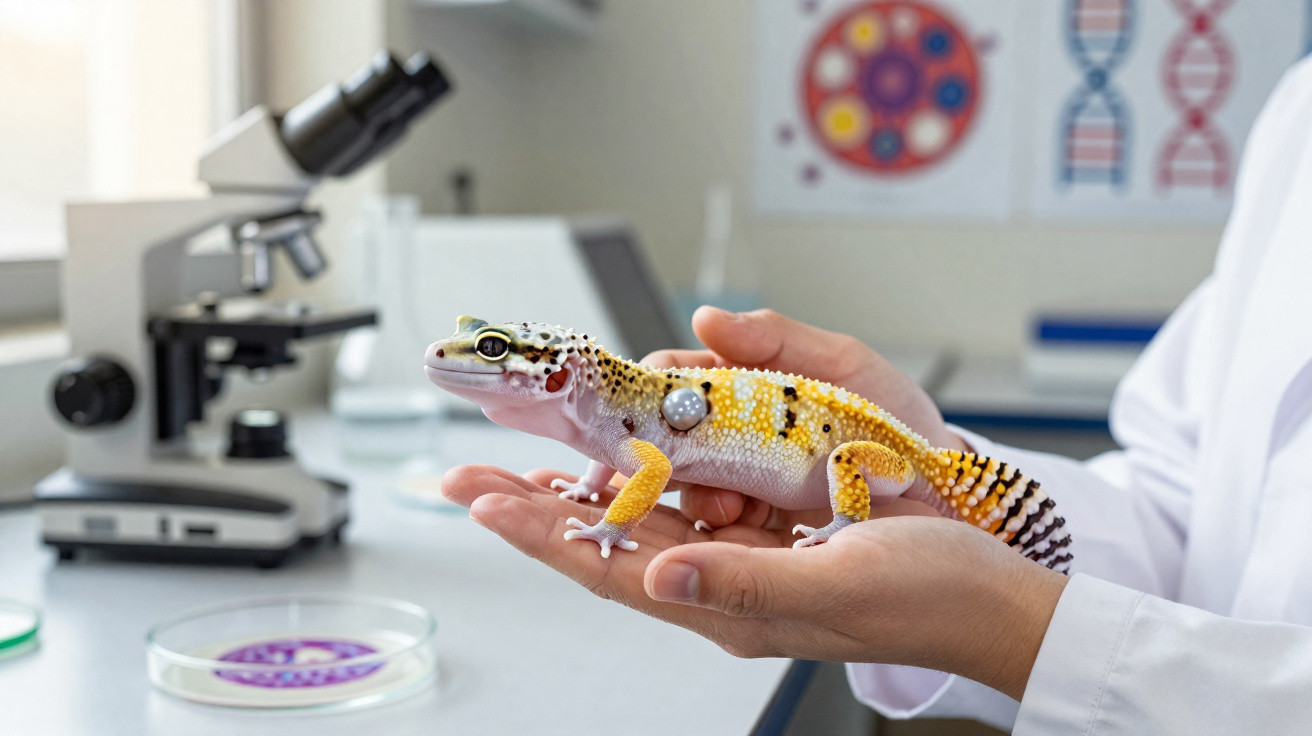
The lemon frost leopard gecko is a pale, silvery morph valued in the pet trade. It originated from a spontaneous mutation in a single animal and spread through years of selective breeding.
That distinctive appearance came at a considerable cost. Around 80% of these geckos develop iridophoromas: tumours that form dense white nodules in the skin.
The growths seldom remain confined to one place. Even after surgeons remove them, new ones can appear elsewhere, and the cancer often spreads to the liver.
Breeders spotted the pattern not long after the morph entered the market. Many young animals were developing aggressive tumours that spread throughout their bodies.
Comparing healthy and cancerous tissue
A research team set out to discover what triggers the cancer. They read the complete genomes of three affected geckos, comparing tumour tissue with healthy tissue from the same individual.
Some of the geckos were housed in a laboratory at Marquette University (MU), where keepers monitored each animal for characteristic skin growths and signs of declining health.
After an animal died, its tissues were sent to the University of Florida (UF) for detailed examination. Comparing paired samples allowed the team to identify changes specific to the tumour.
The researchers sequenced each genome at high depth so they could detect even faint signals. This thorough reading of the DNA gave them confidence in the small differences they identified.
One mutation shared by all
One finding stood out immediately: every tumour contained the same small change in a gene called TBP, short for TATA-box binding protein.
TBP acts like a master switch in the reading of DNA. It helps position the machinery that activates genes, meaning a fault in TBP can have effects across many genes at once.
The change in the geckos lies in a part of the gene that is almost identical in humans. Related faults near the same location have previously been linked to human illnesses, including lung cancer.
A low overall mutation count
The tumours also showed an unexpected characteristic. Although they spread aggressively, they contained relatively few genetic mutations overall.
That low count resembles the pattern seen in some childhood cancers in humans. It also raises the possibility that these tumours evade the immune system, as fewer mutations provide fewer warning signs for the body to detect.
Broken genes and fusions
The single TBP change was not the only fault present. Every tumour also had a fusion of two genes, IARS1 and RNF213, joined together in a way not found in healthy cells.
RNF213 has previously been found in human cancers, sometimes as a safeguard that has been disabled.
Its new partner normally helps with everyday protein chemistry, so joining the two genes could disrupt several functions at once.
Other cancer-associated genes had lost their healthy backup copies. The damaged versions were left without a counterweight, creating a double hit repeatedly seen in human tumours.
The tumours had also acquired extra copies of some genes. Several regulate the activation of other genes, and having too many copies can push healthy cells towards uncontrolled growth.
How the cancer spreads in geckos
The genomes provided clues about how these tumours spread. Several disrupted pathways centred on actin, the protein scaffolding that allows cells to change shape and move.
That scaffolding is central to metastasis, the deadly stage at which cancer leaves its original site.
Cells rebuild their internal skeletons to penetrate new tissue, and the gecko tumours showed signs that this process had gone wrong.
The same actin machinery helps tumour cells invade and travel in human cancers.
Finding those signals in a gecko suggests that the basic tools of cancer spread are shared widely across the animal kingdom.
Why a natural model matters
“By studying why some animals are so susceptible to cancer while others are remarkably resistant, we hope to uncover the different ways species have evolved to deal with cancer,” said study co-author Dr Ylenia Chiari.
“Specifically, this gecko could become an incredible model in cancer research because tumours appear naturally at a relatively early age. Together, these natural strategies could inspire new ways of preventing, detecting, and treating cancer in humans.”
The gecko stands apart because the disease begins naturally and early. Much laboratory cancer research relies on mice, whose tumours usually have to be induced, whereas these geckos develop the disease on their own.
Lessons from other species
“Overall, our paper demonstrates the importance of looking across the tree of life in search of answers that are needed to better understand diseases that can have a profound impact on human life, such as cancer,” said Brandon Hastings, lead author of the study.
“Methodologically, it also highlights that the variety of genomic software programs developed to analyse human cancers can be adapted to provide meaningful insights in diverse organisms.”
The implications extend beyond one unusual lizard. Looking at species that seldom develop cancer alongside those that frequently do offers a more complete picture of the disease than any single model can provide.
The power to understand disease
Study co-author Dr Scott Glaberman observed that people often look inward for solutions to human problems, but that every species has something to teach us.
“By studying both animals that are vulnerable to cancer and those that resist it, we have far greater power to understand the disease itself,” noted Dr Glaberman.
“This is one of the many reasons why protecting biodiversity is so important.”
The research shows how studying a range of animals could inspire new approaches to preventing and treating cancer.






Comments
No comments yet. Be the first to comment!
Leave a Comment