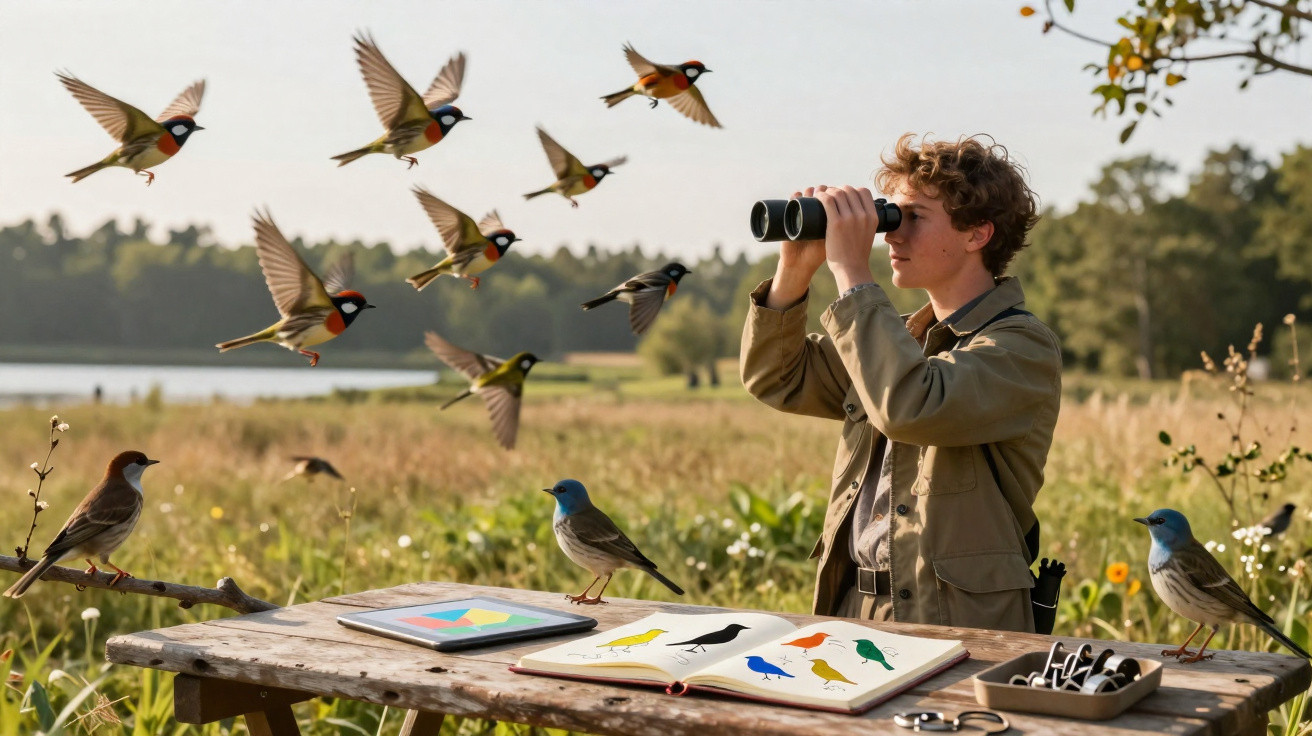
Birds do not find partners, rear chicks or display brightly coloured feathers without reason. A deeper force shapes those traits. New research suggests that survival, rather than romance or rivalry, is the real driving force.
Each year, roughly equal numbers of male and female birds hatch. Although that suggests a balanced population, the balance rarely lasts.
As birds mature, encounter predators, compete for food and contend with disease, one sex often dies at a higher rate than the other. By adulthood, males or females may make up a much larger share of the population.
That imbalance appears to affect almost every aspect of bird behaviour.
A closer look at bird populations
An international team examined 261 bird species from 69 families. The researchers set out to establish which comes first: birds’ behaviour or the proportion of males and females in a population.
Initially, the answer was unclear. Some behaviours appear to carry risks: females incubating eggs, for instance, can be easy prey for predators.
Likewise, males with striking plumage may draw the attention of hunters as well as potential mates. This posed a difficult question: do such behaviours lead to higher mortality in one sex, or do they arise because one sex already outnumbers the other?
To find out, the team examined large datasets and applied statistical models.
What the bird data revealed
Professor Tamás Székely and colleagues at the University of Bath joined researchers from China, Germany and Hungary to investigate.
“We’ve previously shown that the sex ratio – the balance of males to females in a population – plays a crucial role in how birds choose mates, how promiscuous they are, and how mothers and fathers share the load in bringing up their offspring,” said Székely.
“However until now we haven’t known if these behaviours are driven by demography or whether they themselves cause sex differences in survival, reinforcing an imbalance between the sexes.”
The results point to demographics coming first, with behaviour following.
The chicken or the egg problem
Distinguishing cause from consequence was difficult, as Dr Zitan Song of Nanjing Forestry University explained.
“Separating what is cause and what is consequence was challenging – a bit like asking whether the egg or the chicken came first – so we used sophisticated statistical tools in the analyses of data from contemporary bird populations,” said Dr Song.
“The results were nevertheless convincing: unbalanced sex ratio was the cause, rather than the consequence, of sex differences in breeding behaviour and parenting.”
The finding settles a long-running debate in evolutionary biology.
When one sex outnumbers the other
An uneven population affects the way birds behave. When one sex is less common, it gains an advantage.
“Sex ratios matter because when one sex outnumbers the other, the rarer sex is more likely to be promiscuous and breed with several mates. They are also more likely to leave the other parent to care for offspring whilst they find another mate,” said Professor Székely.
This change influences how much care chicks receive, including whether both parents remain involved or one takes on most of the work.
Competition shapes appearance
Behaviour is not the only thing an uneven sex ratio affects. Birds’ appearance changes too.
When one sex is more numerous, competition intensifies. That pressure shapes physical characteristics, as members of the more common sex must either stand out or fight harder to attract mates.
Where males outnumber females, females often grow larger or become more competitive. In species with a greater number of females, males tend to develop more conspicuous features.
Peafowl provide a familiar example: peacocks have large, colourful tail feathers that attract attention.
Male great bustards, meanwhile, can grow to about 2.5 times the size of females. Such differences reflect long-term competitive pressure.
Why survival patterns matter
The research returns to a straightforward idea: small differences in survival can have effects that spread across generations.
“Our results support a one-directional evolutionary pathway: demography shapes the sex ratio, which in turn shapes social behaviour,” said Professor Székely.
“This means that if one sex consistently dies younger, perhaps due to fierce competition for food, increased infection risk or higher vulnerability to predators, the sex ratio bias can influence sexual selection pressures, sex roles and mating behaviour for generations.”
This chain of events explains the wide variety in how bird species mate, raise their young and compete.
A broader view of evolution
The findings change how scientists understand behaviour in the wild. Rather than treating mating habits or parenting styles as the starting point, it makes more sense to examine survival patterns first.
For birds, the course of life is shaped early: which individuals reach adulthood determines what follows.
Once that balance shifts, it can guide behaviour for years, or even centuries.
The full study appeared in the journal Nature Communications.










Comments
No comments yet. Be the first to comment!
Leave a Comment