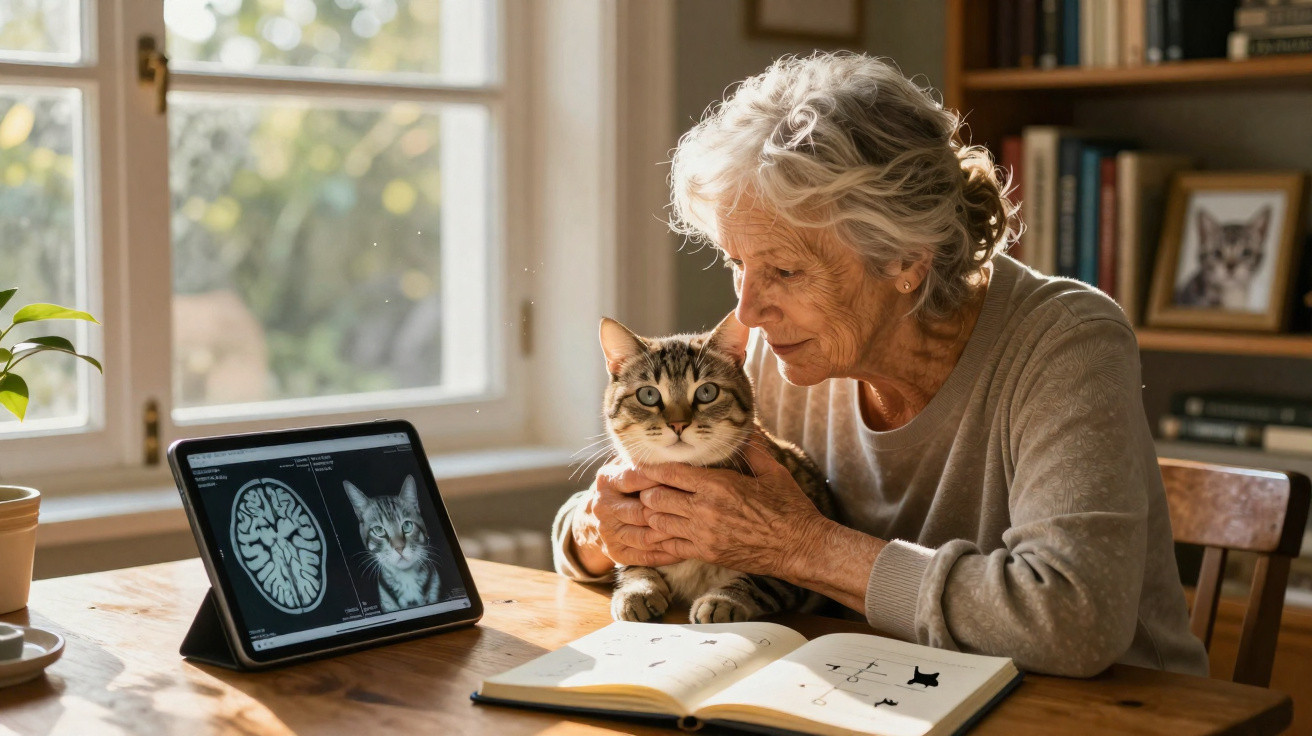
Your ageing cat may have more in common with you than a favourite place on the sofa. New research suggests that cats and humans follow remarkably similar paths into old age.
As cats grow older, their brains shrink and change much as human brains do. That similarity could make ordinary domestic cats valuable partners in research into how we age.
The researchers set out to ask whether a cat can reach an age equivalent to a human in their 80s.
Cats age like people
To investigate, the team assembled 3,754 data points from cats, humans and other mammals.
The information included brain scans, blood chemistry, patterns of disease and early developmental milestones, such as when the eyes open.
Their goal was to chart how ageing unfolds across species. Instead of relying on estimates, they used biology to guide the comparison.
Long lives and large numbers
Two features made cats promising candidates for the study.
They are long-lived, with the oldest reaching around 30 years, and their worldwide population is estimated at 600 million.
That combination is more important than it might first appear. A long lifespan allows cats to reach advanced old age, while their large population provides plenty of animals to study.
Cat and human brains shrink in similar ways
Magnetic resonance imaging (MRI) provided the clearest evidence of overlap.
Older cats and humans share the same general pattern of brain shrinkage, including enlargement of the fluid-filled spaces known as ventricles.
The changes in cats looked remarkably similar to those found in people in their 80s. Brain changes in a 16-year-old cat mirrored those of an 88-year-old person.
Brier Rigby Dames, a research associate at the University of Bath, worked on the analysis.
“It was interesting to see that cats show patterns of age-related brain atrophy similar to those observed in humans,” said Rigby Dames.
“These findings add to growing evidence that companion animals can provide valuable insights into ageing.”
Shared signs of ageing run deeper
The similarities extended beyond brain shrinkage.
Researchers also followed changes in particular structures, including the bridge of tissue joining the two halves of the thalamus and the folds on the brain’s surface.
Both changed with age in cats and humans. The resemblance appeared in routine blood tests too, with certain markers rising or falling on a shared schedule.
The overlap is not confined to the brain. Older cats develop cataracts, stiff, painful joints and the protein clumps that have long been associated with Alzheimer’s disease in humans.
A new way to compare ages
People often use a simple formula in which one cat year corresponds to a fixed number of human years.
The researchers put that idea aside and instead created a biological model using measurable changes across the lifespan.
Their model shows that ageing does not proceed at a constant rate: it accelerates and slows at different points in life.
Cats in their mid-teens match humans in their 80s
The closest alignment appeared in later life. A cat in its mid-teens corresponds to a person in their 80s.
The comparison also works at younger ages. A newborn kitten is roughly equivalent to a human fetus at close to 40 weeks, while a six-month-old cat falls within a person’s first decade.
Not every animal gets that far. Few chimpanzees survive beyond their 40s and few mice reach the equivalent of human middle age, but domestic cats routinely enter the equivalent of human old age.
Domestic cats age like wildcats
Thousands of years alongside humans might have changed the way cats age, but the team found little evidence of that.
Domestic cats and their wild relatives develop at almost the same rate. Pedigree breeds also kept pace with ordinary cats at every step.
The pattern of feline development and ageing appears to be deeply ingrained. That consistency makes cats a reliable reference point for ageing research.
Pet cats reach old age
The researchers compared cats kept as pets with those living in research colonies.
Pets brought in for scans were much older, often well into their teens, whereas colony cats seldom lived beyond about 10 years.
The older pets also had the greatest brain atrophy, making their records particularly valuable to researchers studying changes in people late in life.
Why pets beat laboratory animals
Much ageing research still depends on laboratory animals, in which diseases are induced and lifespans remain short.
Pet cats overcome both limitations because they age naturally in real homes.
An increasing number of owners are requesting advanced brain scans to assess their ageing pets, creating a growing opportunity for research.
“This expanded clinical access creates meaningful opportunities for translational research (research that bridges the gap between scientific findings and healthcare), improving our understanding of ageing and neurological disease in ways that can benefit both feline and human patients,” said Dr Ryan Gibson, a veterinary neurologist at Auburn University.
Questions that still remain
The picture is still incomplete. Colony cats were seldom studied beyond their teens, leaving the researchers unable to fully compare brain ageing in pets and laboratory cats.
The team also could not establish whether environment, health or genetics accelerates that decline. Tools for measuring memory loss in cats are still lacking.
Improved mental tests will be needed before researchers can determine whether some cats age faster mentally than physically.
What this means for medicine
The researchers hope veterinary and human medicine will collaborate much more closely. Insights shared between the fields could help us understand conditions such as dementia more quickly.
One proposal is to create large health databases for companion animals, based on resources that already exist for humans.
“There’s potential to develop large-scale veterinary health databases for companion animals, analogous to human health databases such as the UK Biobank,” Rigby Dames said.
“These kinds of resources could enhance our ability to study ageing and disease using real-world clinical and owner-reported data collected across species.”
For now, the finding is straightforward and somewhat surprising: the cat sleeping on your bed could offer one of the best windows into our own later years.





Comments
No comments yet. Be the first to comment!
Leave a Comment