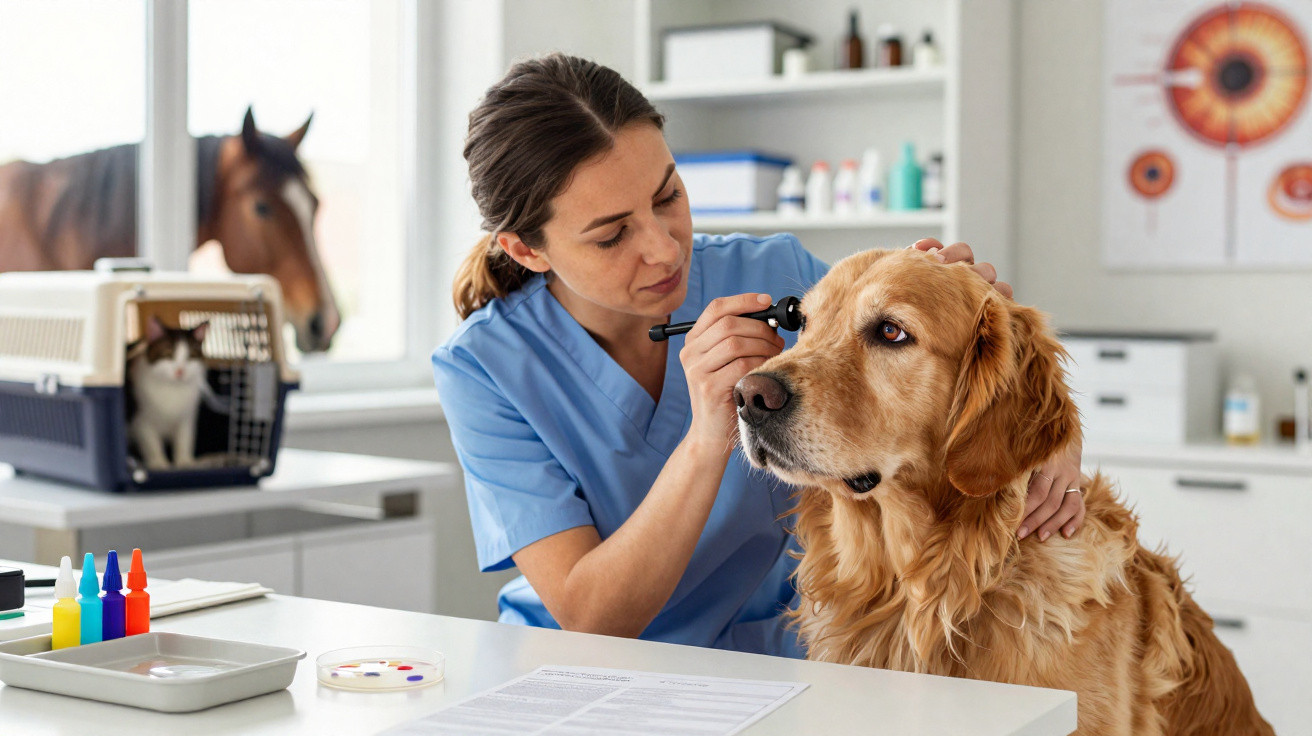
A minor scratch on the eye may not seem serious, but in dogs, cats and horses it can develop into an infection that threatens sight within just one day.
Medicines that once cleared these infections are beginning to fail. The bacteria are surviving treatment, and the problem is appearing in more places each year.
Keratitis is an infection of the cornea, the transparent dome at the front of the eye. Once germs enter it, they can rapidly eat through the tissue.
The cornea has no blood supply to bring in defences, making this particularly serious. It relies on tears, which can do only so much after the surface has been damaged.
Resistant bacteria are spreading
A new review brings together research from around the world on the issue. It is by Dr Lionel Sebbag and Dr Oren Pe’er of the Koret School of Veterinary Medicine at the Hebrew University of Jerusalem.
The review focuses on antimicrobial resistance (AMR), meaning that bacteria no longer die when exposed to a drug.
Eye infections are a major concern because a delay of just a day or two can cost an animal its sight.
“Antimicrobial resistance is no longer a theoretical concern in veterinary ophthalmology,” the authors noted. “It is a clinically significant and evolving reality.”
The same bacteria keep appearing in eye infections
Research from North America, Europe, Asia, South America and Australia identifies the same small group of bacteria.
The main types are Staphylococcus pseudintermedius, beta-haemolytic streptococci and Pseudomonas aeruginosa.
Vets are most concerned about Pseudomonas. It can quickly dissolve the cornea, with affected animals often needing surgery or losing an eye.
Horses face additional complications
Bacteria are not always the sole cause of eye infections in horses. Fungi are often involved too, meaning an antibiotic may fail because it is targeting the wrong cause.
For that reason, vets test horses early for both bacteria and fungi. Missing this step can waste days while the true cause continues to spread.
Cats generally fare better
Cats offer some encouragement in the overall picture. In most reports, their eye infections still respond well to commonly used medicines.
Even so, the evidence on cats remains limited, with studies involving only small groups. It is therefore too soon to say they are unaffected by the broader trend.
Resistance to several drugs at once
Some bacteria can now withstand several different medicines simultaneously. These are known as multidrug-resistant (MDR) bacteria, and they leave vets with very few treatment options.
Such strains are most often found at referral clinics, which deal with the most difficult cases.
The rate is close to 20 to 25 per cent in many groups of dogs, reaching 40 or even 50 per cent at some clinics.
The picture varies by region
Resistance differs from place to place.
Some clinics in Asia report very high rates, while resistance has risen sharply in parts of Europe over only a few years.
That makes local monitoring particularly important. A medicine that remains effective in one country may already be useless in another.
Earlier treatment can cause problems later
Nearly every study reported one finding: animals recently treated with antibiotic eye drops were more likely to carry resistant bacteria.
There is another difficulty for these animals. Their cultures often come back negative, leaving the vet unable to identify the germ causing the problem.
The lesson is to take samples early. A swab collected before further drugs are given provides the clearest picture of what is present.
Once treatment begins, that picture can quickly become unclear. The surviving germs tend to be the most resistant, which distorts the results of later testing.
Why laboratory tests can mislead
A laboratory can test a sample and report which drugs should be effective. However, those tests are based on medicines given as tablets or injections rather than as eye drops.
Drops behave quite differently on the eye’s surface. As a result, a drug that appears useless in a test may work in practice, while one marked effective may still fail the animal.
How eye drops work
As soon as a drop is applied, the drug concentration on the eye rises sharply. Within minutes, however, tears wash most of it away.
Other factors can also interfere. Proteins in tears, swelling and a slimy protective layer made by bacteria, known as a biofilm, can all weaken a drug that appeared potent in the laboratory.
A risk for people as well
The review considers the issue through a One Health lens: the idea that human and animal health are connected. Several of these bacteria can pass between pets and people.
Staphylococcus pseudintermedius is one example. Once regarded as a dog germ, it is now known to infect humans and can spread through clinics, equipment and even homes.
Transmission within a household can go in either direction. Dogs whose owners work in human or animal healthcare are about 4.6 times more likely to carry methicillin-resistant staph in their eyes.
Options beyond antibiotics
As older drugs become less effective, the authors highlight other options. These include antiseptics, treatments that disrupt biofilms, corneal cross-linking and ultraviolet light methods.
None is a substitute for appropriate antibiotics in a serious case. They are most useful as supporting treatments that reduce the amount of antibiotic an animal needs.
The authors call for earlier testing, more considered drug choices and improved hygiene in clinics. They also want eye-specific guidelines that reflect how drops actually behave.
“The goal is not simply to resolve the current infection, but to preserve therapeutic reliability for future patients,” the researchers concluded.









Comments
No comments yet. Be the first to comment!
Leave a Comment