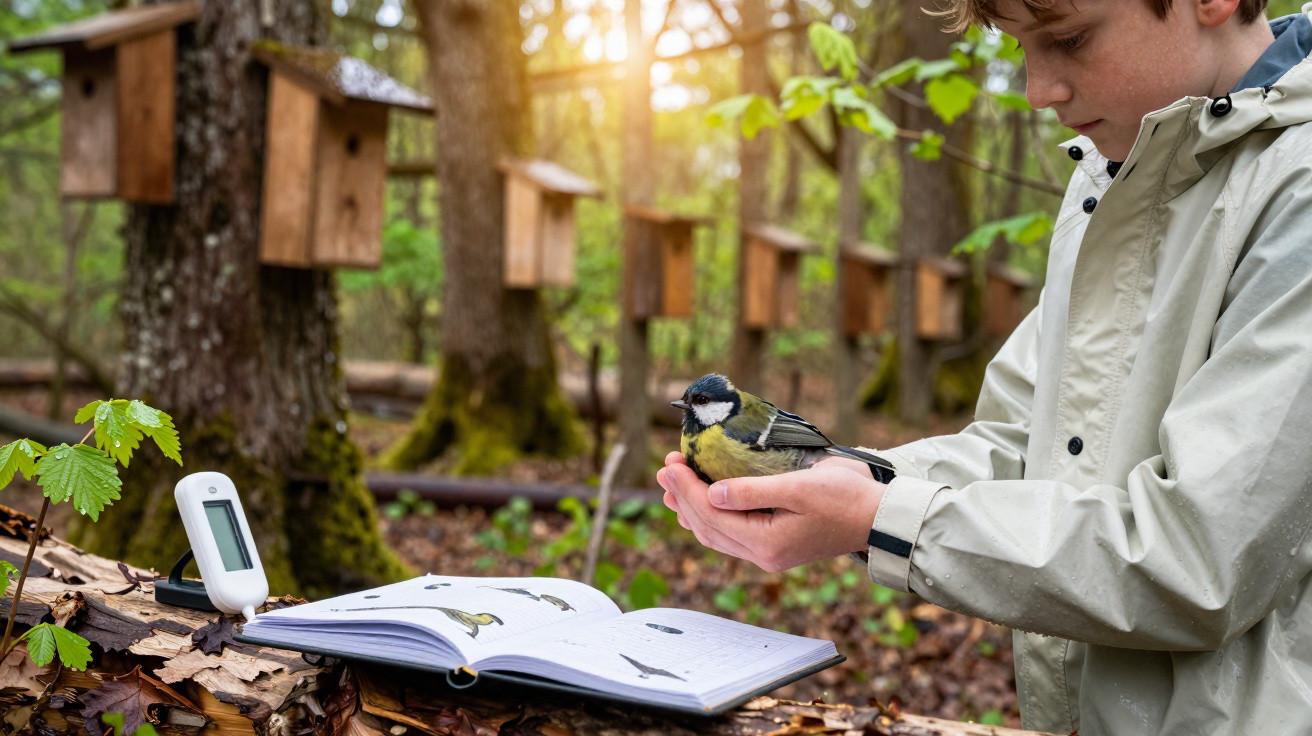
A new analysis of Oxford’s well-known great tit population reveals that extreme weather affects chicks differently depending on when it strikes.
Cold spells immediately after hatching are particularly severe, while heavy rain does more harm later, once chicks are larger and need more food.
When extreme heat coincides with heavy rainfall, conditions can rapidly deteriorate. Nestlings leave the nest dramatically lighter, particularly in broods laid later in the season.
Led by the University of Oxford, the study uses a remarkable dataset: 60 years of records covering more than 80,000 individual wild great tits in Wytham Woods, matched with historical daily weather data.
Researchers identified the coldest, wettest and hottest days of each breeding season, then counted how many occurred during particular developmental “windows” for chicks.
They examined the effects of those extremes on body mass at fledging, an important measure because it strongly predicts a young bird’s chances of survival.
Cold early, rain later for great tit chicks
The researchers found that extreme cold is especially damaging during the first week after hatching. This is understandable: newly hatched chicks have no feathers and struggle to regulate their body temperature.
In cold conditions, they must use energy to keep warm rather than put it towards growth.
Heavy rainfall had its greatest impact at a later stage, as the chicks got older. Both cold and rain lowered fledging mass by up to about 3%. Although that may seem modest, small deficits early in life can have significant consequences for survival in the wild.
The most dramatic fall occurred when extreme heat and heavy rain happened together. Fledging mass dropped by up to 27% in those circumstances, especially among broods laid later in the season. A reduction of that scale can alter the survival prospects of an entire brood.
Birds are adapting, but the risks remain
Wytham’s great tits have already changed their breeding schedule. In warmer springs, they breed earlier to stay in step with the peak abundance of caterpillars, the main food for their nestlings.
According to lead researcher Devi Satarkar of the University of Oxford, the change is generally beneficial, but there is a drawback: breeding earlier can leave chicks exposed to cold spells that still occur at the start of the season.
“In the Wytham population, great tits have adjusted to warmer springs by breeding earlier to track peak abundance of their main prey, caterpillars,” she said.
“This overall earlier laying is beneficial, buffering them against many impacts of extreme weather – but it also exposes them to cold spells early in the season.”
“Even small early life deficits can have large implications for survival. It will only get tougher for birds to keep up as extreme weather increases in frequency and intensity with climate change.”
In other words, earlier breeding is not simply better: it protects against some problems while creating others.
Why cold and rain affect chicks so severely
Several processes are at work. In cold weather, hatchlings expend energy keeping warm, leaving less available for growth.
Cold and rain can also make it harder for parents to forage effectively. Adults may fly and hunt less in poor weather, returning to the nest with fewer meals.
Rain brings a further difficulty: it can knock caterpillars off vegetation. When caterpillars fall or become harder to locate, less food is available just as chicks need a steady supply of energy.
Chicks also have enormous energy requirements. Before leaving the nest, they need to develop muscle and feathers quickly, much like tiny furnaces burning through fuel.
Hot days helped, at least in Oxford
Among the most surprising findings was that extreme heat actually increased fledging mass during the nestling stage.
Higher temperatures might be expected to cause heat stress. Here, however, the “extreme heat” appears mild enough to be beneficial rather than damaging.
“Extreme weather events are affecting wild bird populations in complex ways. The level of warmth we see in these heat extremes in Oxfordshire might boost growth because it can increase insect activity and visibility – making caterpillars easier to find – while letting parents forage more and reducing nestlings’ thermoregulatory costs,” Satarkar said.
“The high water content in caterpillars also helps against dehydration. This contrasts sharply with hotter regions like the Mediterranean, where similar events can exceed 35°C and harm nestlings.”
An Oxfordshire “heat extreme” may therefore still sit comfortably within the birds’ thermal limits, while also making their prey easier to find.
Early broods fare better than late broods
Timing within the breeding season made a substantial difference. Broods raised early in the season often benefit from warm spells, when caterpillars are plentiful and temperatures remain tolerable.
Later broods do not appear to gain the same advantage, even when “hot days” reach similar absolute temperatures of around 16–17°C.
Overall, late fledglings were about a third lighter. This suggests later broods face different ecological conditions – probably fewer caterpillars, different combinations of weather and possibly parents whose resources are already stretched.
Over the longer term, extreme cold and rain slightly reduced the chances of surviving to adulthood, whereas extreme heat had small positive effects in this population.
Crucially, breeding earlier within a season appeared to lessen many of the effects associated with the weather.
What this means for conservation
The study’s central message is that climate change involves more than warmer average temperatures. It also concerns the timing and combinations of extremes, and whether they coincide with vulnerable stages of life.
The researchers say that forecasting resilience will depend on closer attention to microclimates, differences between habitats and fine-scale weather.
Such research could inform practical conservation decisions, including where to position nest boxes and how to manage woodland structure to reduce exposure during critical stages of chick development.
The team intends to continue monitoring the Wytham birds as warming progresses, particularly to test whether heat extremes that are “helpful” today eventually become harmful if temperatures continue to rise.
The research is published in the journal Global Change Biology.







Comments
No comments yet. Be the first to comment!
Leave a Comment