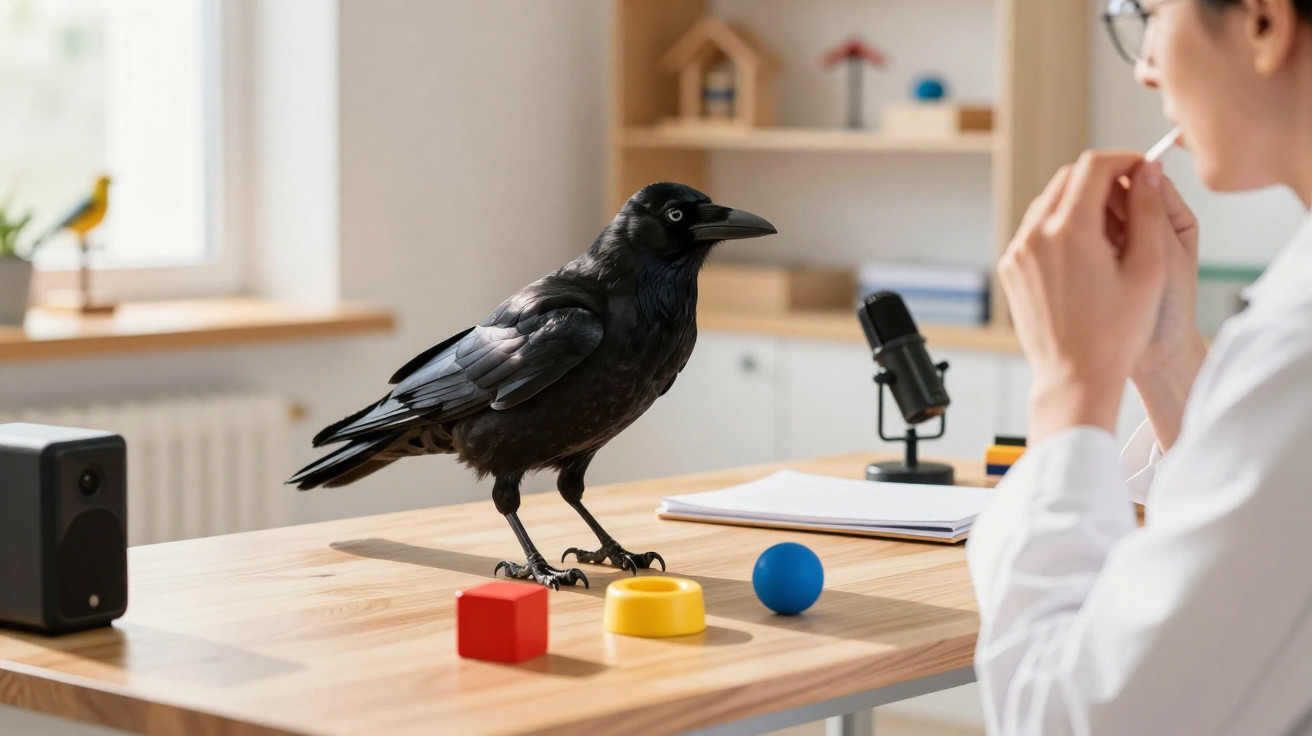
Researchers have discovered that a corvid bird called a rook can learn to follow spoken human commands by attending to the words, rather than depending on silent cues.
The finding suggests that the ability to understand human voice instructions may not require domestication, an assumption long influenced by research on dogs and other pets.
Testing a rook with human commands
In controlled trials using a simple food reward, a rook called Leo repeatedly selected the right response after hearing a spoken cue.
At the University of Cambridge, Francesca M. Cornero recorded Leo responding correctly when the words “speak,” “come here,” and “wait” were said aloud.
Further trials established that he continued to carry out the commands when visual signals, including eye gaze and lip movements, were removed.
The results pointed to one main explanation: Leo was responding to the sound of the human voice itself, rather than to silent signals from his trainer.
What Leo learned
Leo learnt three responses: he cawed for “speak,” came closer for “come here,” and held back for “wait.”
Every action had to take place within a fixed time window, preventing him from succeeding by chance simply by lingering near a reward.
Recorded sessions also revealed that two other rooks, Connelly and Fry, were learning parts of the same routine.
Leo was the only bird to complete the full battery of tests, however, making the paper strongest as a detailed case study.
Sound rather than sight
Sunglasses did not disrupt Leo’s performance, a significant result because eyes and posture can inadvertently convey information during animal training.
Later trials also removed lip movements, requiring the rook to rely more directly on the audible signal.
In a fully blind control, Leo still got 13 of 15 right, whereas his score fell to 7 of 15 in a silent control.
That difference made hearing the most likely explanation, rather than reading a face or following unconscious prompts.
Live speech versus recordings
Leo encountered difficulties when live speech was replaced with a phone recording, although the same words could still be heard at the table.
He needed 50 rounds to regain his footing under that condition, considerably more than in any other.
Earlier experiments with dogs found a similar decline when commands were recorded, suggesting that animals respond differently to speakers than to live voices.
The slower performance did not wipe out Leo’s learning, but it indicated that familiar speech contains subtle features beyond the words themselves.
When daily practice ended
Leo returned to the task after two breaks of about six months without having to begin from scratch.
During one gap, his caretakers avoided saying the command words around him for a period, yet he recovered quickly.
His return to the task points to long-term memory rather than a fleeting training effect that disappeared when daily practice ended.
That distinction matters to the wider claim, because lasting memory makes obedience appear less like a trick.
How dogs differ
Dogs have dominated research into human commands for a long time, and are consequently often regarded as the natural benchmark.
Rooks, by contrast, are wild songbirds rather than household companions, so Leo’s performance challenged the idea that domestication must come first.
He lived mainly with other rooks in an outdoor aviary, rather than in a family home full of daily commands.
That distinction matters because extensive exposure to humans could have provided an easier alternative explanation for the result.
Birds with problem-solving abilities
Rooks did not come to this study without a relevant background: their relatives already had a reputation for flexible problem-solving.
Previous research on rooks showed that they can reshape tools and tackle physical problems that do not arise naturally in the wild.
Crows have even produced selected numbers of calls on cue, suggesting that members of the crow family can deliberately control their voices.
None of that history proves that rooks understand speech as humans do, but it makes Leo’s performance much less surprising.
Beyond simple tricks
Parrots already feature prominently in the public imagination when it comes to research on human words, particularly studies of African greys that used labels.
In one classic experiment, a bird answered same-or-different questions using learnt vocal labels, a considerably richer skill.
Leo’s achievement was narrower: he associated sounds with actions instead of using words to describe the world.
Recognising that limit allows the finding to remain impressive without exaggerating it into bird language.
Limitations of the study
One caution applies throughout the study: just one rook completed the entire sequence.
A further limitation lies in the commands themselves. “wait” required inhibitory control - holding back before taking food - as well as recognition.
That additional demand likely explains why recorded speech affected Leo’s performance most when waiting, rather than when calling or approaching.
A larger comparison involving birds, mammals and different training histories would show whether Leo was exceptional or merely the first to be measured.
Leo’s success brings several ideas together: complex social birds can retain spoken rules, respond without visual cues and preserve that memory for months.
Researchers now have a reason to investigate other undomesticated species and ask which existing abilities are being reused in new settings.
















Comments
No comments yet. Be the first to comment!
Leave a Comment