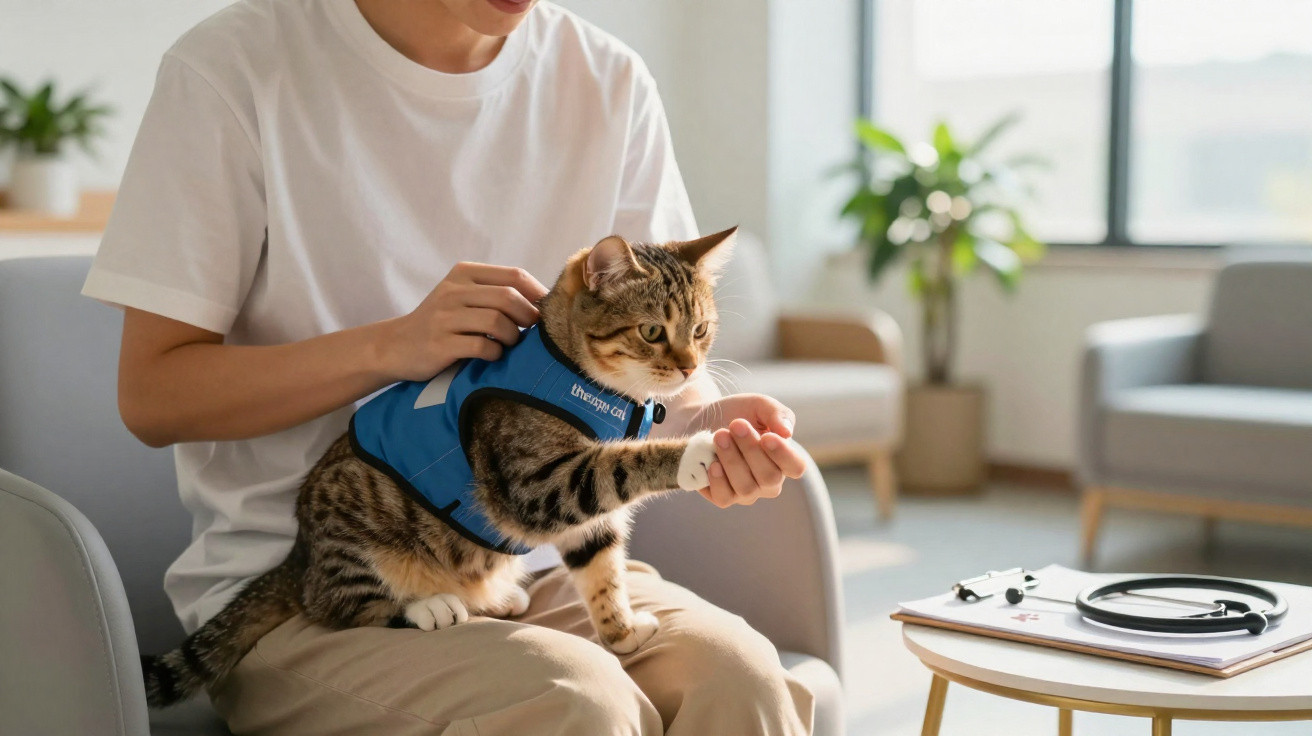
Dogs are sociable and enthusiastic, and are frequently used to comfort people in hospitals, schools and care homes. An increasingly popular alternative, however, is the therapy cat.
The term is often used loosely by the media and inconsistently in scientific work. Strictly speaking, animal-assisted therapy is a structured activity with clinical goals, delivered by health professionals.
Most cats doing this work take part in the broader category of animal-assisted services. For simplicity, this article uses the term "therapy cat" throughout.
Therapy cats help relieve loneliness and stress in prisons, schools, hospices, care homes and hospitals. They are also recommended for people who fear dogs or may find it difficult to interact with large animals such as horses.
How therapy cats cope with unfamiliar settings
The places therapy cats commonly visit, including care homes and schools, can be noisy and unpredictable, with unfamiliar people and surroundings. These are exactly the conditions that might unsettle a typical cat.
Cats generally favour predictable, stable environments. Like their wildcat ancestors, domestic cats place greater importance on territorial security than on social bonds with people or other cats.
Scent helps cats find their way around and feel secure. The F3 pheromone allows them to mark areas as "safe" or "known", producing a kind of scent map of their home range.
Recent social media trends, however, suggest that our understanding is changing. More cats can be seen travelling with their owners in campervans, on planes and even on motorbikes.
These cats seem able to tolerate, and sometimes even thrive in, settings that animal behaviour experts once considered too stressful for them. What sets them apart?
A trusted human can help some cats in unfamiliar or potentially stressful places. In a 2021 study, animal behaviour researcher Alexandra Behnke and her colleagues found signs of the secure base effect in nearly half of the 42 cats tested. This bond helps reduce stress and encourages exploration when a cat is reunited with its owner.
The effect could help therapy cats manage new surroundings.
The traits and preparation of therapy cats
A recent study led by Joni Delanoeije, a Belgian researcher in human-animal interaction, examined how cats chosen for animal-assisted services differ from the average household pet.
Researchers analysed survey responses about 474 cats, 12 of which had taken part in such services. Those involved in animal-assisted services were more sociable with people and other cats, sought more attention and were less resistant to being restrained.
The findings indicate that behavioural qualities such as sociability and tolerance could make some cats better suited to interacting with people in unfamiliar places. However, so few cats in the study had actually worked in services that further research is needed before firm conclusions can be drawn.
These cats also form strong, trusting relationships with their handlers. Early socialisation and gradual exposure appear essential in preparing them for the unpredictability of service work.
Even cats with these qualities can face difficulties in therapy settings. In a 2023 global study of cat-assisted services, US psychologists Taylor Griffin and Lori Kogan found that even well-adapted cats may struggle in practice.
The study found that 68% of handlers had cut visits short when they considered it best for the cat. They also described strong bonds with their cats, a relationship probably central to the cat's ability to adapt by providing safety and predictability in a potentially stressful environment.
How do therapy cats compare to dogs?
Cats differ from dogs in their social needs, temperament and tolerance of change. These differences need careful consideration when selecting animals for therapy work, but they also bring advantages.
Therapy cats, for instance, may offer greater benefits to people who regard themselves as "cat people". Research has linked this self-classification to personality traits, with cat people often being more independent, creative and self-sufficient.
Dog people, by contrast, tend to be more outgoing, sociable and group-oriented. Cat lovers may feel more comfortable in one-to-one therapeutic sessions, whereas dog lovers might favour group activities.
Preferences for a species can also influence emotional responses. In a 2022 study, researcher Jovita Lukšaite and colleagues used facial expression software to assess participants' reactions to images of animals.
Images of cats and dogs produced similar average levels of happiness, but dog images prompted significantly more fear. For some people, fear of dogs could make canine-assisted therapy less effective, making cats a valuable alternative.
Dogs may be particularly good at providing emotional support through physical interaction, but cats have a distinctive feature that may offer therapeutic benefits: their purr. A 2001 study found that domestic cats purr at frequencies between 25 and 50 hertz, a range that promotes healing in humans.
Although more recent research supporting that finding is lacking, a 2021 study found that cat owners reported a calming effect from their cats' purrs.
Dogs may be the traditional therapy animal, but cats have also shown they can fulfil the role. Given the right temperament and training, they can offer a different form of comfort to people who need it.
Grace Carroll, Lecturer in Animal Behaviour and Welfare, School of Psychology, Queen's University Belfast
This article is republished from The Conversation under a Creative Commons licence. Read the original article.












Comments
No comments yet. Be the first to comment!
Leave a Comment