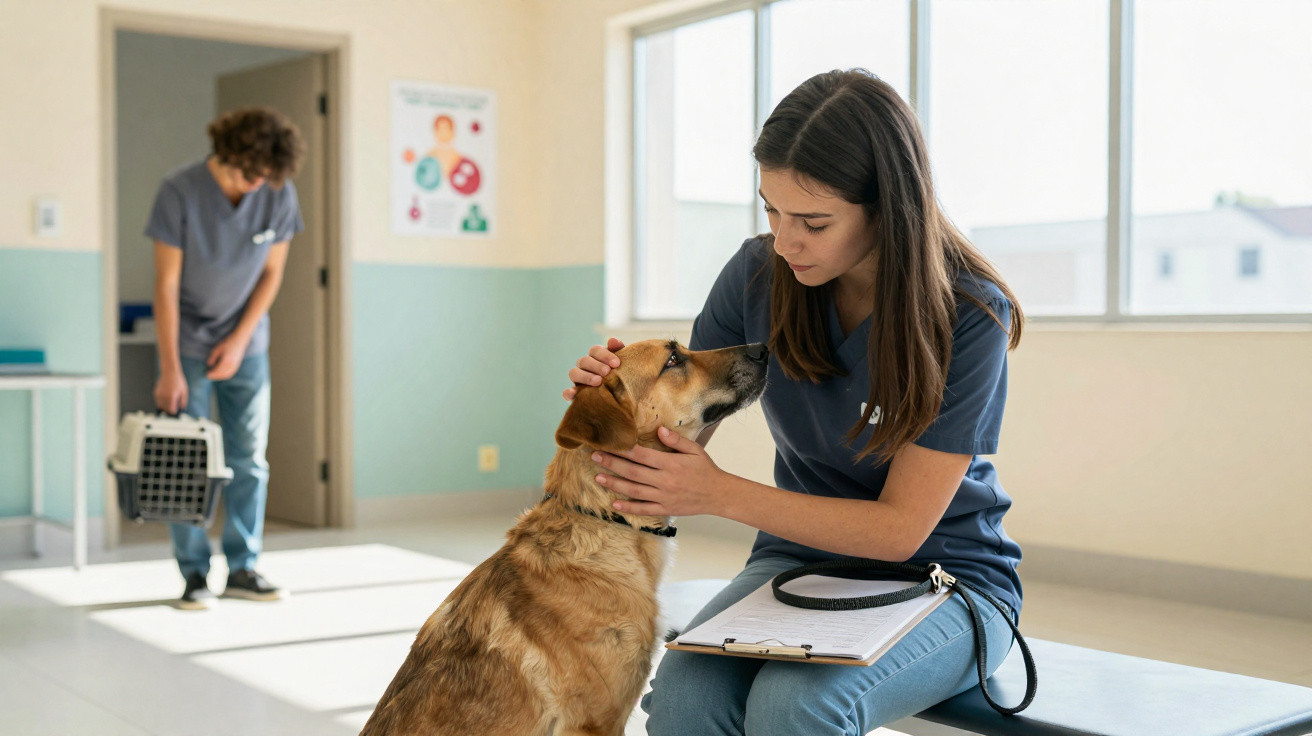
Dogs have shared their lives with humans for thousands of years. They have helped with hunting, guarding, herding and many other jobs, although their main role today is as companions.
Their lives may appear easier than those of their ancestors, but dogs still encounter plenty of stressful situations, including trips to the vet.
Owner stress and dogs at the vet
A few years ago, researchers in France demonstrated that an owner's behaviour at the vet can affect their dog's stress levels. Their study found that negative behaviour by owners, such as scolding, made dogs more anxious during a veterinary examination.
However, before our recent research at Queen's University Belfast, nobody had studied how owner stress affects dogs in a controlled environment.
Unlike the earlier study, ours specifically examines how owner stress, measured through changes in heart rate, affects the stress their dog experiences at the vet.
Our experiment involved 28 owners and their dogs. Both wore heart-rate monitors throughout, allowing us to record their heart rate and heart-rate variability as measures of stress.
We exposed the owners to either a stressful or a stress-relieving intervention, then monitored its effects on both the owners and their dogs.
For the stressful intervention, owners took a digital stress test involving a mental arithmetic task and a verbal presentation task. The stress-relieving intervention consisted of a five-minute guided breathing meditation video.
Dogs adjusting to the veterinary clinic
We found that the dogs' heart rates fell as they became accustomed to the veterinary clinic. This suggests vets should allow dogs time to adjust to the clinic before carrying out an examination.
As well as lowering stress, this could make examinations and tests more valid, because heightened stress can raise measurements such as heart and respiratory rates.
Emotional contagion
We also found that changes in an owner's heart rate between the period before the experiment and the experiment itself could predict changes in their dog's heart rate. When an owner's heart rate rose or fell during the experiment, their dog's was likely to rise or fall alongside it.
These findings suggest dogs may recognise stress in their owners and that this could affect their own stress levels through a process called "emotional contagion".
This phenomenon occurs when people or other animals consciously or unconsciously "catch" or imitate the emotions and behaviour of those around them.
The findings may also suggest that dogs look to their owners for guidance on how to respond to unfamiliar environments. Owners were instructed not to interact with their dogs during the experiment, so the dogs assessed any owner stress without direct communication with their owners.
What might this mean for the average dog owner? If our stress can affect our dogs, we should bear that in mind when visiting the vet. Helping owners feel calmer at the clinic could also help their dogs feel more at ease.
A holistic approach to veterinary care that considers the animal, their owner and the environment is likely to produce the best welfare outcomes.
Although our research focused mainly on the bond between dogs and their owners, a recent study of canine behaviour found that the smell of sweat from a stressed person unfamiliar to a dog affected that dog's learning and cognition during a cognitive bias test.
This test assesses whether an animal is in a positive or negative emotional state and whether it is likely to make decisions with an optimistic or pessimistic outlook. The finding shows that dogs may be affected by the stress of strangers as well as their owners.
Our latest research makes clear that dogs are perceptive animals, influenced by the world and the people around them. Anyone caring for or working with dogs should remember that their own stress may affect the stress experienced by those dogs.
Aoife Byrne, PhD Candidate, Animal Behaviour and Welfare, University of Nottingham, and Gareth Arnott, Lecturer in Animal Behaviour and Welfare, Queen's University Belfast
This article is republished from The Conversation under a Creative Commons licence. Read the original article.







Comments
No comments yet. Be the first to comment!
Leave a Comment