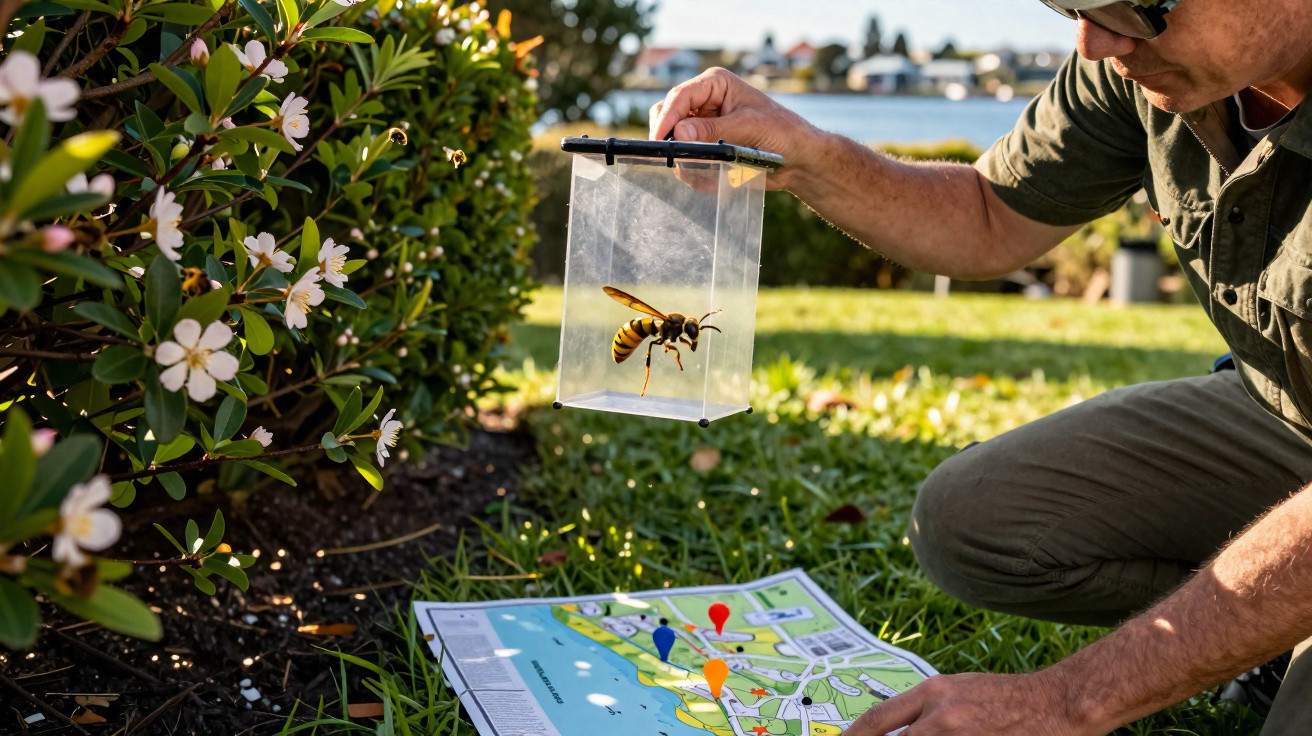
Yellow-legged hornets are being found at an increasing rate on Auckland’s North Shore, where 68 queens and 108 nests have now been confirmed.
The growing total has transformed a summer pest response into a race to prevent the bee-killing invader from becoming permanently established.
Yellow-legged hornet invasion on the North Shore
In Glenfield and Birkdale, confirmed discoveries remain concentrated within the most tightly controlled response zone on Auckland’s North Shore.
Using that distribution, Biosecurity New Zealand has established a 10.9-kilometre search ring comprising traps, feeding stations and checks by beekeepers.
The agency is inspecting more than 575 registered beekeeping sites within the ring, as hives can indicate where hornets are finding food.
This concentration is the reason officials still believe the invasion is localised, although the increasing number of finds makes the search urgent.
How the search works
At feeding stations, crews attract worker hornets with sugar before observing the direction in which they fly away.
When insects repeatedly follow the same flight path, teams reduce the size of the search area and seek the place to which the traffic keeps returning.
Small radio tags and direct visual tracking help crews get closer when a colony has established itself in taller trees.
Even large nests can remain hidden above ordinary streets until worker traffic increases, making them easy to miss.
How hornets harm bees
These hornets hover at hive entrances and seize bees returning home, disrupting the flow of food before winter stores can accumulate.
Records from European hives showed that workers spent most of their time facing the entrance, waiting for bees to return by flight.
As attacks intensify over the season, bees devote more time to defence and less to foraging, weakening colonies even when they are not directly killed.
That pressure is why Auckland’s beekeepers are following the response closely, even though a wider spread has not been confirmed.
Lessons from Europe
Well before the Auckland outbreak, Vespa velutina escaped in France and subsequently spread across much of Europe.
An eight-year survey tracked 528 nests in one part of France and found that trapping queens in spring alone was an ineffective means of control.
The nests were also concentrated near coastlines and human activity, indicating that landscapes rich in food can quietly sustain rapid colony growth.
This history explains why New Zealand is not depending solely on backyard traps to complete the job.
Queens drive the invasion
Each queen that survives the winter can establish a new colony in spring, making discoveries of queens more significant than counts of workers.
In Britain, one model of spread projected 129 nests by the fifth year without strong early control. By year ten, that model estimated more than 50,000 nests, illustrating how quickly numbers can rise once the hornets become established.
Officials therefore continue to concentrate on queens and nests rather than only the insects people happen to see in flight.
Protein bait targets colonies
The latest tool in Auckland’s response is a protein bait: food mixed with insecticide that worker hornets take back to their colony.
Foragers gather the bait because larvae require protein, carrying the poison into the nest as they do so.
According to officials, the blue product is intended to target hornets while sparing honeybees and New Zealand’s native wasps.
This makes the bait useful initially in outer areas, where crews hope to reach nests missed by traps and sightings.
Where hornets hide
Hornets do not always nest in the places people check first, so crews examine houses, sheds, decks and trees.
The larger secondary nests built after early nests are often high in trees, making them more difficult to detect.
Boats, caravans and campervans also matter because concealed nests can be transported as people travel, before anyone spots them.
For that reason, officials continue to ask Aucklanders to check before travelling or beginning noisy work around structures.
Why public reports matter
Public reporting has so far generated 14,759 notifications, helping turn thousands of uncertain sightings into a smaller set of genuine leads.
Biosecurity New Zealand said public reports of suspected hornets or hornet nests are currently the best surveillance tool.
Although many reports prove to be false alarms, the volume still helps crews identify patterns, return to blocks and locate nests more quickly.
Without that local vigilance, queens may disappear into winter shelter and start the entire problem again the following spring.
The difficult part
Early successes do not bring an invasion to an end: eradication can fail if even a few mated queens survive the season undetected.
While homemade traps can capture hornets, they also catch other flying insects that Auckland is not trying to kill.
If the population moves beyond the present cluster, each search becomes wider, slower and more costly for residents and officials.
The campaign therefore remains urgent, even though authorities say hornets are unlikely to be found outside Auckland.
Auckland’s narrow window
Auckland still has a limited opportunity to stop the yellow-legged hornet before scattered nests become a lasting burden on bees and orchards.
Success now rests on the same three elements that have supported the response throughout the summer: concentrated searches, smarter tools and public attention.
















Comments
No comments yet. Be the first to comment!
Leave a Comment