Much of what researchers know about bird flu in wild flocks comes from birds that have died. Their bodies are discovered and counted, and a sample is sent away for testing.
Living birds receive far less attention, including those that become infected but survive.
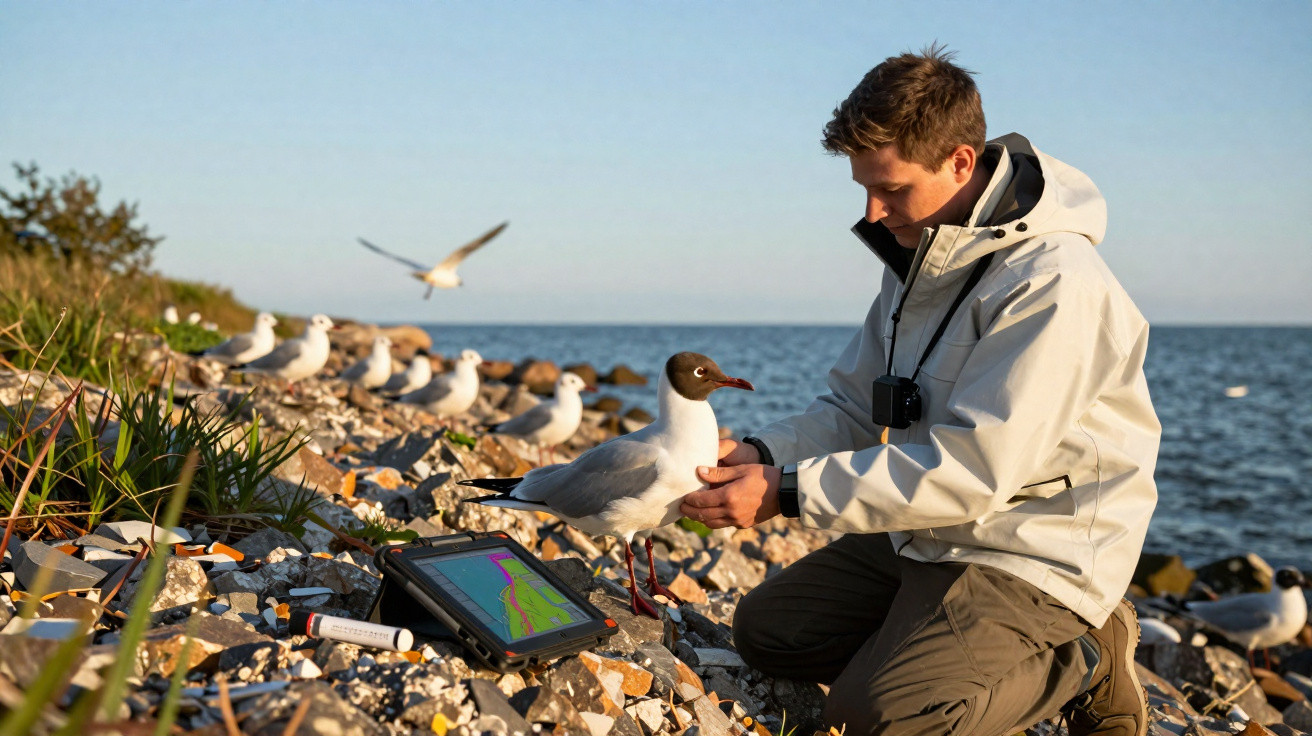
Researchers at Linnaeus University in Sweden found a way to observe those survivors after an outbreak swept through gull colonies near the coastal town of Kalmar in summer 2023.
A deadly summer in Kalmar
The outbreak affected black-headed gulls, which are common along the Baltic coast. From mid-June to mid-July, more than 700 were found dead across three municipalities.
Seabirds that nest in colonies are particularly vulnerable to such a virus. Thousands gather close together, allowing infection to spread quickly.
Chicks were hit hardest: mortality among young birds exceeded 90 per cent, and almost none survived in some colonies.
Adults also died, and those that fell ill showed unmistakable signs.
“At every affected colony, young chicks showing signs of the disease could be seen at the water’s edge, while dead juveniles were floating in the water,” said Jonas Waldenström, professor of disease ecology.
“Adult birds showed neurological symptoms such as inability to use their legs properly and spasmic movements of the head.”
Black-headed gulls were tagged before the bird flu outbreak
The timing proved fortunate. Around 30 black-headed gulls had been fitted with global positioning system (GPS) trackers by the same team a year before the outbreak.
The tags were unrelated to bird flu; they were part of another project examining how gulls acquire antibiotic-resistant bacteria from their environment.
“We were capturing and tagging birds as late as May 2023, a month later the outbreak started,” said doctoral student Alessia Ostolani.
A natural experiment
Some tagged birds belonged to a colony on the island of Öland that the virus did not reach, providing a natural comparison group.
“The outbreak became a natural experiment for us to study how avian influenza affects the behaviour and survival of black-headed gulls. Thanks to the GPS tagging we could follow the movement of a number of birds,” said Ostolani.
“This is very useful, as our current understanding of the virus’ effects on wild bird populations remains largely based on mortality counts and analyses of dead birds.”
Sick gulls slowed down
The tracking records changed after the virus arrived, with birds in affected colonies moving much less than they usually did.
Their mean daily speed dropped by about 54 per cent once the outbreak began. For a bird that normally flies back and forth throughout the day, that represents a major shift.
“Black-headed gulls show a quite predictable behaviour during the breeding season. Both males and females move back and forth to the colony to gather food and feed their chicks, basically doing the same thing over and over again,” said Ostolani.
“If that changes, you know something has happened.”
Infection reduced movement
There was another possible explanation to consider: adults whose chicks had died might simply have had no reason to continue making those return flights.
The evidence, however, suggested otherwise.
“We know from other studies that when birds lose their chicks they tend to move more because they are no longer constrained by having to return to the nest,” said Ostolani.
“We therefore believe the reduced movement was caused by the infection.”
The virus also appeared to leave a different mark. Gulls from affected colonies set off on their autumn migration almost two weeks earlier than usual.
The team found this surprising because the birds normally follow strict schedules. After losing their chicks, the adults had no reason to stay.
Early flights spread the virus
Leaving early has implications beyond a change in schedule: infected or exposed birds can encounter species they would not otherwise meet.
That is important for predicting where the virus might travel next.
“Knowing that birds might migrate substantially earlier if they are struck by bird flu during the breeding season means that we can incorporate this information into future models of migration behaviour,” said Mariëlle van Toor, an ecology researcher at Linnaeus University.
Several tagged gulls travelled vast distances, with the tracking data showing that some reached Portugal.
“A gull can move across Europe in a couple of days,” van Toor noted.
Survivors carry protection for years
The surviving birds offered another insight. Researchers recaptured them during the two subsequent breeding seasons and tested their blood.
One year after the outbreak, antibody levels against the virus remained high. About 84 per cent of birds sampled in 2024 tested positive.
A year after that, most of the birds tested still had protection, although levels had fallen. The proportion testing positive remained close to 81 per cent.
“These results indicate that Black-headed gulls that do survive the infection can be protected against the virus for at least two years, if not longer,” said Ostolani.
“Should the virus return to Kalmar, this would hopefully result in outbreaks of much less dramatic dimensions.”
Bracing for the next outbreak
Bird flu remains a threat. Now that H5N1 is established across Europe, mass deaths like those in Kalmar are likely to happen again.
Black-headed gulls remain common in the area two years later. Yet one colony that emptied during the outbreak stayed quiet throughout the following summer, showing that some losses take time to recover from.
What distinguishes this work is its attention to survivors as well as dead birds. It reveals how a virus changes a flock’s daily life long after the counting has ended.








Comments
No comments yet. Be the first to comment!
Leave a Comment