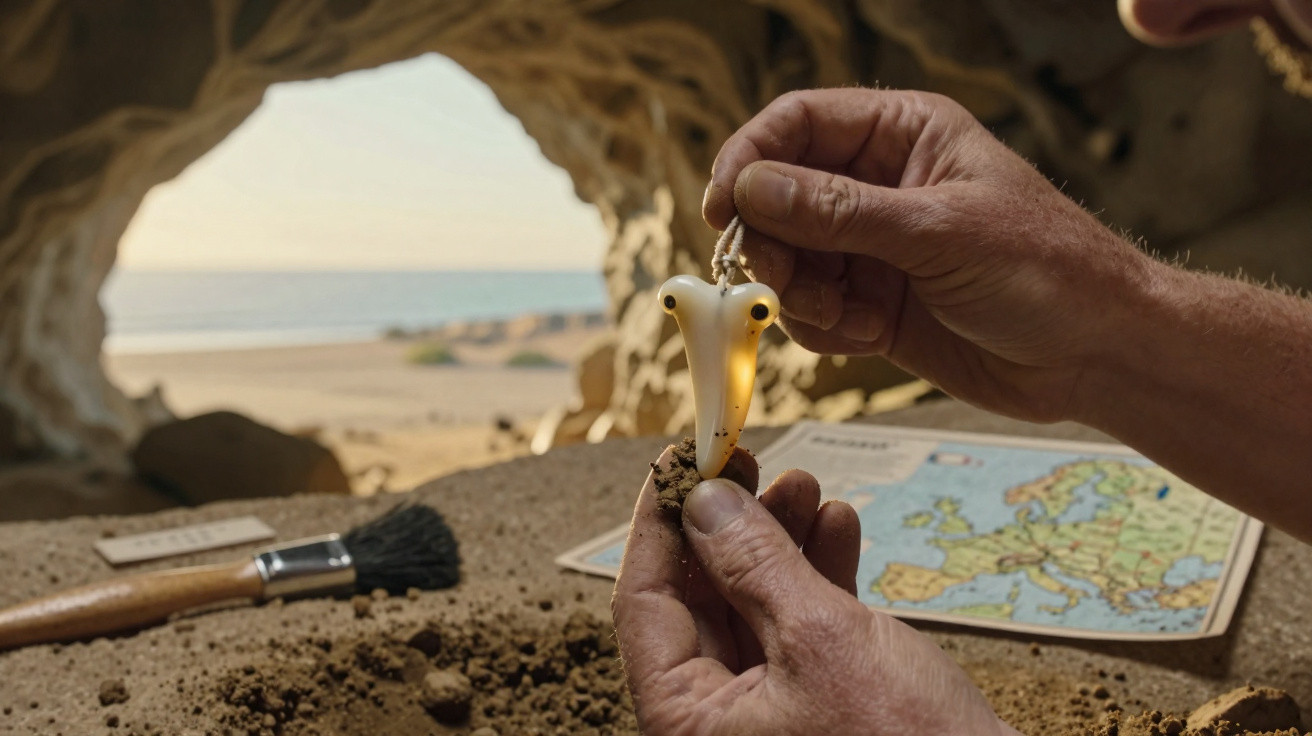
A tooth recovered from a cave in Torquay, England, in 1867 was recorded as belonging to a badger. A subsequent researcher identified it as a wolf’s tooth. Neither was correct.
The object is, in fact, a seal tooth pendant made 15,000 years ago. Years of use wore it smooth, and it was discovered far inland from the coast.
A new study has finally established what it is, raising more difficult questions than the original misidentification.
Lost for a century
William Pengelly unearthed the tooth at Kents Cavern, a cave system in Torquay, Devon, in 1867. His work was among Britain’s earliest systematic cave excavations, but the incorrect label remained in place and the identification went unchecked.
For most of the following century, the object sat largely unexamined in the museum’s anthropology collection.
In 2012, Simon Parfitt came across it while preparing a major exhibition on British prehistory. An archaeologist at University College London’s Institute of Archaeology and a scientific associate at the Natural History Museum, he immediately recognised that both earlier identifications were wrong.
There was not enough time to solve the mystery before the exhibition opened, so the display label described it simply as “carnivore tooth.” More than a decade later, its correct identification was still outstanding.
Matching the tooth to a seal
Parfitt recently revisited the problem with Dr Silvia Bello, a human evolution specialist at the Natural History Museum, and Dr Claire Lucas, a University College London honorary lecturer specialising in prehistoric Europe.
The researchers considered every land animal known to have lived in the area, but found no match.
They then expanded their search to the museum’s marine mammal collection. The tooth proved to be a grey seal premolar. Its root shape and wear indicated that it had come from a male around 12 years old.
To verify the identification without damaging the artefact, the team used high-powered microscopes, 3D scans and internal CT imaging. The tooth was too fragile for direct sampling for dating or genetic analysis.
How the seal tooth pendant was made
A premolar’s root is held by bone deep within the jaw. Removing the tooth would have required the jawbone to be broken open, a forceful and deliberate action. It is not known whether the seal was hunted or died naturally.
After freeing the tooth, its maker thinned and smoothed the root before drilling through it with a sharp flint point. The tool was turned slowly and carefully until it emerged on the other side. One mistake could have split the root.
The completed pendant hung freely from a cord. As it swung over time, its round hole became oval, with one side wearing thinner than the other, consistent with movement in one direction. Years of wear also left a smooth patina across the entire surface.
First seal tooth pendant in the British Isles
In the Ice Age, Kents Cavern was approximately 126 kilometres from the nearest shoreline, far to the south-east. Sea levels were much lower, making the coast a long journey away. The pendant was somehow carried inland.
Comparable perforated seal tooth pendants have been found at sites in the Pyrenees in France and Spain.
All are associated with the Magdalenian people, a western European culture active across the continent during the same period and best known for the cave paintings at Lascaux and Altamira.
The Kents Cavern pendant is the first of its kind found in the British Isles. Magdalenian communities in Britain shared ornament-making traditions with groups across the Channel, and objects from the sea reached them far from the coast.
Connected across Europe
A study of ancient DNA from Ice Age British remains indicates that Magdalenian people crossed from mainland Europe into Britain around 15,500 years ago. They used a land bridge now submerged beneath the North Sea and were much more mobile than earlier assumptions suggested.
Marine objects travelled across the continent with them. Shells, shark teeth and fossil molluscs from coastal sites regularly appear at Magdalenian camps hundreds of kilometres inland. The seal tooth fits this established pattern.
Bello commented on what the pendant may have meant.
“This seal tooth pendant might have had some formal purpose – perhaps to show the social identity of the pendant’s owner. It could be an indication that the person, or group they were part of, was familiar with the sea and maybe used to live near the coast,” said Bello.
What is known now
The seal tooth pendant places Ice Age Britain within a broader Magdalenian network extending from Devon to the Pyrenees.
The familiar picture of isolated cave dwellers does not hold up. These people had connections, and archaeologists can now begin to ask how far those links extended.
Laboratory analysis of the tooth’s chemistry and DNA could eventually reveal where the seal came from. A separate study of the timing of Magdalenian settlement in Britain suggests that the population was small and highly mobile, making such long-distance cultural links particularly striking.
“We don’t know if the person who carved it was also the one who wore it all the way to Kents Cavern and what story it may have held about their travels or connections,” said Lucas. Future chemical analysis and DNA testing may offer answers.












Comments
No comments yet. Be the first to comment!
Leave a Comment