Freshwater mussels hardly seem like devoted parents. Wedged into riverbeds, they spend years filtering water and can easily be mistaken for ordinary stones.
Yet females protect their developing young inside their own gills before releasing them.
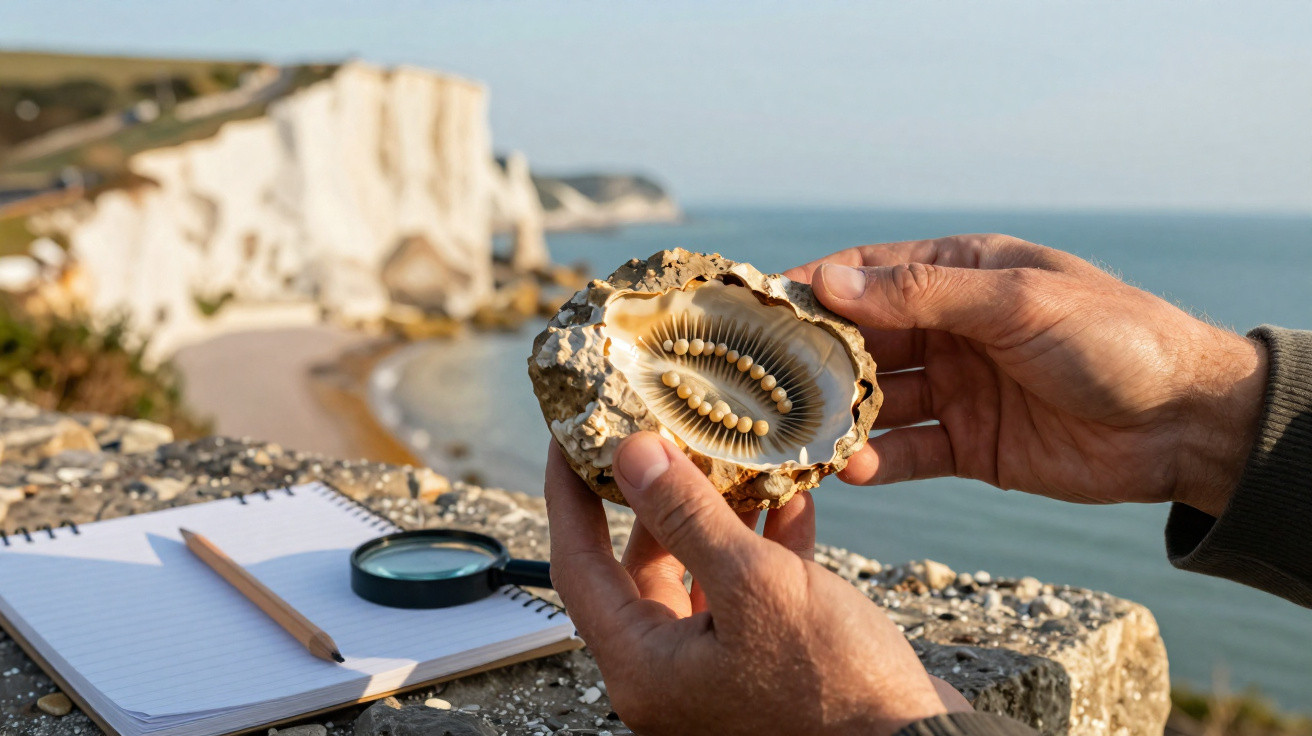
Such care relies on soft tissue, which normally decays long before an animal can become a fossil. No one therefore expected to find evidence of it preserved in stone from the age of dinosaurs. A handful of mussels from southern England changed that.
Freshwater mussel fossils trapped in stone
The mussels were discovered on the Isle of Wight, off the south coast of England, a place renowned for its Iguanodon bones and other dinosaur remains.
They inhabited shallow rivers during the Early Cretaceous, around 125 million years ago. The remarkable feature of their shells lies within.
Their soft tissue, normally the first part to decay, survived in the form of hard minerals. Victorian naturalists spotted the dark material almost two centuries ago.
They found that roughly a third of it was animal carbon and called it “Molluskite”, although they did not know what it was.
A research team led by Dr Graciela Delvene of the Geological and Mining Institute of Spain (IGME) cut three of the fossils into cross-sections. Using powerful microscopes, the researchers examined the slices and found that their internal details had survived, mineral by mineral.
Young in the gills
Living freshwater mussels have an unusual way of raising their young. A female draws in sperm with the water she filters, fertilises her eggs internally and places the embryos in pockets within her gills.
Before this study, that behaviour had never been seen in the fossil record. Isolated ancient larvae had been found, but never a mother with her brood still preserved inside her gills.
These mussels contain exactly that: larvae at several stages of development. The most mature larvae, known as glochidia, had their tiny shells open in what the team calls a butterfly position.
They are the oldest larvae ever discovered inside a parent that was still brooding them. Decades of research on the gills of living mussels, including a paper on gill tissue, helped make the pockets recognisable.
A freshwater challenge
Shell formation requires calcium, and freshwater contains much less of it than seawater. Freshwater mussels must contend with that continuing shortage, especially when they also need to supply their young with material for shells.
The animals build up a calcium store in advance. They keep the mineral in tiny round grains, known as mineral concretions, spread throughout their tissues as a reserve.
Once a female begins brooding, that supply supports the shells developing on her embryos. The fossils contained striking numbers of these grains close to the shell.
For the first time, the slices revealed where the grains ended up. The same calcium was found both outside and inside the embryos.
The young therefore appear to start drawing on the stored mineral to make their first shells while they are still in the gills.
How calcium passes into an embryo remains a mystery, even in living mussels. Until this discovery, however, the transfer itself had never been seen in a fossil.
Distinguishing life from rock
A reasonable question is whether the spheres are merely minerals that formed by chance in the rock, without any biological origin. Delvene’s team investigated that possibility and found evidence pointing the other way.
In two of the brooding mussels, the spheres survived in entirely different minerals but were alike in size and shape. Random mineral formation would not be expected to produce matching results by two different routes.
Each sphere contained a hollow left by a dissolved tiny shell, with a texture that only a living larva would leave behind.
Their position strengthened the case. The spheres lay exactly where brood pockets should be, close to the gill supports and the tissue that braces them. Chance mineral growth has little reason to follow living anatomy so precisely.
The empty mussel
Not all the mussels in the group were carrying young. One of the three, otherwise similar in most respects, contained no embryos or larvae at all.
That absence proved useful. The empty mussel still had large numbers of loose calcium grains, the kind consumed during brooding.
The tissue bracing its gills was also thinner. In living mussels, this tissue thickens to support a brood, so its slender form indicates an animal that had never bred.
The fossils captured different points in the same reproductive cycle: one mussel before brooding and two while it was under way. This enabled the team to reconstruct the whole sequence.
What the fossils change
By 125 million years ago, freshwater mussels were already brooding their young in their gills and supplying them with stored calcium, just as their descendants do today.
Gill brooding probably helped the animals spread through calcium-poor rivers and lakes during the dinosaur era, an early advantage reflected in their long success.
The find also gives palaeontologists another place to search, because the reproductive record survived in minerals beyond the shell.
There are implications for conservation today, too. Freshwater mussels are among the most threatened animals on Earth, and one study warns that a large proportion of species now face extinction.
Understanding how long this reproductive strategy has endured gives researchers a deeper evolutionary record to use in their efforts to protect modern freshwater mussels.













Comments
No comments yet. Be the first to comment!
Leave a Comment