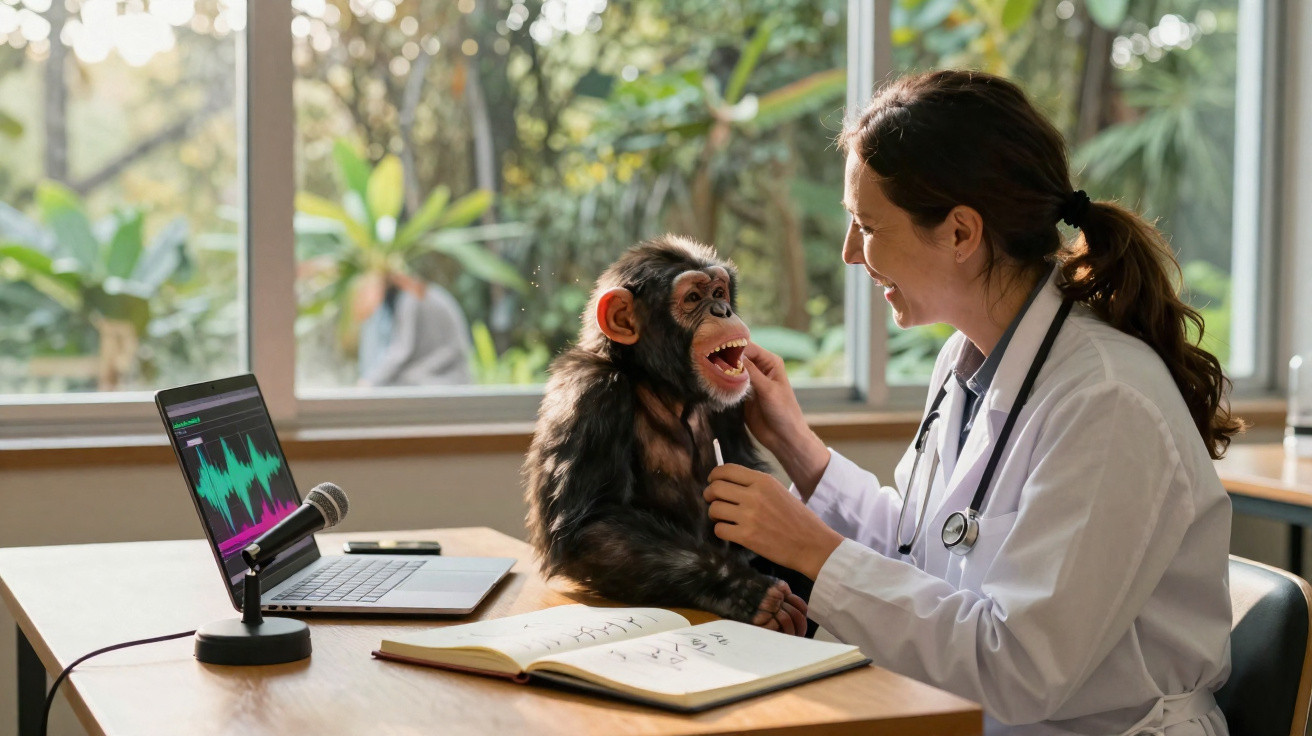
A baby chuckling on a changing mat and a chimpanzee panting as it is tickled may seem unlikely subjects for a discussion about human language. Yet a pattern in great ape laughter could tell us something about how language evolved.
The sound pattern they share may offer one of the oldest clues available about the beginnings of speech.
That is the unexpected suggestion of a new University of Warwick study. After examining the rhythm of laughter across great apes, researchers found evidence pointing back approximately 15 million years.
Laughter across great apes
Tracing the origins of spoken language poses an unusual challenge: speech leaves no trace in the fossil record, and humans are its only users.
Laughter is different. All living great apes laugh, including orangutans, gorillas, bonobos and chimpanzees, making it one of the few vocal behaviours available for comparison between species.
“How did humans evolve the remarkable ability to speak? Speech leaves no fossils, and complex language exists only in our own species. But we’ve found a 15-million-year-old clue in an unexpected place: our laughter,” said Dr Chiara De Gregorio of the University of Warwick.
“Unlike speech, laughter is shared by all living great apes. By comparing how different species laugh, we can see that a basic rhythmic structure has remained unchanged since our last common ancestor. That’s extraordinary.”
The ancient rhythm of great ape laughter
Researchers collected laughter recordings from four orangutans, two gorillas, three bonobos, four chimpanzees and four humans. The human participants ranged in age from six months to seven years.
One characteristic appeared repeatedly across 140 distinct bouts of laughter. In every species, the sounds were separated by evenly spaced intervals, producing a regular pulse known to scientists as isochrony.
Whether the laughter came from a child or an orangutan, its ha-ha-ha pattern followed roughly the same internal beat. The researchers suggest that this rhythm was present in the common ancestor of all great apes around 15 million years ago.
There are no recordings of that ancient ancestor, so living apes provide the only available model. By comparing their laughter today, researchers can reconstruct vocal characteristics that disappeared long before the first humans appeared on Earth.
Measuring the timing of laughter
The team concentrated on timing rather than pitch or volume. They measured the interval from the beginning of one laugh sound to the beginning of the next, using that value as a proxy for tempo.
All the apes were recorded at home while playing in a relaxed setting with people they knew well.
Those familiar humans encouraged laughter through games and tickling, the two situations in which ape laughter occurs most reliably.
Tickling and the laughter beat
The circumstances in which laughter occurred proved more important than expected. Laughter brought on by tickling maintained a notably regular rhythm, whereas laughter during play moved away from a strict beat.
A physical explanation accounts for that variation. Rough-and-tumble play twists and compresses the chest, disturbing the steady breathing cycle that normally supports laughter.
Tickling, on the other hand, leaves that cycle largely undisturbed. Laughter produced by tickling therefore offers a clearer view of the deep changes that altered the ape breathing-and-voice system over time.
How human laughter is different
Although the basic rhythm persisted over millions of years, it did not remain entirely unchanged. Laughter became faster as the hominid line progressed towards humans.
The increase in speed was most apparent in laughter caused by tickling. When the researchers analysed the figures by species, they found that only humans altered their laughter tempo according to the situation, laughing faster when tickled than during play.
The other apes did not show this change. The ability to adjust laughter tempo to the context therefore appears to be uniquely human.
Why variation in timing matters
Human laughter also showed the greatest variability of all. Its timing can bend and stretch in ways not observed in the laughter of other apes.
That may sound like irregularity, but the variation has meaning. People tend to perceive loose, varied laughter as warmer and more genuine, whereas rigid, mechanical timing feels wrong.
Changing rhythms may also help make laughter contagious. Unexpected shifts in timing seem to draw others in, allowing one chuckle to spread across an entire room.
Such control is significant. The capacity to deliberately vary a sound’s rhythm is one of the foundations of speech.
Speech evolved gradually
For a long time, the account of human speech featured a sudden turning point: our species appeared already possessing vocal abilities unlike those of anything else. The study instead suggests a more gradual process.
“It is impossible to assess the precursor forms of language directly from our extinct ancestors,” explained Dr Adriano Lameira of the University of Warwick.
“Laughter, being evolutionarily older and having remained shared between all living great apes, provides a rare evolutionary window into the vocal transformations that unfolded across hominid evolution until the first humans appeared on scene,” he added.
A long history of vocal control
The evolution of laughter indicates that humans did not necessarily acquire vocal control abilities distinct from those of their predecessors all at once.
Rather, humans form part of a continuum with their ancestors, whose vocal control capacities had already been refined over 15 million years.
From this perspective, laughter is much more than a social reflex. It is a living thread reaching back through our family tree, preserving evidence of the slow development of vocal control that ultimately made speech possible.












Comments
No comments yet. Be the first to comment!
Leave a Comment