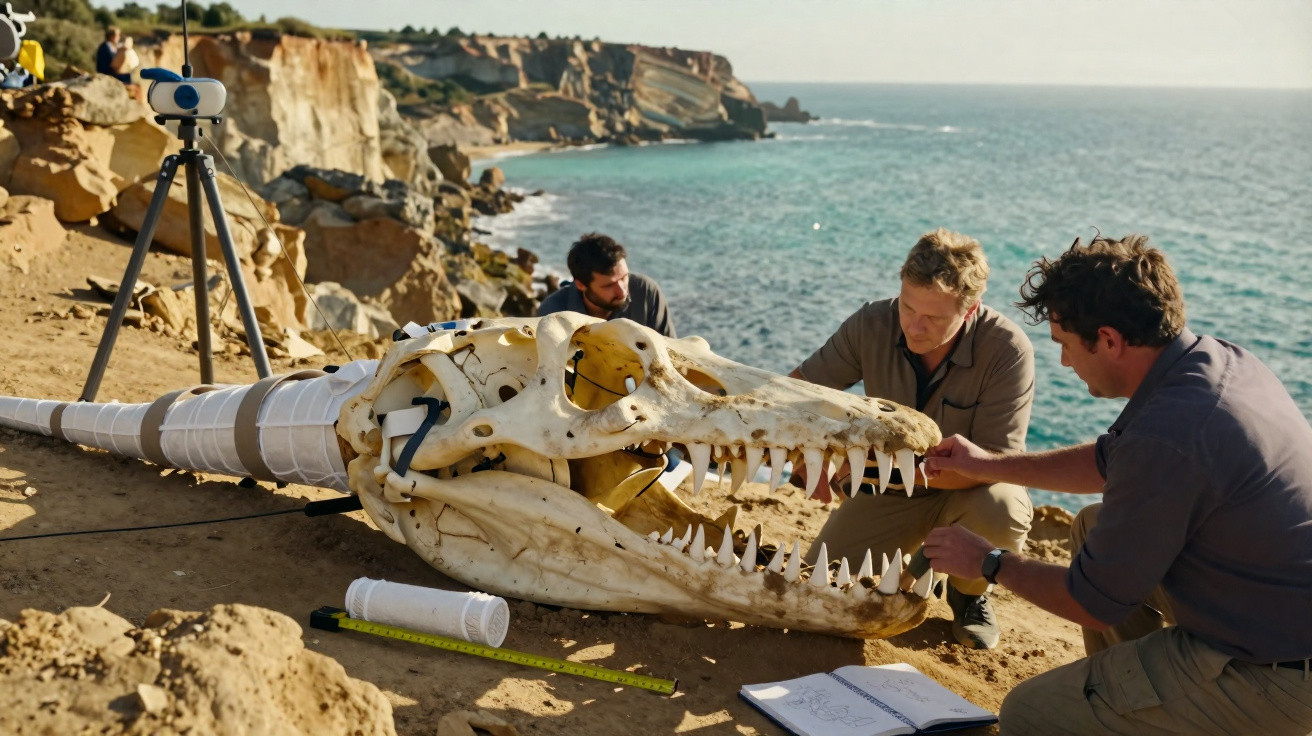
British scientists have discovered a 2-metre-long pliosaur skull with its upper and lower jaws still locked together in their natural position.
This unusual state of preservation gives palaeontologists an exceptionally clear look at how one of the Jurassic ocean’s most powerful predators bit and fed.
Pliosaur skull found intact
The skull was embedded in rock on England’s Jurassic Coast, with its bones still connected and the predator’s original shape preserved.
Having recognised how exceptionally complete it was, Dr Steve Etches secured the specimen and recorded its intact structure as it was raised from the cliff.
Most marine reptile skulls break or scatter before fossilisation, but this one kept the close fit between the upper skull and lower jaw, with little distortion.
Because the structure remained intact, researchers can now study the animal’s bite and feeding mechanics using an undisturbed framework rather than an estimated reconstruction.
A record-setting fossil
Guinness World Records lists the skull as approximately 95% intact overall by surface area.
The jaws measured just under 2 metres long and about 0.6 metres wide, and contained around 130 teeth.
Local news outlets covered the display, while a Meridian report documented the skull’s first public showing.
“This really is the most complete Pliosaur skull that has been discovered to date,” said Dr Etches.
Cliff rescue logistics
On 5 April 2022, amateur fossil hunter Philip Jacobs discovered the tip of the snout on the beach below Kimmeridge Bay.
Following that find, a team returned in August 2022 and used ropes to work around 15 metres down the cliff.
The rock was cut into blocks to protect the bones, and the skull was lifted carefully to prevent it shattering during transport.
Erosion on the World Heritage Jurassic Coast continually exposes fossils, although the same waves can also destroy them quickly.
Testing bite strength
Scars on the skull indicate where the jaw muscles were attached, helping researchers reconstruct the bite.
A 2014 paper examined a giant marine reptile skull using biomechanics, the study of forces within bodies.
With the jaw hinges still aligned, computer models can retain the teeth in their correct positions without relying on additional assumptions.
Even when bones are perfectly preserved, estimates of bite strength remain uncertain because fossil skulls cannot retain the missing muscle and cartilage.
Naming the animal
Researchers have informally called the skull “Sea-Rex”, but have yet to agree whether it represents a known species or an entirely new one.
To resolve that question, they compare its skull proportions and tooth sockets with older fossils, looking for consistent characteristics.
This painstaking process is taxonomy, the system used to name and group organisms, and a single skull leaves little margin for error.
Debate about Sea-Rex will remain provisional and subject to revision until researchers publish a formal description.
Top predator basics
Pliosaurs occupied a position close to the top of Jurassic ocean food webs, and other reptiles frequently became their prey.
Their four flippers powered their swimming, with each stroke driving water backwards and propelling the animal forwards at speed.
Unlike dinosaurs, pliosaurs lived entirely in the sea and probably hunted fish, squid and other marine reptiles.
Sea-Rex is significant because its complete skull allows scientists to test these ideas about hunting against actual bone, rather than illustrations or guesswork.
Clay and preservation
Sea-Rex was recovered from the Kimmeridge Clay Formation, a fossil-rich clay rock deposited in warm Jurassic seas.
When collectors expose the clay to air, it can dry out and shrink, creating pressure that may crack bone.
Etches spent ten months cleaning the specimen, removing rock grain by grain because working too quickly could snap the thin bones beneath the mouth.
These concealed stresses help explain why most marine reptile skulls fall apart, even if they were initially well preserved.
TV and museum crowds
The museum put the skull on display on 2 January 2024, transforming a laboratory achievement into a public exhibit.
A David Attenborough documentary broadcast on 1 January 2024 followed the excavation and restoration, then used graphics to explain the animal.
For many viewers, the programme made the skull’s sealed joints easier to understand than isolated fossils kept in a drawer.
Public interest also brings higher expectations, so researchers must distinguish what the bones reveal from what television adds.
Clues beyond the skull
A few vertebrae, the bones that make up the spine, were recovered with the skull, suggesting the head separated before burial.
As currents carried the carcass, its heavier parts sank first and were rapidly covered by mud in a low-oxygen environment.
The swift burial slowed scavengers and kept the joints together long enough for minerals to replace tissue.
Discovering the rest of the skeleton could shed light on how the animal died, although its remains may be scattered through the cliff.
Implications for fossils
A skull that remained whole has transformed a beach discovery into a rare opportunity to test how a Jurassic predator functioned.
Careful research can refine its identification and the understanding of its feeding mechanics, but incomplete remains can still restrict what scientists are able to prove.









Comments
No comments yet. Be the first to comment!
Leave a Comment