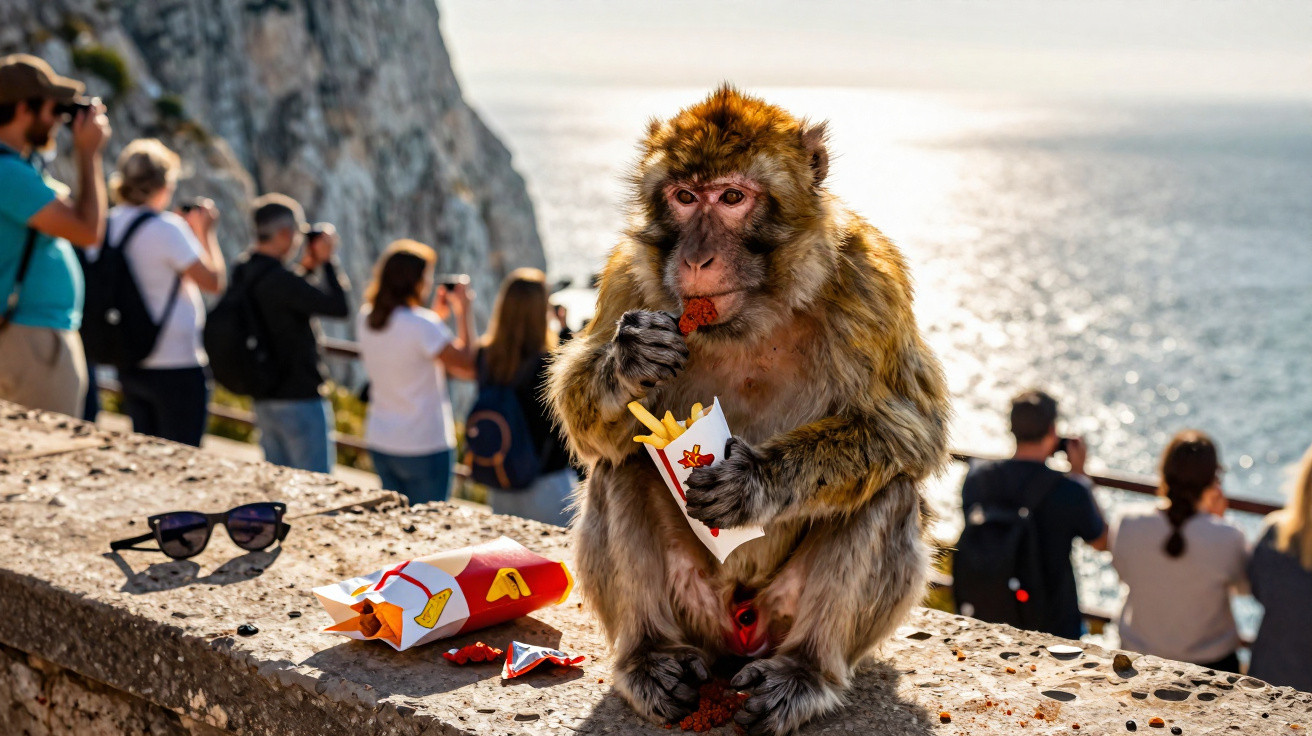
A troop of monkeys on a well-known rocky outcrop has acquired an unusual habit: deliberately eating soil. It might look peculiar, but the reason points to the ways human behaviour is changing the natural world.
People visit for the scenery, photographs and close encounters with wild monkeys. Many take snacks with them, which they may share or have snatched by quick, inquisitive hands.
These treats have gradually become a regular part of the monkeys’ diet. Sweet, salty and rich foods are now eaten alongside the foods they would normally find in the wild.
That shift has consequences. Foods the animals’ bodies were never designed to process are causing stomach problems, and the monkeys appear to have found a remedy that works for them.
A team led by Dr Sylvain Lemoine of the University of Cambridge studied groups of macaques in Gibraltar, the only place in Europe where wild monkeys roam free.
The researchers closely observed and recorded a behaviour known as geophagy: the deliberate eating of soil.
Junk food and Gibraltar’s macaques
The monkeys are comfortable around people. In crowded tourist spots, they take or accept snacks such as chocolate, crisps and ice cream.
“Foods brought by tourists and eaten by Gibraltar’s macaques are extremely rich in calories, sugar, salt and dairy,” said Dr Lemoine.
“This is completely unlike the foods typically consumed by the species, such as herbs, leaves, seeds and the occasional insect.”
The effects can be felt in their bodies. Rich food may disrupt the balance of gut bacteria and cause discomfort, which appears to encourage the monkeys to eat soil.
“We think the macaques started eating soil to buffer their digestive system against the high energy, low fibre nature of these snacks and junk foods, which have been shown to cause gastric upsets in some primates,” said Dr Lemoine.
Why soil might help
Soil is more than just dirt: it contains minerals and microbes that can influence digestion. For the monkeys, it may serve as a natural remedy.
“Our findings are more supportive of this protection hypothesis. The consumed soil acts as a barrier in the digestive tract, limiting absorption of harmful compounds,” said Dr Lemoine.
“This could alleviate gastrointestinal symptoms from nausea to diarrhoea. Soil may also provide friendly bacteria that helps with the gut microbiome.”
Dairy presents another problem.
“Non-human primates become lactose intolerant after weaning, so dairy is known to cause digestive issues in monkeys, and ice cream is hugely popular with Gibraltar’s tourists and consequently its macaques,” said Lemoine.
On a few occasions, researchers observed monkeys eating soil soon after bread and ice cream. The timing suggests a clear connection between their food and their response.
A behaviour that spreads
This does not appear to be an isolated habit. Instead, the monkeys seem to learn it from one another.
Across the population, researchers recorded about 12 soil-eating events each week, a high rate compared with other primates.
Around 30% of those events occurred in groups, and other monkeys often watched. Indeed, 89% of all incidents happened with other macaques present, creating conditions in which the behaviour could readily spread.
Groups also have different preferences. Most favour a red clay soil called terra rossa, which accounted for 83% of all observed cases.
One group living farther down the slopes, however, frequently chose soil mixed with tar from potholes. That accounted for 70% of its soil-eating.
These choices suggest something beyond instinct: local traditions and small cultural patterns developing within each group.
Where tourists make the difference
The monkeys do not all behave alike; their location matters. Groups that spend more time close to tourists eat more junk food and, in turn, more soil.
Those in the busiest places were two and a half times more likely to eat human snacks. The three groups living at the top of the rock were responsible for 72% of all dirt-eating.
By contrast, one group with no access to tourists or their food showed no soil-eating at all.
Seasonal changes reveal a similar pattern. Junk food consumption rises in summer, when more tourists visit.
In winter, it falls by about 40%. Soil-eating follows the same trend, dropping by about 31%.
In total, almost one-fifth, or 18.8%, of everything these monkeys now eat comes from tourists.
A long shared history
The macaques have lived alongside people for centuries. They probably arrived from North Africa during medieval times and, over the years, became both a symbol of the area and a major attraction.
Their history is linked to wartime, too, when leaders ensured that their numbers did not decline.
Today, the macaques live in eight stable groups, partly supported by official feeding stations supplying fruit and vegetables.
Despite those efforts, human food remains a strong attraction.
“Humans evolved to seek out and store energy-dense fats and sugars to survive periods of scarcity, leading us to crave high-calorie junk food,” said Dr Lemoine.
“Availability of human junk food could trigger this same evolutionary mechanism in macaques. Soil-eating may allow them to keep consuming food that has negative digestive effects, but is as delicious for them as it is for us.”
A changing way of life
What is striking is how rapidly behaviour can change when animals live near people. The monkeys are adapting not only physically, but also by acquiring new habits and passing them on.
“The emergence of this behaviour in macaques is both a functional and cultural one, like nutcracking in chimps, except it is driven entirely by proximity to humans,” said Dr Lemoine.
The combination of biology and learned behaviour provides a rare glimpse of animals adjusting in real time.
“Gibraltar’s macaques are deeply entwined with human history, offering a striking example of a human-primate interface.”
“The range of human interaction across Gibraltar’s macaque groups create a natural experiment for understanding how anthropogenic landscapes affect primate behaviour and culture.”
The full study appeared in the journal Scientific Reports.








Comments
No comments yet. Be the first to comment!
Leave a Comment