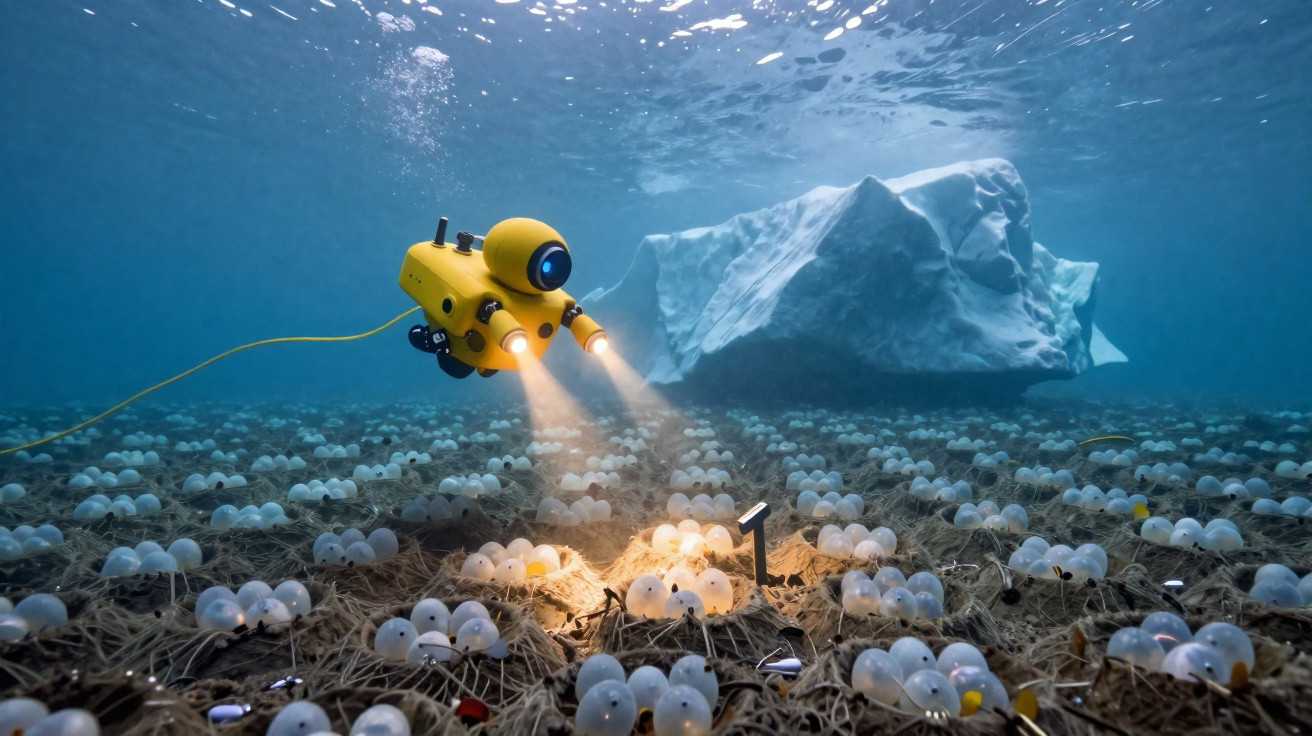
A tethered underwater robot has discovered more than 1,000 Lindbergichthys nudifrons fish nests in Antarctica’s western Weddell Sea. Instead of being scattered randomly, the nests form distinct patterns.
The discovery was made on a stretch of seabed exposed when a giant iceberg broke away from Antarctica’s Larsen C ice shelf. It points to an organised breeding ground that remained hidden from view for decades.
Lindbergichthys nudifrons nests
Researchers examined 27 hours of seabed footage for a new study, mapping the geometric patterns formed by the nests. Their rims averaged around 12 centimetres across, a size consistent with adult fish guarding eggs.
“The most significant finding is the discovery of six distinct, geometric nesting patterns,” wrote lead author Russell B. Connelly of the University of Essex (UE), who studied footage from the remotely operated vehicle.
The vehicle filmed Antarctic fish nests arranged in curves, lines, clusters, ovals, sharp U shapes and isolated single nests.
How nests protect fish
The nest arrangements are consistent with the selfish herd theory, a concept formalised in a classic paper. It proposes that animals lower their risk by keeping neighbours between themselves and predators. Nests in the centre gain protection, while those at the edges face greater danger.
Another Antarctic icefish colony, reported in 2022, associated the position of nests with modified warm, deep water.
This is a relatively warm water mass that reaches the continental shelf and determines where nests are placed, rather than social geometry doing so.
That study recorded the world’s largest known fish breeding area and found slightly warmer bottom water where the nests were most concentrated.
At the new Weddell Sea site, there is little local temperature variation across the nest fields. This suggests that behaviour and pressure from predators, rather than small temperature gradients, shape the patterns observed there.
Iceberg reveals Antarctic fish life
In July 2017, iceberg A68 broke away from Larsen C, opening a research route into waters that had been covered by ice. The floe covered about 5,800 square kilometres, and its drift exposed habitats on the seabed.
During the 2019 Weddell Sea Expedition, engineers deployed the remotely operated vehicle from the SA Agulhas II. The ship-tethered robot was equipped with cameras and lasers.
The same ship later supported the expedition that found Shackleton’s Endurance, but the scientific results from the earlier mission were valuable in their own right.
The nests were made by the yellowfin notie (Lindbergichthys nudifrons), a small rockcod adapted to polar waters. Researchers saw no eggs because the dives took place after hatching, and a small proportion of the pits may belong to other icefish.
Protecting fish nurseries
This nursery is both structured and vulnerable by seabed standards. Nursery sites of this kind carry conservation significance under the Food and Agriculture Organization’s Vulnerable Marine Ecosystem criteria.
“States and RFMO/As should close such areas to DSFs until appropriate conservation and management measures have been established,” stated the FAO guidelines.
The Commission for the Conservation of Antarctic Marine Living Resources is considering a Weddell Sea MPA plan. Its Phase 1 proposal identifies protection of spawning and nesting sites as a core objective and sets out zones where activities would be restricted or allowed.
The study’s clear video footage strengthens the case for recognising these fish nest fields as features that meet protection triggers. It also gives managers a behavioural perspective when interpreting hotspots identified through camera transects and mapping.
Why patterns matter
All six patterns recur across the site, although one is more prominent than the others. Clusters were the most frequent arrangement of fish nests, whereas linear arrays were uncommon, suggesting that long lines provide poor collective shelter from predators.
Nests at the edges tended to be larger than those within groups. The difference in size is consistent with stronger adults occupying the fringe, where guarding nests is most demanding.
Rocks also played a local role. Small nests were often close to rocks and pebbles, which may break up currents or help conceal scent trails from scavengers and worms moving across the flats.
Lindbergichthys nudifrons impact
The Lindbergichthys nudifrons nests are part of a food web connecting fish, invertebrates and predators. If a trawl or other bottom gear passed through the area, the damage would extend well beyond a single season’s eggs.
Once established, protection could also turn the site into a living laboratory. Managers could track changes in the nest fields alongside sea ice, currents and productivity, adjusting boundaries if the core area moves.
The discovery brings a new form of evidence to Antarctic planning. The geometry on the seabed is more than decoration: it is behaviour recorded in the habitat, showing where risk is greatest and help is most needed.









Comments
No comments yet. Be the first to comment!
Leave a Comment