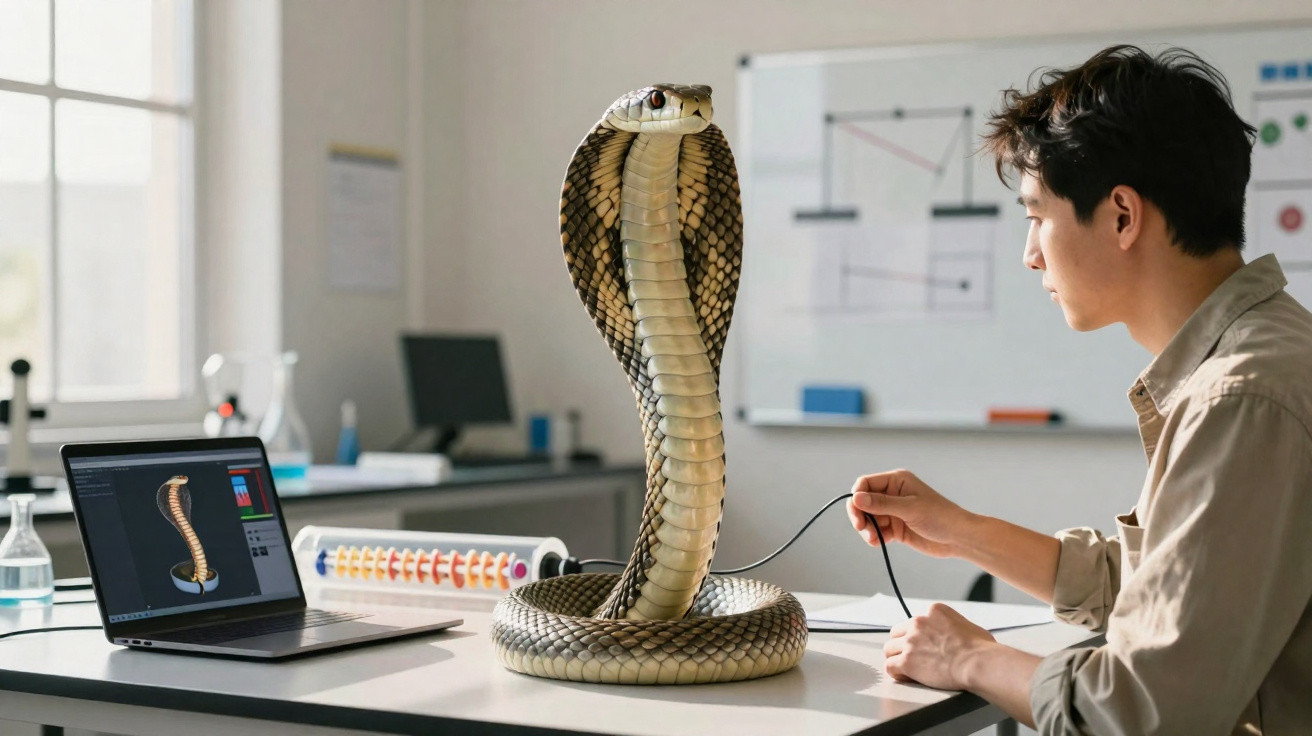
Snakes hardly seem designed to stand upright. They lack legs and a rigid, pole-like spine, while their bodies bend readily in every direction.
Even so, some can lift themselves almost vertically into the air and remain there. More remarkably, they can balance in this position on a narrow branch.
In certain species, close to 70 per cent of the snake’s body can rise off the ground, with the remainder held securely in place.
The elevated portion stays nearly vertical and balanced, despite the animal having no limbs to keep it stable.
Investigating how snakes stand upright
Researchers recently set out to discover how snakes achieve this. Their findings suggest that the feat depends not on brute strength, but on a combination of physics, muscular control and awareness of body shape.
The study was carried out by a team led by L. Mahadevan of Harvard University, whose group investigates the physics of biological movement.
By bringing together biology, mathematics and mechanical modelling, the researchers explain how snakes perform such a delicate balancing act.
“For some it may be the stuff of nightmares, but we’ve now analyzed, mathematically and physically, the hidden physics and control strategies that allow snakes to defy gravity,” said Mahadevan.
How snakes perform the upright stand
Tree-dwelling snakes, including brown tree snakes and scrub pythons, frequently have to bridge gaps between branches. They do so by raising a substantial part of their body into the air before reaching forwards.
At first sight, this position appears precarious. A snake has a soft, flexible body that gravity might be expected to buckle or collapse. Nevertheless, these animals can remain upright long enough to reach another branch.
Where snakes do the real work
Detailed tracking of snake movements uncovered an unexpected finding: snakes do not stiffen their whole body as they rise.
Instead, most of the control involved in balancing upright takes place in a short section near the base, where the body lifts away from its perch.
In this region, the body bends and muscles work intensely, creating what the researchers call a boundary layer. The rest of the body above it remains almost straight.
The approach works because gravity produces very little bending force when the body is vertical. Concentrating effort near the base therefore reduces the energy a snake needs to remain upright.
How the body senses itself
The team also studied how snakes coordinate their muscles while balancing in this position. An important factor is proprioception: the animal’s ability to sense its own body’s position and shape.
To investigate the mechanics, the researchers developed a mathematical model that represents a snake as an active elastic filament. Put simply, this is a flexible structure capable of detecting its own shape and responding through muscular forces.
The model revealed two possible control strategies. In the first, muscles respond directly to bending in a particular area, stiffening the body wherever it curves.
In the second, muscles coordinate their activity along the body to reduce the total effort required. Both approaches produced the familiar S-shaped posture of upright snakes, although the coordinated method demanded considerably less muscular effort.
Why balance is the hardest part
For snakes, raising the body is not the greatest challenge. The harder task is maintaining balance.
The researchers found that a snake needs only moderate muscular forces to lift itself into position.
Keeping stable once upright is the real difficulty. Greater forces are needed to stop the snake tipping over as gravity continually pulls it off balance.
This helps explain why upright snakes often sway gently as they hold their position. That slow movement reflects the ongoing adjustments the animal makes to stabilise itself.
What engineers can learn from snake balance
The study offers more than an explanation for an unusual snake behaviour. It also suggests fresh ideas for the engineering of flexible machines.
Robots made from soft materials often have difficulty staying stable when they extend upwards or reach outwards.
Learning how snakes focus control in just one part of the body could help engineers create machines that stay stable without wasting energy.
“By concentrating control where it counts, engineers may learn to build machines that are both efficient and resilient,” said Ludwig Hoffmann, the study’s first author and a postdoctoral researcher in applied mathematics.
Nature frequently addresses challenging physical problems with simple strategies. For tree-climbing snakes, the answer is to concentrate effort where it is most needed while allowing the rest of the body to remain almost still.
The full study appeared in the Journal of The Royal Society Interface.















Comments
No comments yet. Be the first to comment!
Leave a Comment