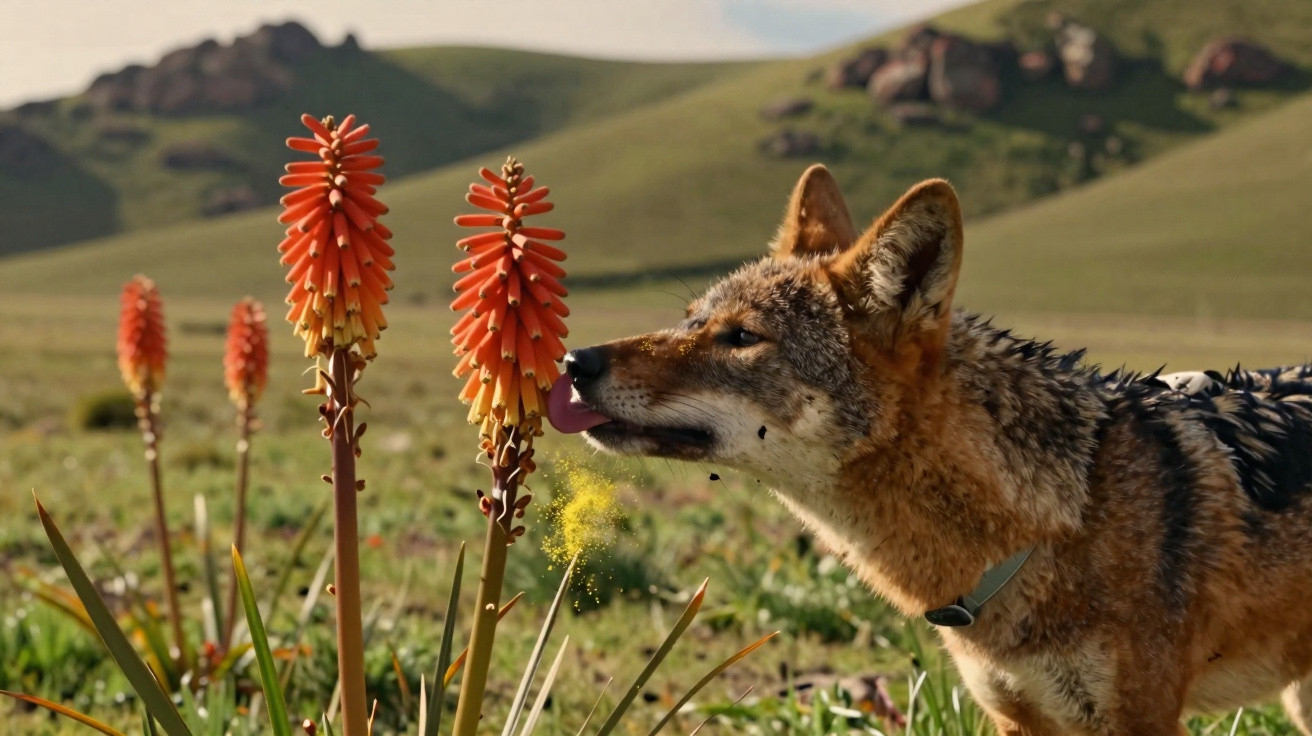
A species of wolf in Ethiopia has been unexpectedly filmed licking flowers, raising the possibility that the carnivores act like giant, ground-dwelling bees.
As the fuzzy red wolves move from bloom to bloom, lapping up the flowers’ sweet nectar, pollen from the red hot poker turns their white snouts yellow.
Oxford University ecologist Sandra Lai and her colleagues therefore suspect that these otherwise strict meat eaters may carry pollen between Kniphofia foliosa plants. If confirmed, the Ethiopian wolf (Canis simensis) would be the first known example of a large carnivoran pollinator.
“Wolves were observed foraging for nectar on K. foliosa flowers, which deposited a relatively large amount of pollen on their muzzles, suggesting they could contribute to pollination,” the team writes in its paper. The researchers explain that further work is needed to confirm whether pollination actually occurs.
A video in the supplementary information accompanying the paper by Lai and co-authors in Ecology shows potential pollination of Kniphofia foliosa by Ethiopian wolves. 🐺
Read the paper: esajournals.onlinelibrary.wiley.com/doi/10.1002/…
@pollinet.bsky.social
[Image or embedded content]
- FLOWer Lab 🌸🍒 🐝 🪰🔬🧬 (@flowerlab.bsky.social), 21 November 2024 at 9.41 pm
Ethiopian wolves and red hot poker nectar
If the endangered wolves do help fertilise flowers, they would join a select but endearing group of non-flying mammal pollinators. This form of pollination, known as therophily, involves animals including rodents, primates, elephant shrews and honey possums (Tarsipes rostratus). The honey possum is the only mammal other than a bat that feeds entirely on nectar.
During years of fieldwork, Lai and her colleagues noticed that the wolves occasionally had a taste for sugar. To look into the behaviour, they followed six wolves from different packs over four days.
“I first became aware of the nectar of the Ethiopian red hot poker when I saw children of shepherds in the Bale Mountains licking the flowers,” explains University of Oxford conservation biologist Claudio Sillero. “In no time, I had a taste of it myself – the nectar was pleasantly sweet.”
The researchers watched one wolf visit as many as 30 flowers in a single foray. Flowers that depend on mammals for pollination are often sturdy or specially adapted, and the red hot poker is no exception. Its blooms, known as racemes, cluster around heads on stalks that can reach 1 metre (about 3 feet) above the ground.
The potential role of mammal pollinators
Animals pollinate almost 90 per cent of Earth’s flowering plants, and the findings suggest that lesser-known pollinators could play a bigger part than previously realised.
Most mammals that pollinate plants are small or medium-sized and usually arboreal, such as bats or sugar gliders. The few other meat-eating mammals known to consume nectar are small-bodied species, including relatives of civets and raccoons, which makes the fox-coloured wolf unusual.
An endangered wolf with a specialised diet
With fewer than 500 individuals remaining in the wild, the Ethiopian wolf is Africa’s most endangered carnivore. Like many of the planet’s most threatened species, it is a specialised feeder, eating mainly particular rodents found in Africa’s mountainous regions, presumably with a flowery dessert as an occasional treat.
Like its main prey, the wolf occurs only across seven mountain ranges, isolated at altitudes above 3,000 metres. Genetic evidence suggests that these wolves are a remnant ancestral group from a line of canids that eventually gave rise to grey wolves.
The team wants to establish whether the wolves do pollinate the flowers and to investigate whether there is evidence that this unusual pair co-evolved.
“These findings highlight just how much we still have to learn about one of the world's most-threatened carnivores,” says Lai.
The research was published in Ecology.
















Comments
No comments yet. Be the first to comment!
Leave a Comment