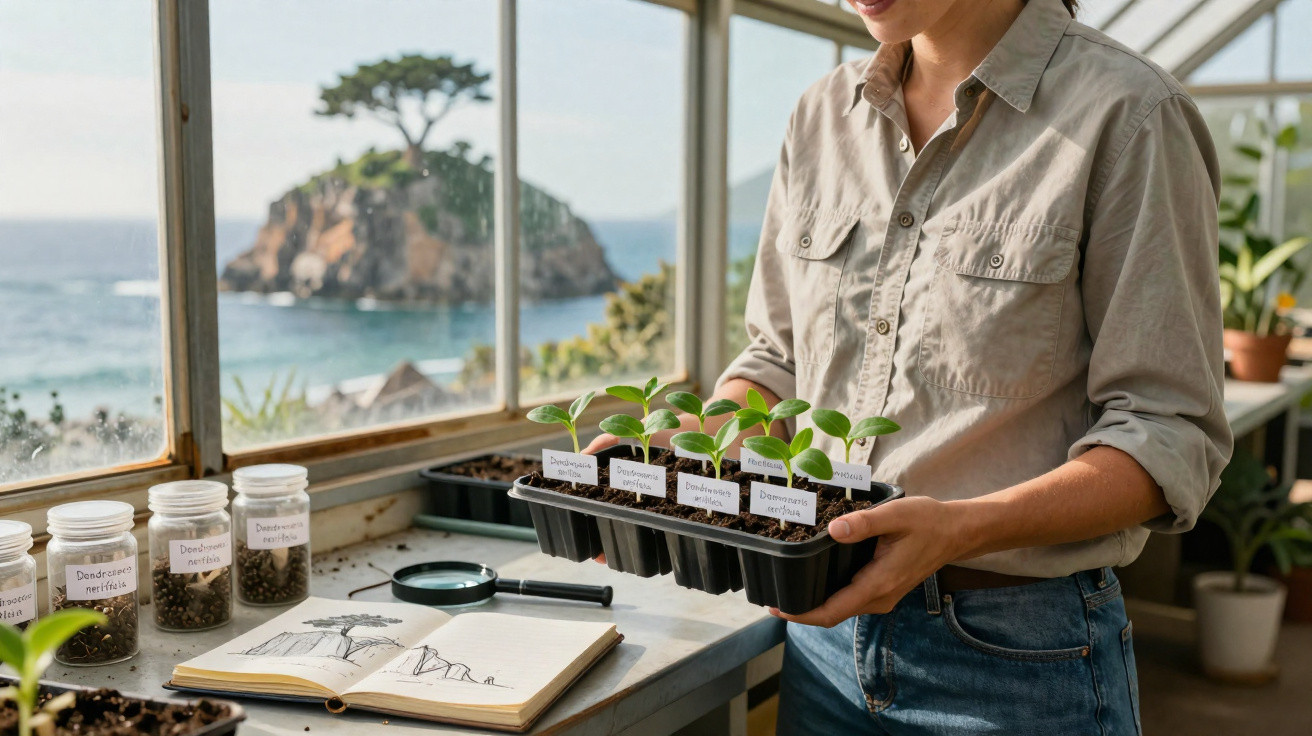
On a remote cliff on Chile’s Robinson Crusoe Island stands an ageing tree: the last known wild individual of Dendroseris neriifolia. Seeds from the survivor, which is nearly 150 years old, have produced eight seedlings at England’s Millennium Seed Bank, offering a narrow but genuine route away from extinction in the wild.
In its latest update, the bank says 29 seeds arrived at its laboratories, X-ray analysis suggested 25 could be viable, and all eight selected for the first growing trial germinated. Seedlings on their own, however, do not amount to recovery.
The long-term aim is to grow more plants and produce more seeds, restore damaged habitat and, eventually, return descendants of the cliffside tree to Chile.
The Dendroseris tree on the cliff
Dendroseris neriifolia is sometimes called a “tree daisy”: although it is a member of the daisy family, it grows as a woody, branching plant that can reach around 4 metres in height.
The species is native solely to Robinson Crusoe Island. Chile’s official species committee classifies it as Critically Endangered, with just one known location.
Collecting seeds from a plant that represents an entire wild population requires care. The tree grows on the side of El Lápiz ravine and is supported by ropes. Trained collectors move carefully along its trunk, using nets to catch the ripe fruits.
The team collected 400 seeds during the March 2026 expedition.
How the species neared extinction
The species once grew in ravines and lower-lying parts of the island, but by 1980 only eight wild trees were left.
Its habitat has been damaged by forest clearance, invasive plants, grazing by introduced mammals and repeated fires. Chile’s assessment identifies exotic herbivores and competing plants as particular threats.
The danger has been recognised for years. In a 2003 Conservation Biology study, Thomas Dirnböck and colleagues used historical vegetation maps and field data to project the spread of invasive plants across Robinson Crusoe Island, illustrating the importance of long-term control.
Isolation has brought a further difficulty. The conservation team estimates that around 90 per cent of the seeds are non-viable. Some plants kept in gardens have also hybridised with related species, leaving their seeds unsuitable for the rescue programme.
Earlier recovery efforts have yet to establish a secure wild population.
What happened to the seeds
The 400 seeds were screened, and 29 were then sent to England. According to the bank’s latest update, 25 looked potentially viable on X-rays; an earlier project account reported visible embryo development in 24. The number available for the rescue effort remains very small.
Researchers sowed eight seeds directly into compost in controlled greenhouses, aiming to limit excessive humidity and avoid disturbing their delicate roots.
All eight germinated, and three are expected to be moved to Logan Botanic Garden in Scotland. The remaining seeds will be kept in long-term conservation storage.
This method is known as ex situ conservation: protecting a species away from its natural habitat.
Paulina Hechenleitner, a research associate at Royal Botanic Garden Edinburgh and science leader at Jardín Botánico VerdeNativo, said the germination demonstrated the value of sustained international cooperation. Botanist Diego Penneckamp expressed the urgency more directly, describing it as “a race against time.”
A seed bank is just the beginning
A seed bank serves as a biological backup. The facility is the world’s largest underground seed bank, holding more than 2.5 billion seeds from over 40,000 wild plant species for research, reintroduction and restoration.
The seedlings will be shared among botanical gardens across the United Kingdom, allowing growers to discover which conditions help them survive, mature and produce further seeds.
In practice, the aim is to build up enough healthy material to strengthen conservation collections and, in time, send plants or seeds back to Chile.
The island, however, must be ready to receive them. Restoring a wild population will take years of habitat repair, invasive-species control, monitoring and carefully planned reintroductions.
Young trees cannot become established if goats, rodents or aggressive plants bring back the pressures that caused the species’ decline in the first place.
The rescue is linked to a whole ecosystem
All 11 species in the Dendroseris group are unique to the Juan Fernández Archipelago.
The islands support 285 native plant species, 144 of which occur nowhere else. Losing one lineage can therefore remove an irreplaceable part of the ecosystem.
The Critically Endangered Juan Fernández firecrown hummingbird is also part of that network.
The bird feeds on Dendroseris flowers, so protecting the tree also helps safeguard a rare relationship between a native plant and its pollinator. The stakes extend beyond a single isolated trunk.
Chile’s National Forest Corporation plans to collect more seeds for shipment to the United Kingdom in 2027.
Eight seedlings do not constitute a restored population, but they provide the first living bridge between one old tree on a cliff and a possible future in the wild.
The Royal Botanic Gardens, Kew has published the official conservation update.

Comments
No comments yet. Be the first to comment!
Leave a Comment