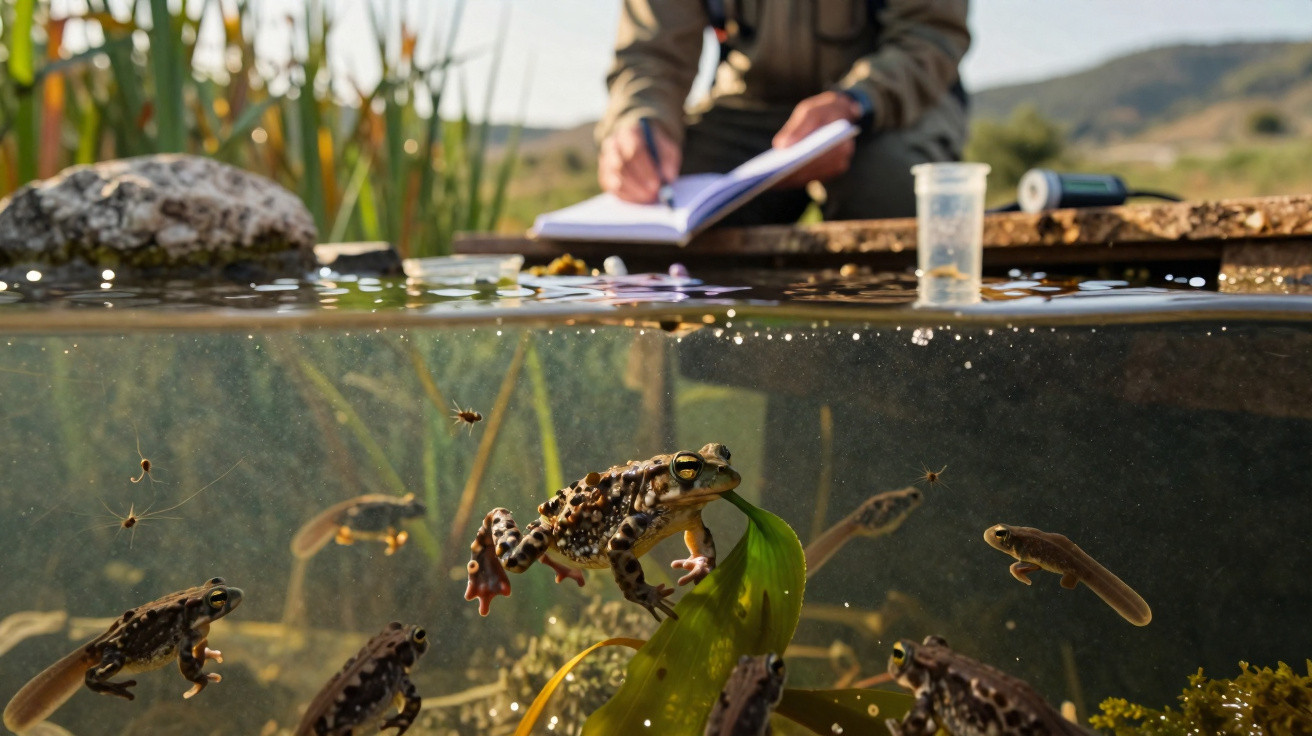
As the water around them warms, tadpoles respond in a surprisingly ingenious way: they alter their diet.
New research suggests this is more than an unusual behaviour. It is a genuine strategy for coping with rising temperatures.
However, there is a limit to how well it works. Once the water becomes hot enough, the strategy begins to break down.
The study provides the first experimental evidence in any vertebrate that using diet to manage the effects of climate change eventually encounters a physiological limit.
Iberian spined toad as a test subject
To investigate how warmer water affects amphibian development, the researchers focused on the Iberian spined toad, a relatively ordinary amphibian found throughout Portugal.
Like fish and reptiles, amphibians are cold-blooded, meaning their bodies depend almost entirely on cues from their surroundings. A rise in temperature can therefore change how they grow and survive.
To find out whether diet could lessen the impact, the team collected tadpoles from Portugal’s Sintra Mountains. They raised them under a combination of temperatures and feeding conditions, then observed the results.
Tadpoles adapt their diet
The researchers found that tadpoles do not simply endure warmer water passively. Instead, they respond by changing what they eat.
“This is the first study of its kind conducted in vertebrates and it shows that tadpoles can adjust their diet in response to temperature,” said lead author Sara Bento from the University of Lisbon.
“At lower temperatures, tadpoles incorporate a higher proportion of animal-derived food into their diet, whereas at higher temperatures they increase their consumption of plant material as well as their overall feeding rate.”
“However, we found that this strategy becomes progressively less effective as temperatures rise.”
In effect, the tadpoles appear to sense that something is wrong and try to make up for it by eating more and changing their food choices.
That response works for a time, but once temperatures climb high enough, it is no longer sufficient.
Faster development, smaller tadpoles
Temperature made a substantial difference to the speed of the tadpoles’ development.
At 20°C, they completed their entire larval stage in around 30 days. At 12°C, the same process took approximately 177 days: almost six times longer.
That extra speed came at a cost. Tadpoles raised in warmer water were smaller and in poorer physical condition than those that developed more slowly in cooler water.
The finding suggests that rapid development could leave lasting effects on an animal’s health long after it has passed the tadpole stage.
Changes at the cellular level
The data also revealed a less obvious change. Warming altered the elemental composition of the tadpoles’ tissue, as well as their size and growth rate.
This suggests climate change could be disrupting the way these animals process and store nutrients at a fundamental level, rather than merely changing the speed at which they mature.
The finding is more troubling than it may initially appear. Tadpoles raised in warmer water are not simply smaller versions of those raised in cooler conditions.
Their basic body chemistry is changing too, potentially in ways that would be missed if researchers monitored only size and survival rates.
Wider implications of the study
“The implications of these findings extend beyond amphibians,” said corresponding author Pavel Kratina from Queen Mary University of London.
“Our findings help explain how global warming may alter feeding preferences, interactions among cold-bloodied organisms, and systematically alter entire food webs.”
“By modifying tissue composition, increasing temperatures may also affect the energetic value of these animals as prey, potentially altering the function of aquatic ecosystems.”
If warming alters not only how tadpoles grow but also what they are made of, the effects could travel up the food chain to fish, birds and other predators that feed on amphibians.
The nutritional value passed through the food web could be changing unnoticed, even where tadpole populations appear healthy on the surface.
How to protect tadpoles
The researchers see important conservation implications, particularly in Mediterranean regions, where temperatures are expected to rise substantially in the coming decades.
Amphibians in these areas already live close to their physical limits, and the study indicates that their usual coping strategies may not be enough to withstand much further warming.
One practical recommendation is to protect cooler areas within wetlands and freshwater habitats wherever possible.
These small thermal refuges could give amphibians and many other aquatic species places to retreat as their surroundings continue to warm. They could provide a modest but useful buffer against a problem that dietary changes can address only up to a point.




Comments
No comments yet. Be the first to comment!
Leave a Comment