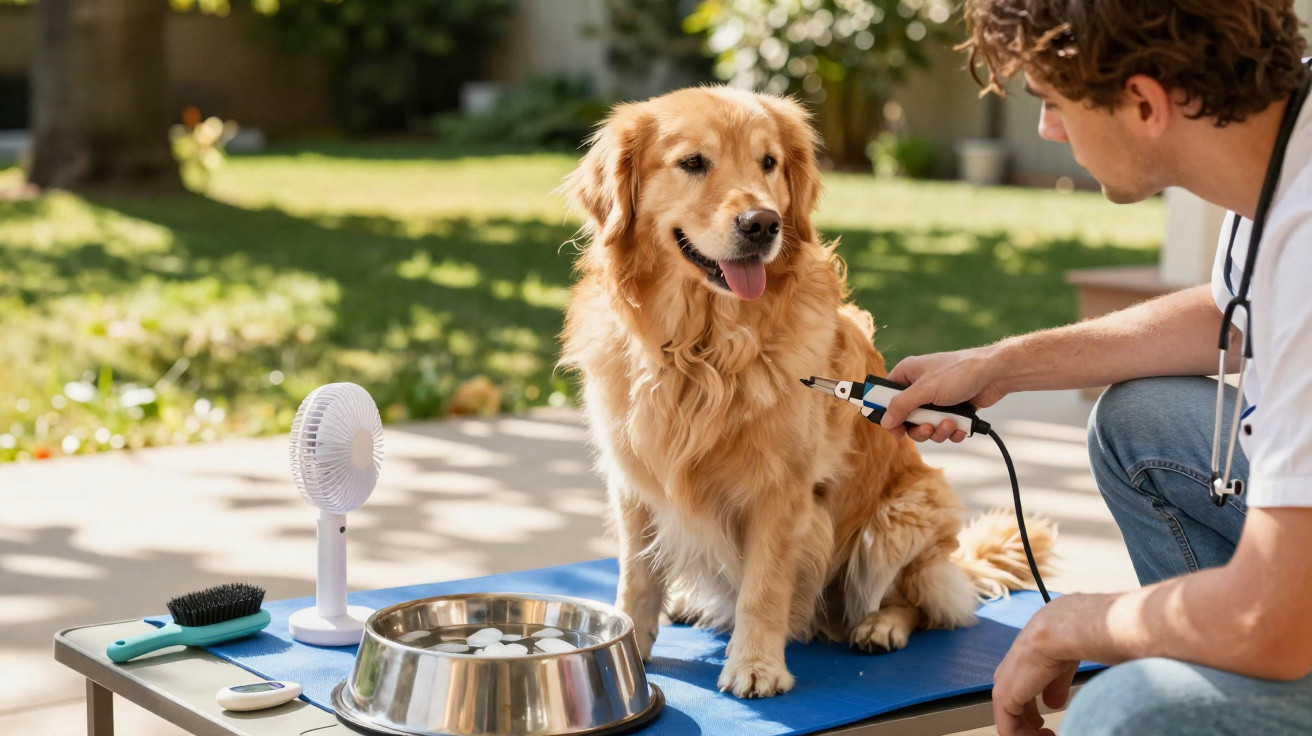
The video appears innocent enough: a golden retriever stands on a grooming table while fur drifts down like snow beneath the hum of clippers. The comments pile up: “He must feel SO much better!”, “Perfect for summer!”, “My dog needs this ASAP.”
But on a different screen, a vet is shaking her head and explaining that this very haircut can bring a dog nearer to heatstroke rather than keeping it safe. The same summer weather, the same type of dog - but two completely opposing views.
We believe we are helping, when we could actually be doing the reverse.
The surprising part is understanding why.
Why shaving a double coat can be dangerous in the heat
On a scorching July afternoon, the park provides plenty of examples. Huskies pant beneath the trees, German shepherds lie across the coolest strip of grass they can locate, while a border collie keeps pace beside a runner as though the temperature means nothing.
Then a shaved Australian shepherd passes by, with pink skin visible beneath its short stubble. People glance over and nod with approval.
“Smart idea, must be so much cooler,” someone whispers.
Yet this dog is panting more heavily than the rest, stopping more often and clinging desperately to every patch of shade. It seems to contradict what people expect.
Veterinarians and professional groomers tend to give the same advice: shaving a double-coated dog for the summer is generally a poor choice. Double-coated breeds - including huskies, shepherds, collies, golden retrievers, Newfoundlands, Akitas and Pomeranians, among many others - have two distinct layers of fur.
The thick, soft undercoat acts as insulation, while the longer guard hairs provide a protective barrier. Removing that barrier does not “free” a dog from the heat. Instead, it takes away part of its natural temperature-control system and its protection from sunlight.
It sounds backwards, rather like being told that ice cream does not cool you down.
In reality, a heavy coat does more than keep a dog warm during winter; it also helps manage body temperature in summer. The undercoat holds a layer of air close to the skin, and air provides insulation against both heat and cold.
The longer, rougher outer hairs help screen out UV rays, divert direct sunlight and move warm air away from the body as the dog walks or runs. Once the coat is shaved close, sunlight reaches the skin directly. The dog warms up more quickly, while the likelihood of sunburn and heatstroke increases.
There is a further complication: after a close shave, the undercoat can grow back unevenly or more densely than it was before. The outer coat may not recover completely. As a result, a single “summer cut” can create a long-term issue with the coat.
Safer alternatives to shaving a double-coated dog
The simplest starting point is to work with the coat rather than against it. Regular brushing that removes dead undercoat allows air to circulate through the fur again. Even this alone can make a double-coated dog noticeably more comfortable.
Many groomers use high-velocity dryers and de-shedding tools to blast out the loose fluff trapped beneath the surface. It can look spectacular - with clouds of fur flying everywhere - but the result is a lighter, more breathable coat that continues to offer protection.
Trimming a few centimetres from the feathering on the legs, belly and tail may also make cleaning and drying easier, without damaging the coat’s overall structure.
Then there is the dog’s environment. Shade, fresh water in more than one place and a cool area for resting can make an enormous difference. During a heatwave, a damp towel placed on tiles, a cooling mat or a paddling pool can be a real game-changer.
Walks should move to the early morning or later evening. If the pavement is hot enough to burn your hand, it can burn a dog’s paws. Indoor mental activities - scent games, food puzzles and trick training - can take the place of a 3 p.m. run in 35°C heat.
Let’s be honest: nobody manages all of this every day. Even so, adopting just a few heat-adapted habits can greatly lower the risk.
Most owners who shave their dogs are not irresponsible; they are concerned and have been given the wrong impression. They look at a dense coat and imagine their own discomfort in summer. On a person, a lot of hair can feel oppressive. For a double-coated dog, though, that fur is part of the animal’s cooling design.
As one veterinarian told me after seeing yet another shaved husky at her practice:
“People think they’re doing an act of love. My job is to show them that real protection can look very different from what we imagine.”
There are a small number of situations in which close clipping is appropriate: medical needs, severe matting that cannot be resolved, or surgery. Beyond those cases, most experts suggest running through the same checklist before reaching for the clippers:
- Is this genuinely a double-coated breed?
- Has the coat been cared for through regular brushing and de-shedding?
- Has the dog’s environment been adapted for summer temperatures?
- Are there health concerns - obesity, heart conditions or brachycephalic traits - that increase heat risk?
- Have you discussed breed-safe choices with a vet or professional groomer?
Reading your dog’s heat signals in a different way
Once you understand that shaving is not a magic answer, the idea of “summer care” starts to look different. You begin to notice subtler cues: how rapidly your dog pants after a brief walk, whether its tongue remains broad and dark for a long time, or if it is reluctant to leave the shade for the sun.
You realise that lying on cool tiles is not laziness, but sensible temperature regulation. You also learn that some breeds become dramatic in hot weather, whereas others keep pushing on until they are dangerously close to collapsing.
The coat is simply one part of the picture, rather than an enemy that needs shaving away.
We have all heard someone say, “He must be boiling under all that fur.” Often, the truth is the opposite: dogs are more likely to struggle when the balance between their coat, surroundings and activity levels breaks down. That might mean a long car journey without adequate airflow, a ball-obsessed border collie that will not stop playing, or a thick-coated dog left in direct sunshine “just for a bit”.
Heatstroke does not always seem dramatic at the beginning. A dog may initially appear only slightly unwell - unsteady, drooling more than usual or panting more loudly - before deteriorating rapidly. That is why vets repeat the same message almost like a mantra: prevention beats emergency every single time.
It leaves an uncomfortable question in the air.
If shaving is so often the wrong answer, how many other things do we do out of love that actually place our dogs at risk?
That question is not an accusation. It creates an opening: somewhere to speak with groomers, exchange advice with other owners and pay closer attention to the quiet warnings coming from veterinary practices.
Some readers will still be drawn to the “clean, short summer look.” Others will post photographs of their magnificent, fluffy huskies resting happily in the shade with their coats completely intact. On a hot day, those discussions may matter more than any viral grooming video.
| Key point | Detail | Why it matters to the reader |
|---|---|---|
| The role of the double coat | The undercoat insulates, while guard hairs shield the dog from the sun and help regulate temperature | Understanding why shaving can increase the risk of heatstroke |
| Alternatives to shaving | Intensive brushing, de-shedding, adapting the environment and changing walking times | Taking practical steps to keep a dog cool without harming its coat |
| Signs of overheating | Excessive panting, a very red tongue, salivation, weakness and disorientation | Responding sooner to possible heatstroke and protecting your dog |








Comments
No comments yet. Be the first to comment!
Leave a Comment