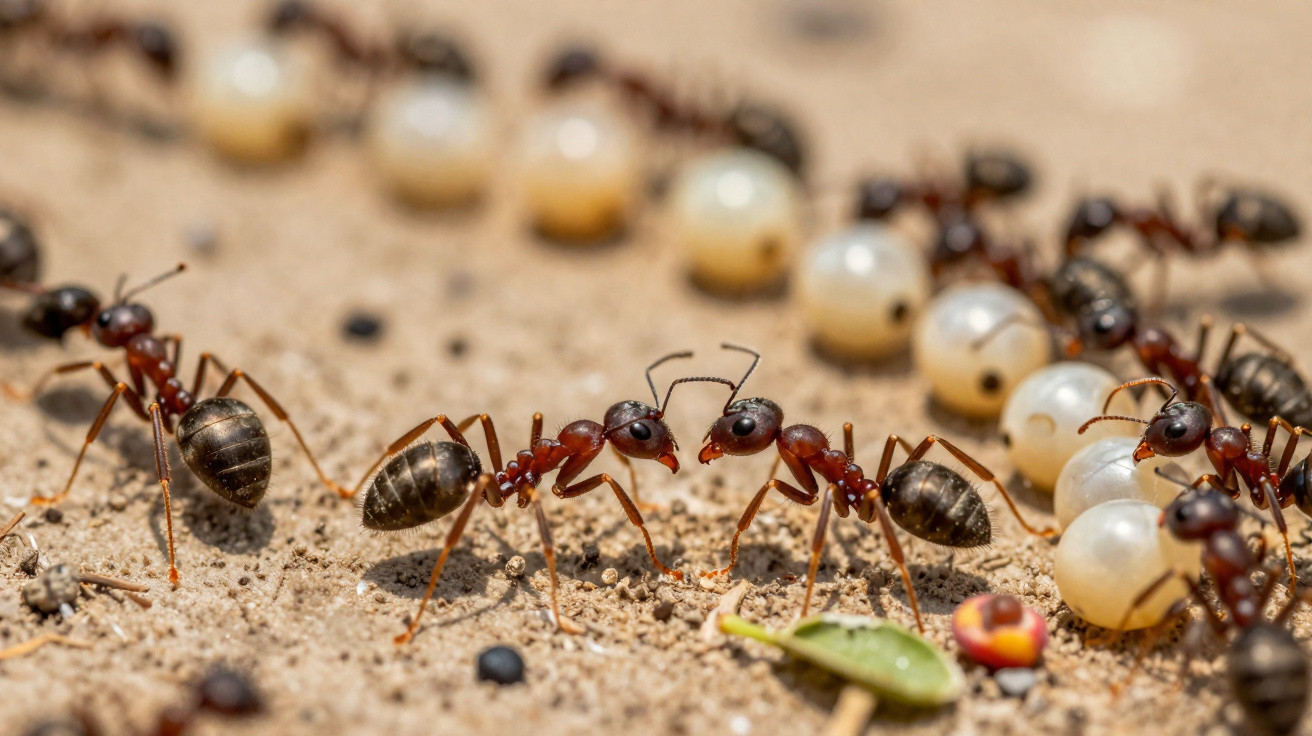
For ant colonies, distinguishing between “us” and “others” is a matter of safety and survival. Accepting an outsider can expose the nest to parasites, predators or even a hostile takeover. New research now shows that ants are remarkably capable of learning in this respect – yet their sense of genetic relatedness remains active in the background.
How ants decide who belongs
Ants do not identify nestmates by appearance; instead, they rely on scent. Their bodies are coated in a waxy layer containing chemical compounds. While the components are similar across many colonies, the proportions in the mixture vary slightly.
This “scent signature” acts like an invisible identity card. Young ants learn it early in life and later use it to distinguish allies from enemies. If another ant smells wrong, the guards attack without mercy.
Researchers show that this scent template is not a fixed programme – adult ants can alter it and learn to tolerate unfamiliar scents.
A team led by social biologist Daniel Kronauer at Rockefeller University set out to determine just how adaptable this system is. To what extent does learning matter, and how much is hard-wired into the nervous system?
Superorganism with its own security logic
Ant societies are regarded as “superorganisms”: thousands of individual animals operate much like one large body. Workers gather food, care for brood and defend the entrances. Such extensive cooperation can function only if the boundary against outsiders works reliably.
The comparison with humans is obvious. Our bodies must also constantly distinguish between “self” and “foreign”. Immune cells should attack viruses and bacteria, but not the body’s own tissue. An ant colony faces a comparable challenge at the social level: who may enter the nest, and who must be fought?
Moreover, a colony’s scent is not static. Its genetic make-up, diet, microorganisms on the body surface and newly neighbouring colonies can all alter the chemical blend. The researchers therefore asked whether an ant colony can adjust its security protocol while it is still operating.
Experiments with clonal raider ants
To test this under controlled conditions, the team used a distinctive species: the clonal raider ant (Ooceraea biroi). These ants reproduce asexually, making it possible to establish genetically identical lines and keep them separate.
This is extremely valuable for research. Scientists can create colonies with uniform genetics and then deliberately combine them with other lines. That makes it possible to establish whether behavioural differences genuinely arise from scent and experience rather than genes.
In simplified form, the laboratory procedure involved:
- Raising genetically identical lines separately
- Measuring the chemical surface profile of each line
- Introducing individual workers from unfamiliar lines into established colonies
- Recording whether attacks occurred
The initial results confirmed expectations: every line had its own scent blend, and introduced outsiders were treated aggressively, with biting and defensive displays. The scent signature clearly served as a boundary marker.
When unfamiliar ants become accepted
The experiment became more revealing when the researchers took it further. They selected very young ants, whose individual scent was still only weakly developed, and placed them permanently in unfamiliar colonies.
Over time, several changes emerged:
- The young ants’ body scent became aligned with that of their foster colony.
- The introduced ants behaved peacefully towards that colony.
- In behavioural tests, they appeared to be “genuine” nestmates.
After around one month, the adopted ants chemically smelled almost like their foster family. They also showed no aggression when tested away from the group. From a laboratory perspective, they had adjusted their social identity.
Prolonged exposure to an unfamiliar colony scent can lead an ant to accept that scent as “normal” – and to become socially integrated.
Loyalty to an ant’s own line remains
However, the system has limits. Even ants raised apart from their genetic line from the outset later recognised animals with the same genotype as “acceptable”. They did not attack those fellow ants.
This indicates that learning broadens what an ant can tolerate, but does not erase a deeply rooted, genetically anchored preference. The internal template for “my own type” remains intact.
Recognition therefore depends on a two-part system:
| Component | Role in the recognition system |
|---|---|
| Innate component | A basic sense of “one’s own line” that persists even without contact |
| Learned component | An adaptable scent template changed through repeated encounters |
Tolerance needs continual reinforcement
The researchers next separated the adopted ants from their foster colony again. The situation then shifted abruptly. After roughly one week, aggression returned, while the ants’ scent profiles began moving back towards their original pattern.
Even more strikingly, the former foster colonies increasingly resumed attacking the animals they had previously accepted. The learned tolerance was therefore not permanently embedded; it required ongoing “reminders”.
Short-term scent fatigue cannot account for this. Such effects last from minutes to hours. In contrast, the tolerant responses in these experiments continued for several days even without direct contact – but were eventually lost.
Even brief, occasional encounters with the “foreign” colony scent were enough to keep tolerance stable – evidence of long-term scent memory in the ant brain.
Parallels with the human immune system
The researchers identify an intriguing parallel with so-called immune tolerance. During allergy treatment, patients receive controlled, small doses of an allergen, such as pollen. Over time, the immune system reacts less strongly. The stimulus remains foreign, but the defensive response is reduced.
Something comparable happens among ants on a social level: repeated exposure to unfamiliar colony scents lowers their readiness to attack. Infrequent, short encounters are sufficient to maintain this state. When contact stops, the defensive response returns.
Biochemically, the immune system and an ant brain naturally work in entirely different ways. At an abstract level, however, they reveal a similar principle: a system learns not to interpret certain signals as threatening, provided the memory remains active.
Tiny brains, complex decisions
The study suggests that nestmate recognition is flexible, though not infinitely malleable. Adult ants can shift their internal idea of “belongs here” when they repeatedly encounter new scent mixtures. At the same time, they retain a deep boundary shaped by genetics.
For researchers, this opens a new avenue. If this behaviour reliably depends on learning and adaptation, the next questions can be asked: where in the tiny ant brain are these memories located? Which nerve cells store the colony scent? How does prolonged exposure alter neural connections?
What this view inside an ant nest means for us
At first glance, studies of this kind may seem highly specialised. Even so, they offer clues to broader questions: how can large groups organise themselves without descending into chaos? How do flexible boundaries form between “us” and “others”?
Humans also have social identity, group membership and boundaries. Of course, our mechanisms are cultural and psychological rather than chemical, as they are in ants. Yet the fundamental conflict is similar: groups want to cooperate without being exploited, while also remaining capable of responding to change.
Ants are equally fascinating for the biology of memory and learning. If a brain containing only a few hundred thousand nerve cells can manage complex security rules, a question follows: what minimal circuits are sufficient for this? The answer could help reveal fundamental principles of learning – including in artificial systems that must also distinguish between “permitted” and “danger”.
In practical terms, the view into an ant nest shows that, even in seemingly simple insects, belonging is not a fixed label. It emerges through an interplay of origin, experience and continually refreshed memory.









Comments
No comments yet. Be the first to comment!
Leave a Comment