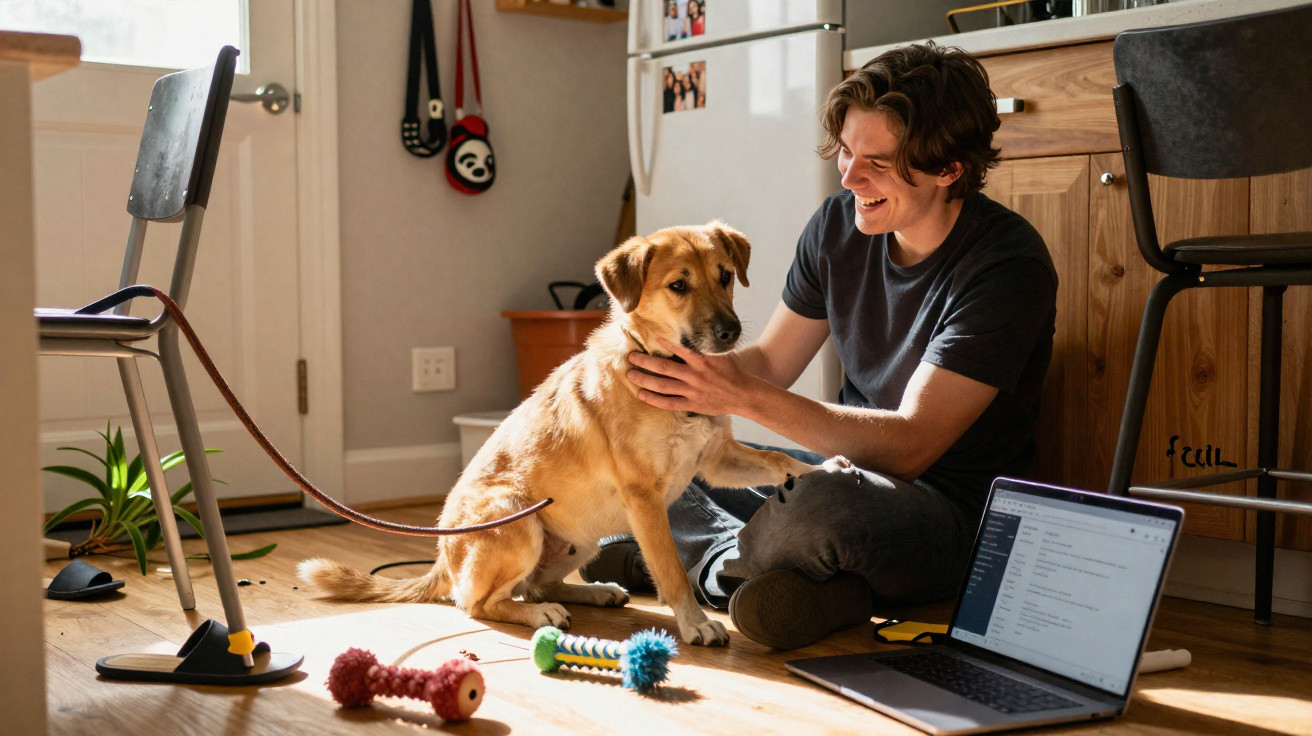
The promise is tempting: a placid, well-mannered companion who slots into a busy routine without disruption. But a few months later, amid muddy walks, ruined shoes and worried barking, that comforting description may seem like a cruel joke.
The quiet growth of the so-called “easy dog”
From marketing dream to real animal
Rescue organisations, breeders and online advertisements now regularly promote dogs as “chill”, “low-energy” or “beginner-friendly”. The implication is straightforward: select the correct label and problems will not arise. In truth, such labels conceal countless variables.
The idea of an “easy dog” usually says more about human expectations than about dogs.
A London family selected a small, fluffy crossbreed advertised as “ideal for flats, minimal exercise”. Within six weeks, the dog howled whenever they went to work, tore up cushions and clawed at the door until his paws were bleeding. The dog had not changed; their view of him had.
Every tidy description represents an individual animal with a background, genetic predispositions, fears, triggers and peculiarities. A settled puppy may become a restless adolescent. A dog described as “great with kids” may freeze around a loud toddler. Labels such as “easy”, “bombproof” and “no issues” smooth over that complexity.
How the “easy dog” myth develops
This myth often begins well before someone adopts. Friends admire a golden retriever that naps on the sofa, and soon the entire breed is considered the same. Social media intensifies this perception through charming clips of faultlessly behaved spaniels or doodles that apparently never make a mistake.
Busy households often hear the assurances they hope for. First-time owners may decide they cannot cope with a “high-energy breed” or a “difficult rescue”, then seek guarantees: low shedding, completely house-trained, a calm nature, happy to be left alone. Looking for confidence soon becomes a hunt for an imaginary dog.
When people buy the promise of zero effort, they often miss the dog standing right in front of them.
Behaviourists throughout the UK and US describe the same recurring situation: owners arrive with a troubled dog and repeat almost the identical line – “But they told me this breed was easy.”
When expectations meet reality
The divide between a label and everyday life
The surprise commonly emerges gradually, through minor but persistent difficulties that do not go away:
- a “calm” dog barking at every noise in a flat with thin walls
- a “good with everyone” dog growling as strangers pet him on a busy high street
- a “low-exercise” dog chewing furniture despite two brief walks each day
- a supposedly “tough” breed panicking around traffic or on packed trains
These behaviours do not mean the dog is bad or damaged. They reveal a mismatch between life imagined on paper and the reality of day-to-day living.
No label can predict how a dog will cope with your specific routine, housing, work hours and stress levels.
Certain breeds do have broad traits: collies often need mental stimulation, scent hounds are inclined to follow smells, and livestock guardians can be wary of unfamiliar people. However, dogs within those broad patterns differ enormously. A quiet collie may find urban bustle harder than an energetic terrier that enjoys people and noise.
The unseen cost to dogs and people
When lived experience conflicts with the original promise, owners often blame themselves before anyone else. They may feel ashamed of being overwhelmed by a dog everyone had portrayed as straightforward. Doubt sets in: “If I cannot manage this one, maybe I should never have a dog.”
Dogs also bear a substantial cost. A bored or anxious animal may develop conduct people call “naughty”: barking, pulling, guarding toys and toileting accidents. Punishment increases, walks become shorter and visitors no longer come round. Rather than deepening, the relationship contracts.
Shelter workers see how this can end. A supposedly easy dog that is not easy enough is returned with descriptions such as “too needy”, “too active” or “doesn’t settle”. The issue is seldom temperament alone; it is the space between a sales pitch and a living animal.
Beyond labels: what really makes a dog easier to live with
Three pillars that matter more than breed
Behaviour research and practical experience point to three influences that shape how manageable a dog appears at home.
| Pillar | What it means in practice |
|---|---|
| Socialisation | Gentle, early introduction to people, dogs, sounds, surfaces, vehicles and handling. |
| Exercise & activity | Daily physical movement alongside mental activities, including scent games, training and problem-solving. |
| Education | Predictable routines, compassionate training and consistent limits from every family member. |
A breed considered “difficult” can often be much easier to manage with these three foundations than a fashionable “easy” crossbreed without them.
An “easy dog” is usually a dog whose needs are understood and met, not a dog born maintenance-free.
Do not compare your dog with the neighbour’s
Owners often make comparisons. They watch another labrador walk neatly off lead and conclude their own dog must be defective because he pulls, sniffs and disregards recall. Yet the neighbour’s dog may be older, have received better socialisation or have trained every day for years.
Differences between littermates can be equally striking. One dog accepts children climbing over him, while another becomes frightened when hugged. One enjoys the park; another favours quiet streets. Treating them as interchangeable “easy” animals creates conflict for everyone.
The imperfect process of adapting together
Sharing life with a dog often requires more changes than expected. That may mean getting up early for walks before work, moving furniture to create a secure resting area or developing habits such as scattering food in grass rather than serving every meal in a bowl.
Some couples take turns with late-night outings so their dog has a final toilet break. Parents rearrange after-school plans to include the dog on certain days instead of leaving them alone for extended periods. People working remotely discover they must plan “sniff breaks” between video calls, because a restless dog will not simply wait until 6 p.m.
The relationship becomes smoother when owners adjust their lives a little, instead of trying to bend the dog entirely to human convenience.
Choosing a dog: questions that matter more than labels
Matching temperament with your actual life
Before being persuaded by claims of a “starter dog”, behaviourists recommend a more candid checklist. It concentrates on everyday suitability rather than a breed name.
- How many hours would the dog be alone on an ordinary weekday?
- Do you truly enjoy walking in rain, darkness and cold, or are you likely to avoid it?
- Is your home loud or quiet, hectic or predictable?
- Are children present, and if so, how familiar are they with recognising animal signals?
- Do you want a dog to accompany every outing, or one comfortable with a quieter routine?
Honest answers reduce the options more effectively than pursuing the “easy” label. A sensitive greyhound in a quiet flat may cope better than a lively spaniel in that same home, whatever marketing materials claim.
What shelters and ethical breeders really assess
Caring shelters and breeders can seem demanding because they take this compatibility seriously. They ask about working schedules, the number of visitors, garden fencing and plans for holidays. Instead of guaranteeing perfection, they discuss possible difficulties.
They may recommend a middle-aged dog that can already cope alone for several hours, rather than an appealing puppy requiring continual supervision. An energetic runner might be directed towards a young, active crossbreed rather than a heavier dog at risk of joint problems.
When someone takes time to question your expectations, they usually try to protect both you and the dog from a painful mismatch.
Rethinking what a “good dog” really means
Moving from perfection towards partnership
The notion of a “good dog” frequently reflects human convenience: quiet in a flat, welcoming to every stranger, comfortable when left alone and willing to stop or start on request. Such expectations overlook the fact that dogs are sentient, living animals rather than ornaments designed for our routine.
A more credible version of a “good dog” is different. It could be a reactive rescue that still barks at strangers but now calmly accepts a harness. It may be a former chewer who still needs stuffed toys to remain settled alone. Progress, rather than perfection, becomes the standard.
Learning to understand the dog in front of you
People who manage so-called challenging dogs well often have a shared ability: they observe closely. They notice ears, tail position, breathing and bodily tension. They recognise when sounds in the stairwell heighten anxiety, and when boisterous play becomes uncomfortable.
That attention produces small, practical adjustments: briefer trips to crowded cafés, leaving busy dog parks sooner, choosing more peaceful scent-walking routes and providing more rest in a crate or on a mat away from children. Minor changes can turn a supposedly “hard” dog into a companion far better suited to the home.
Becoming the right person for your dog
In time, many owners find that the question reverses. Instead of asking, “Did I pick the right dog?”, they ask, “Am I giving this dog what they need to thrive?” This change alters how setbacks are understood. A chewed shoe signals boredom rather than defiance. A growl conveys information, not a personal affront.
No dog arrives fully compatible with human life; they learn. So do we.
For some families, this learning means seeking professional support: training courses, individual behaviour consultations, veterinary examinations for pain or owner groups dealing with similar challenges. Such help can turn unclear guilt into useful action.
Additional factors many owners never hear about
The overlooked influence of health, pain and genetics
Many behaviours considered “difficult” have medical causes beneath them. A dog that snaps when touched may be experiencing joint pain. An older dog that suddenly toilets indoors could have kidney or hormonal problems. A young dog that never settles may be living with persistent itching or digestive discomfort.
Early veterinary checks, suitable nutrition and realistic expectations about breed-related risks, including joint disease, breathing difficulties or deafness, can contribute more to a harmonious home than any supposed training shortcut. A seemingly “easy” puppy from poorly selected parents may develop lifelong physical problems that make behaviour difficult to manage.
Small everyday practices that make any dog feel easier
A number of straightforward routines tend to help, regardless of a dog's breed or history:
- serving part of every meal through puzzle toys or scattering it in grass to meet natural foraging instincts
- creating a consistent daily rhythm, with comparable times for walks, rest and play
- teaching dependable cues such as “settle”, “leave” and “come” through rewards rather than punishment
- providing a secure area where neither children nor visitors interrupt the dog
- offering regular, unhurried sniff-walks instead of only quick, rushed circuits around the block
These practices will not transform every animal into a storybook “easy dog”. They offer something more realistic: a structure in which real dogs, with genuine needs, can settle. As stress reduces, behaviour improves and the companion people hoped for begins to emerge – not due to a label, but because the arrangement finally suits both sides.









Comments
No comments yet. Be the first to comment!
Leave a Comment