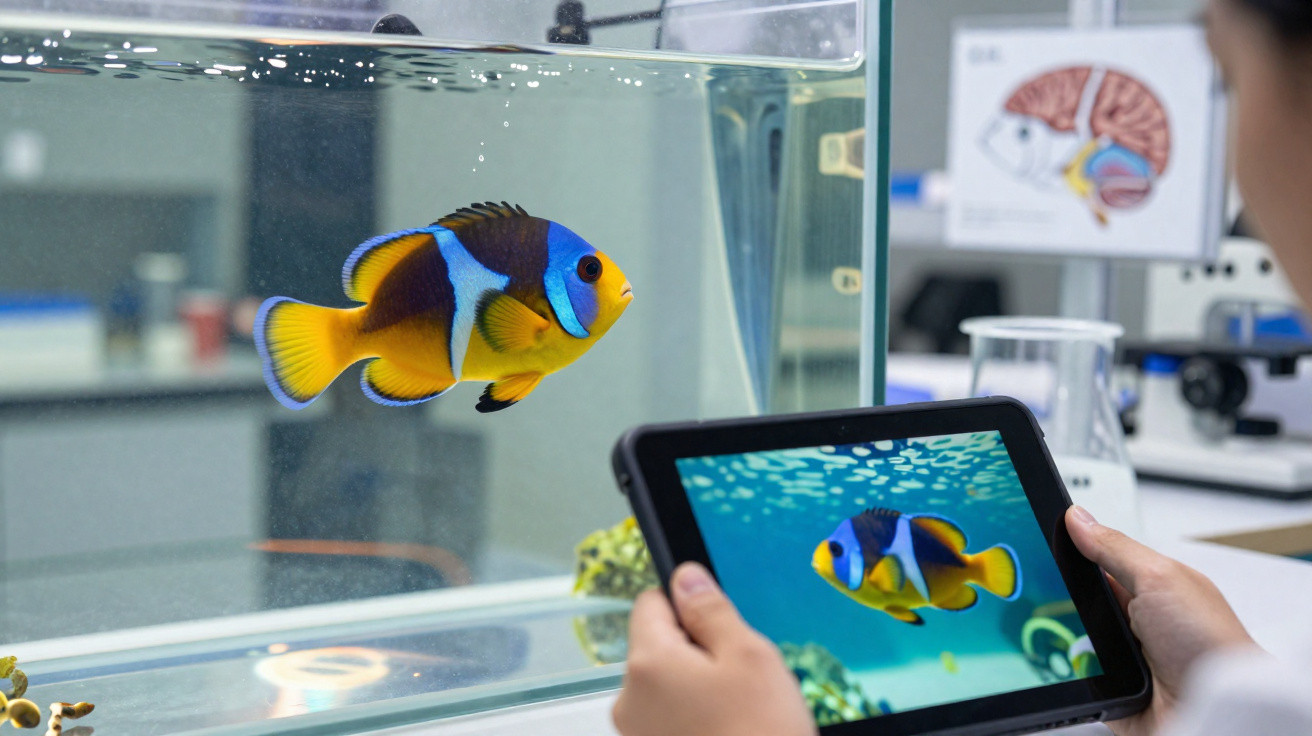
A small, inconspicuous fish is forcing behavioural biologists to reconsider how intelligence is ranked in the animal kingdom. The cleaner fish, scarcely 10 centimetres long, can complete a test once regarded as the preserve of chimpanzees, dolphins and crows – and it uses a mirror in a way nobody had expected from a fish.
The science behind the famous mirror test
Since the 1970s, the mirror test has been a landmark method in behavioural research. Its principle is straightforward: it is intended to establish whether an animal recognises itself.
- A visible mark, such as a coloured spot, is placed on the animal without its knowledge.
- The animal is then shown a mirror.
- If it deliberately responds to the mark on its own body, researchers treat this as evidence of self-recognition.
For a long time, only a small number of species succeeded: certain great apes, dolphins, elephants and particular birds, including magpies. Many animals considered highly intelligent, however, did not pass. Gorillas, for example, avoid eye contact and often disregard their reflection. Dogs are more interested in smells than mirrors and pay little attention to coloured marks in their fur.
This is precisely why criticism of the mirror test has grown for years. Perhaps it measures not so much self-awareness as an animal's interest in visual stimuli and its way of responding to mirrors. A team from Japan and Switzerland has now examined that question particularly rigorously in a fish.
Cleaner fish as test subjects – and playful experimenters
The new study centres on Labroides dimidiatus, the familiar cleaner fish of tropical coral reefs in the Indo-Pacific. It survives by picking parasites from the skin of other fish. This requires a strong memory, social skills and a sharp eye for detail.
Researchers from Osaka and Neuchâtel fundamentally altered the mirror test. Rather than immediately applying a mark, they first allowed the fish extended time to become familiar with a mirror. The animals could explore their reflection calmly, without pressure or a task to complete.
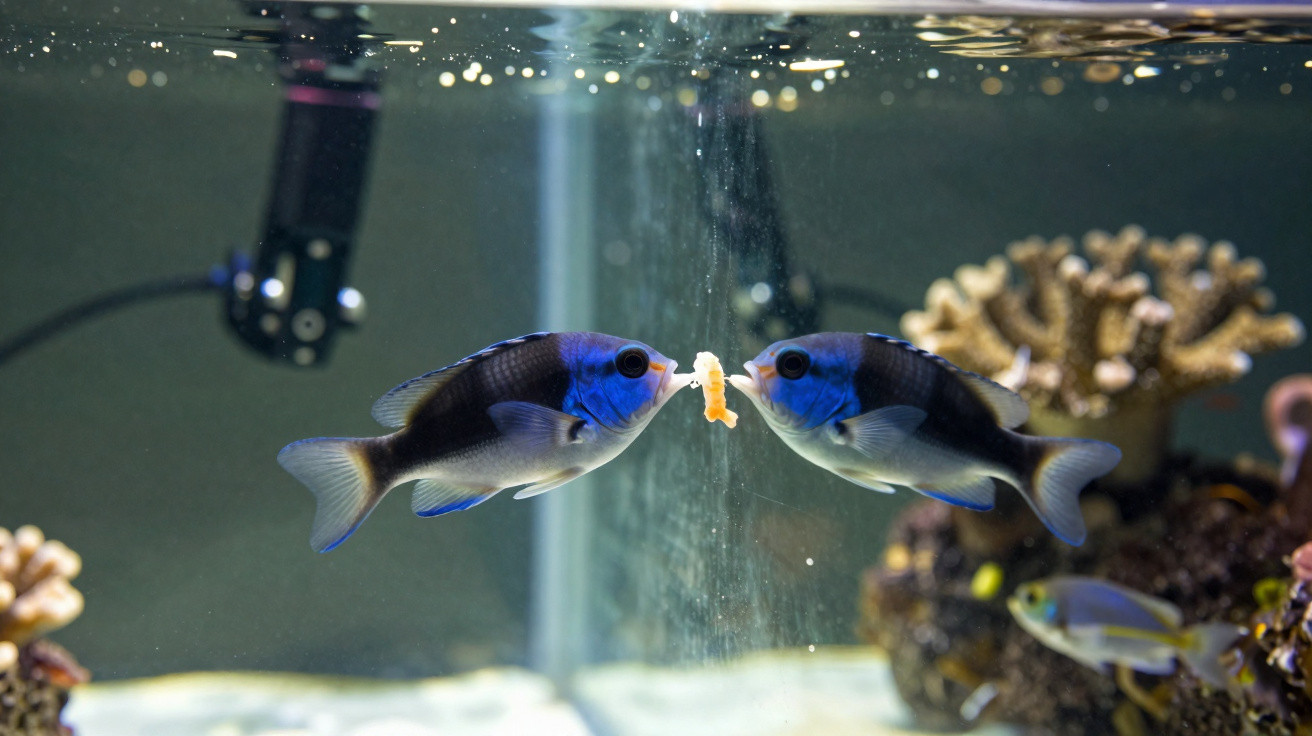
The small reef inhabitant did not merely watch itself in the mirror; it used the mirror experimentally as a tool.
The cleaner fish soon displayed complex behaviour: they swam back and forth in front of the mirror, turned around and tried unusual body positions. Most strikingly, some dropped food – small prawns – directly in front of the mirrored surface, then carefully watched the pieces appear to drift downwards “in the mirror”. They apparently used this to test how the reflection related to real space.
17 of 18 fish pass the standard mirror test
Only after this familiarisation phase did the conventional task begin. The 18 cleaner fish received a coloured mark on their throats, a location they could not see without a mirror. They were then given access to the mirror again.
The result was clear: 17 of the 18 fish directed their behaviour towards the mark.
- They positioned themselves before the mirror so that their throats were clearly visible.
- They changed their viewing angle with great precision.
- Some subsequently rubbed their throats against the floor or rocks.
On average, it took the animals only about 82 minutes to react to the mark. Mammals sometimes take considerably longer. The researchers interpret this as evidence that the fish linked the spot in the mirror with their own throats.
The cleaner fish appears to understand: “That in the mirror is me – and something is wrong there.”
Self-recognition in photographs too
The study went further still. In an additional phase, the researchers investigated whether the fish could recognise themselves not only in a mirror but also in still images. They photographed the heads of the test animals and used several versions:
- A photograph of their own face without a mark
- A photograph of their own face with a brown spot
- Photographs of unfamiliar fish, both with and without a spot
Six of eight fish reacted noticeably whenever a photograph showed their own face with an added spot: they again sought contact with solid surfaces and displayed the characteristic rubbing behaviour seen after the mirror test. By contrast, photographs of unfamiliar marked fish produced little reaction.
This suggests that the animals possess a stable internal representation of their own appearance. In other words, they may not simply react spontaneously to a reflection, but retain their “self” as something recognisable.
What cleaner fish mean for ideas about consciousness
Until now, many specialists assumed that something resembling self-awareness emerged relatively late in evolution, in animals with large brains, a complex neocortex and pronounced social structures. Yet bony fish diverged from other vertebrates around 450 million years ago. Their brains look very different from those of mammals.
If a fish of all animals performs well in the mirror test, that challenges this established account. There are two obvious possibilities:
- Self-recognition is far older than previously believed and developed early among vertebrates.
- Alternatively, comparable abilities evolved independently in different animal groups – in effect, invented more than once.
In the case of the cleaner fish, there is much to support the second explanation. Its way of life creates intense social pressure: it must recognise individual “customers”, remember their responses and manage in cleaning stations where space is extremely limited. Those that behave skilfully have an advantage.
Social intelligence could be a driving force behind the development of self-recognition – in the sea as well.
Limits of the test and fresh questions
Despite the impressive findings, important questions remain. The mirror test assesses only one very specific ability: linking bodily sensation with a visual self-image. It reveals nothing about what it “feels like” to be a fish, whether it reflects on itself or whether it has a sense of self comparable to that of a human.
Specialists therefore caution against too quickly equating cleaner fish with primates. Even so, the result requires established hierarchies to be reconsidered, with mammals placed at the top and fish far below. The more closely researchers study how different species perceive the world, the clearer it becomes that intelligence takes many forms.
What “self-recognition” means in biology
In everyday language, consciousness often refers to personal experience, emotions and inner monologues. In biology, the terms are more narrowly defined. They generally concern specific abilities, such as:
- navigating through space and distinguishing one's own body from the surroundings
- using tools deliberately to achieve a goal
- planning and adapting one's own actions
The cleaner fish now fulfils some of these criteria with surprising clarity. It uses the mirror as a tool to inspect a part of its body that would otherwise be out of sight, then adapts its behaviour accordingly.
Implications for research and animal welfare
The study raises not only scientific questions but practical consequences too. If even a small reef-dweller possesses a form of self-recognition, it prompts renewed consideration of how fish are treated – in aquariums, fisheries and laboratories.
Behavioural biologists now expect similar experiments to begin with other fish species, reptiles and invertebrates. Cuttlefish and octopuses in particular have long been seen as candidates for unexpectedly complex mental abilities. The cleaner fish may therefore be the starting point for an entire wave of new studies.
For non-specialists, the main lesson from these findings is simple: the boundaries in the animal kingdom often lie elsewhere than we imagine. Whether on a coral reef, in a forest or on a farm, many animals make nuanced decisions, remember details and pay close attention to what happens to their own bodies. The small cleaner fish of the reef shows just how easily appearances can mislead us.












Comments
No comments yet. Be the first to comment!
Leave a Comment