Open windows, warm rooms and evening light: to spiders, an ordinary home can seem like a comfortable hotel. They squeeze through the tiniest gaps and end up in bedrooms or above the sofa. Chemical insect sprays make the air unpleasant and pose an unwelcome risk where children or pets live. That is why an old garden plant that cats love and spiders hate is now making a quiet return.
Why window sills attract spiders
Particularly in autumn, when nights turn colder, spiders look for sheltered, dry and reasonably warm places. Homes provide exactly these conditions. They also contain plenty of insects drawn to lights around windows and doors.
Their usual route indoors is almost always the same: up an exterior wall, along the window frame, through narrow gaps or cracked seals, and finally straight into the room. Unless anything changes along this “spider motorway”, they are effectively being invited inside.
Research into essential oils indicates that certain powerful scents confuse spiders and curb their urge to explore. They avoid places where an aroma is too strong or unfamiliar. This is precisely the principle behind the old idea of creating a “scented barrier” at windows and doors.
“With a few pots containing the right plant, you can create an invisible scented wall that often stops spiders before they cross the threshold.”
The secret star: catnip as a natural spider deterrent
The traditional trick mainly relies on an unassuming perennial: true catnip, botanically known as Nepeta cataria. A member of the mint family, it is related to mint and lemon balm, and grows easily in gardens or pots across Central Europe.
Many people know catnip only as an intoxicant for feline friends: quite a few cats become briefly excited near the plant, rubbing against it or rolling on the ground. The substance responsible is called nepetalactone. This same compound has also attracted the attention of insect researchers.
Studies, including research published in the Journal of Economic Entomology, show that catnip extracts have a strong repellent effect on several spider species, especially so-called wolf spiders. In trials, the animals chose areas scented with catnip far less often.
Concentrated extracts of the plant even produced a repellent effect of up to 100 per cent against ticks for several hours, comparable with DEET, the standard chemical active ingredient. For practical use on window sills, the whole plant is sufficient, as it continuously releases its essential oils into the air.
Why spiders dislike this scent
Spiders do not smell in the same way as people. They have sensitive sensory hairs on their legs and bodies that detect chemical stimuli. Strong, unfamiliar aromas can disrupt their navigation system and mask signals from prey or other spiders.
When a spider reaches an area with an intense catnip scent, it functions as a disturbance zone. Many spiders turn away and instead choose a calmer route with a more “neutral” smell. To people, catnip has a mild herbal fragrance, somewhat like a blend of mint and lemon; to spiders, it is more like a red traffic light.
How to position catnip effectively against spiders
For this old-fashioned method to work, the key is not individual plants but the layout: an unbroken line of scent at the usual entry points.
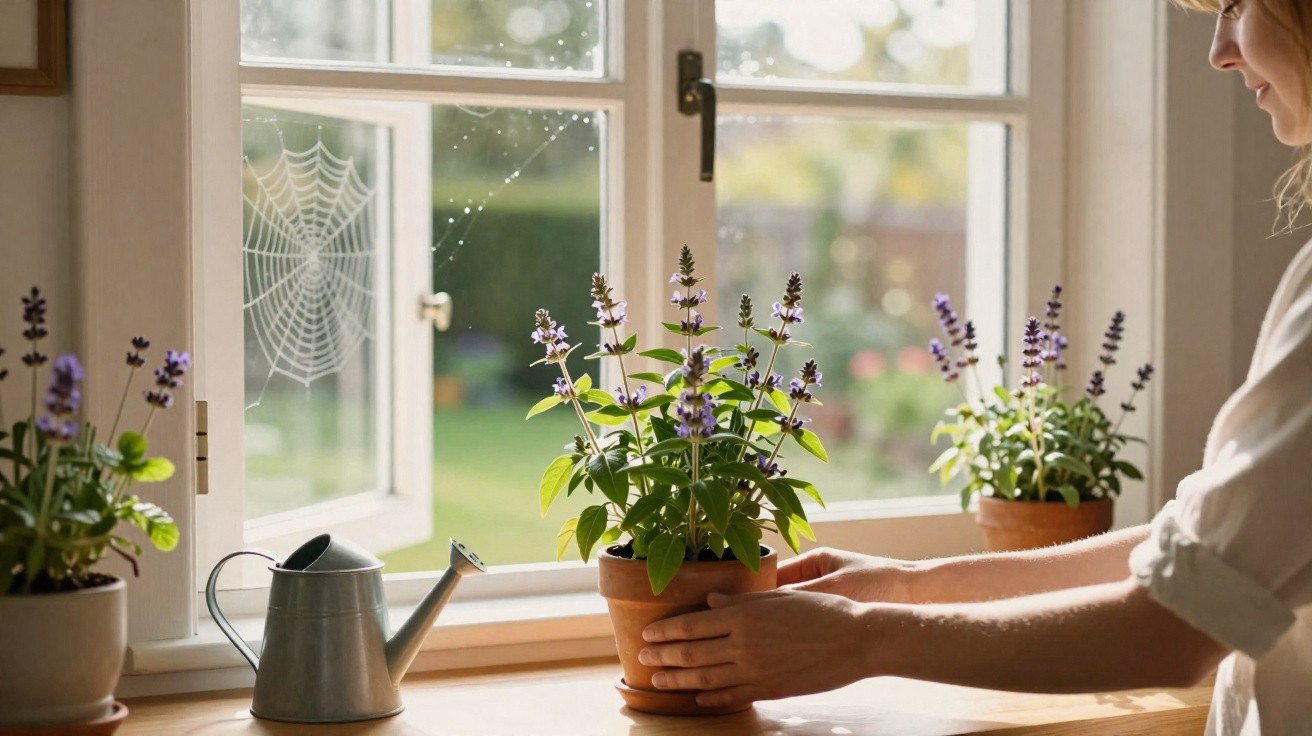
- External window sills: Place 2–4 pots at each window, positioned side by side with as few gaps as possible.
- Balcony and patio doors: Put planters on the left and right of the doorway, ideally extending them into a longer row.
- Basement steps and side entrances: Position pots directly beside the door frame.
- Air vents and light wells: Place catnip very close by, without obstructing ventilation.
The more densely the plants surround an area, the more complete the scented barrier becomes. In multi-storey homes, prioritise entrances that are frequently left open or illuminated.
“You achieve the greatest effect when there is no gap between the house wall and the first ‘scent pot’ that spiders can simply walk through.”
Catnip in pots: low-maintenance protection for windows and doors
Catnip is considered hardy and is well suited to beginner gardeners. It copes with many conditions, provided a few basic rules are followed.
Position, compost and watering
- Position: Full sun to partial shade. It will grow on completely shaded window sills, but will flower less and produce a weaker scent.
- Growing medium: Loose, free-draining and not too heavy. Standard potting compost mixed with a little sand or fine gravel is entirely adequate.
- Watering: Keep it evenly moist, while avoiding waterlogging. It is better to water thoroughly once than to give small amounts constantly.
- Containers: Use pots with drainage holes so excess water can escape.
To overwinter potted plants, place them against a sheltered house wall or cover them lightly with horticultural fleece on very frosty days. In garden beds, catnip is considered surprisingly frost-hardy.
Sowing and care through the year
There are two ways to get started: buy young plants from a nursery or sow seeds.
- Press seeds roughly 3 millimetres deep into seed compost.
- Keep the growing medium lightly moist and do not allow it to dry out.
- At normal room temperature, seeds generally germinate within 7 to 9 days.
- Once seedlings have two to three pairs of true leaves, prick them out into individual pots.
Anyone with established plants can divide them in spring. A root ball can usually be split in half easily with a sharp spade or knife. Replant both sections to extend the spider barrier around windows quickly.
How much protection does catnip really provide – and what are its limits?
Although research shows clear effects, catnip is not an invisible wall guaranteed to keep every single spider outdoors. The aim is a noticeable reduction in visits, rather than complete exclusion.
If there are exceptionally large numbers of spiders indoors, it is also worth checking for possible entry gaps:
- porous silicone seals around window frames
- open cable entry points
- cracks in brickwork
- basement windows that are permanently left on the latch
There is another consideration: some people are sensitive to essential oils. Anyone prone to headaches or irritation should first try only a few pots before filling every window sill. With cats, most animals love catnip, some do not react at all, and very few dislike it; the response varies individually.
Smart combinations with other plants
Many home remedies for spiders depend on powerful scents. Several species work well together in pots and can complement one another:
| Plant | Typical scent | Suitable location |
|---|---|---|
| Catnip (Nepeta cataria) | Herbal, slightly lemony | Window sills, balcony, patio door |
| Lavender | Floral, intense | Bedroom windows, outdoor seating areas |
| Peppermint | Fresh, strongly mentholated | Kitchen windows, basement steps |
| Rosemary | Resinous, Mediterranean | Balcony planters, entrance area |
Combining these plants creates a kind of “mixed-scent zone” that spiders find particularly difficult to assess. Those keeping sensitive pets should ensure they do not nibble unsupervised on every plant: while most of the listed species are considered relatively unproblematic, no animal tolerates large quantities well.
What spider-friendly households should consider
Spiders are useful hunters that catch mosquitoes, flies and other pests. Many people do not want to kill them; they simply do not want them directly beside the bed. Catnip is ideal in this respect, because it tends to drive the animals away rather than destroy them.
If spiders are found indoors, they should, where possible, be carried outside using a glass and a piece of paper rather than handled directly. Experts repeatedly point out that spiders do not normally attack actively, but can bite when they feel threatened.
Combining physical removal indoors with a scented barrier at windows and doors offers a reasonable compromise: fewer spiders inside, while plenty of beneficial creatures remain outside in the garden or around the house.
Practical everyday examples
Those living, for example, in an older property with plenty of cracks often do best by starting with the hotspots: bedroom windows, bathroom windows, and the balcony or patio door. Put catnip pots in these places first, then observe whether the situation improves after a few weeks.
For ground-floor flats surrounded by greenery or with hedges in front of the building, it can be worthwhile combining catnip on the window sill with herb beds directly in front of the façade. This forms a broader belt of scent that spiders are less keen to cross.
Households with children or cats gain an additional benefit: the plant can be used for tea, provides a pleasant fragrance on the balcony, and occasionally gives four-legged companions an exciting sensory experience, while spiders prefer to keep their distance.













Comments
No comments yet. Be the first to comment!
Leave a Comment