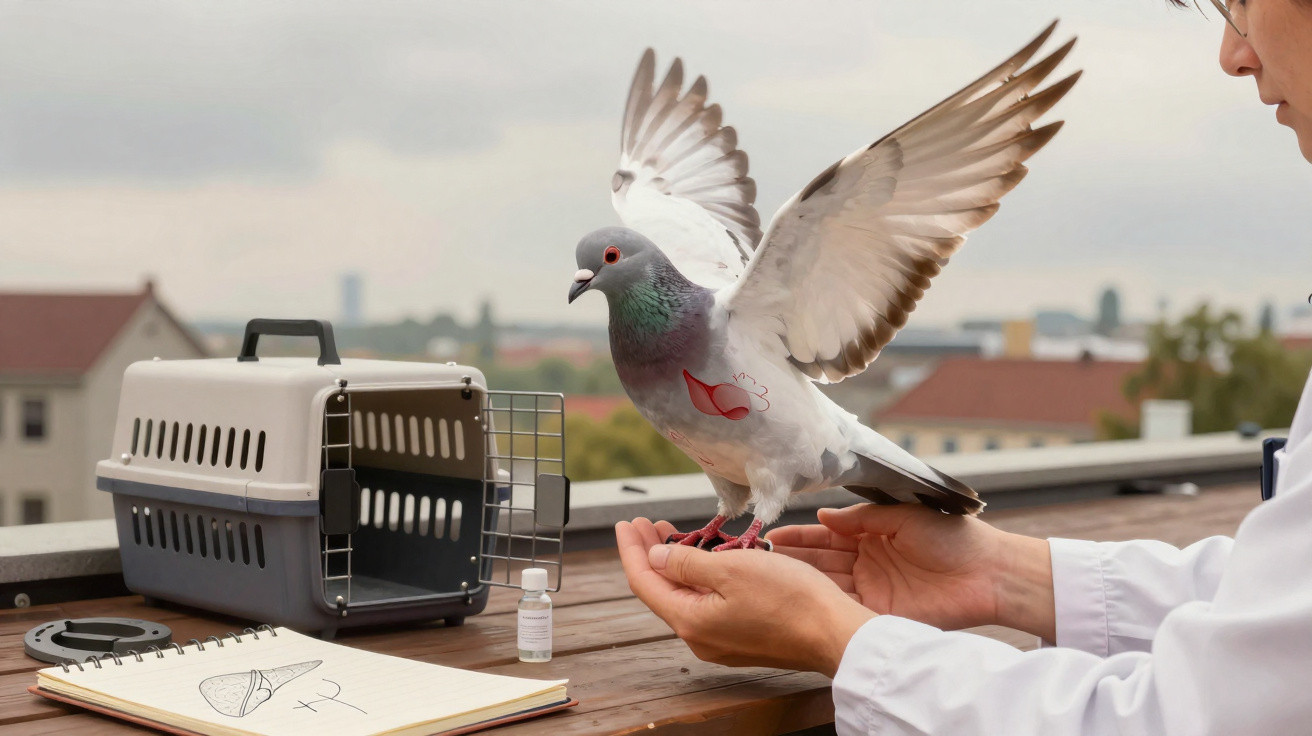
For millennia before internet messaging existed, people valued and bred pigeons for their remarkable ability to return home from enormous distances while carrying a note fastened to a leg.
The cultural significance of ‘pigeon post’ reaches back at least to 1350 BCE, when these birds appeared in ancient Egyptian artwork. For centuries, they represented humanity’s most dependable means of communicating over long distances.
Until the invention of the telegram, homing pigeons (Columba livia domestica) delivered innumerable major business agreements, romantic letters and wartime reports that altered the course of human history. Yet, despite relying on these exceptionally capable birds for so long, we have not understood why their homing ability is so extraordinarily precise, or where their powerful internal compass is located.
Homing pigeons and Earth’s magnetic field
For decades, researchers have proposed that pigeons, like various other animals and birds, may use Earth’s magnetic field for orientation. A team at Germany’s University of Bonn and the Max Planck Institute of Animal Behavior (MPIAB) now says it has found evidence for this idea.
"What looks like a 'gut feeling' in bird navigation may actually have a physical basis," says biologist Martin Wikelski, director at MPI-AB and a senior author on the paper.
Their findings suggest that the homing pigeon’s internal compass could be situated in the liver, which contains high levels of iron.
"We had some clues that the liver and spleen have magnetic properties, because they break down red blood cells and so store much iron in the body," says immunologist Clivia Lisowski from the University of Bonn.
More precisely, the researchers believed that iron-rich macrophages - specialised white blood cells - in the liver could contribute to navigation. More unusually still, these macrophages have a quantum characteristic known as superparamagnetism, which could function as a compass ‘needle’ in an unexpectedly literal way.
A quantum liver compass linked to the brain
The birds appear to possess the necessary system to ‘read’ such a compass. When the scientists examined pigeon liver tissue under a microscope, they identified nerve fibres able to transmit signals from macrophages to the pigeons’ brains.
Although the Sun usually provides pigeons with a clear directional cue, the researchers suspected that these internal quantum liver compasses become particularly valuable when skies are overcast.
To investigate, they released 34 homing pigeons 19 kilometres from their home at MPIAB and assessed their ability to return in cloudy conditions. On the day before the flight, 18 birds received an injection of clodronate, a drug that eliminates macrophages and therefore disrupts the connection between the immune cells in pigeons’ livers and the neurons that convey signals to the brain.
Pigeons that did not receive clodronate reached home within 70 minutes of being released. Those separated from their quantum liver compass, however, became completely disoriented.
"None of the clodronate-treated birds returned on the same day under persistent overcast conditions, instead displaying random spatial orientation," the authors report.
Overcast conditions reveal the pigeons’ navigation system
Once the clouds dispersed and sunlight returned, the clodronate-treated pigeons navigated home as usual. Their capacity for flight, motivation and overall health remained unaffected.
When the team repeated the test on a sunny day, pigeons given clodronate found their way home without difficulty. This indicates that the liver’s ‘internal compass’ may be most crucial when the Sun is unavailable as a guide.
Many species cover vast distances without a map: sharks travelling through the dark depths of the ocean, migratory birds crossing continents, nocturnal bats and blind mole rats. Future work may establish whether they are also steered by quantum immune cells directly connected to the brain.
"Animal navigation is one of the most fascinating phenomena in nature," says Wikelski.
"If immune cells are part of how birds sense direction, it would fundamentally change how we understand navigation."
The research is published in Science.












Comments
No comments yet. Be the first to comment!
Leave a Comment