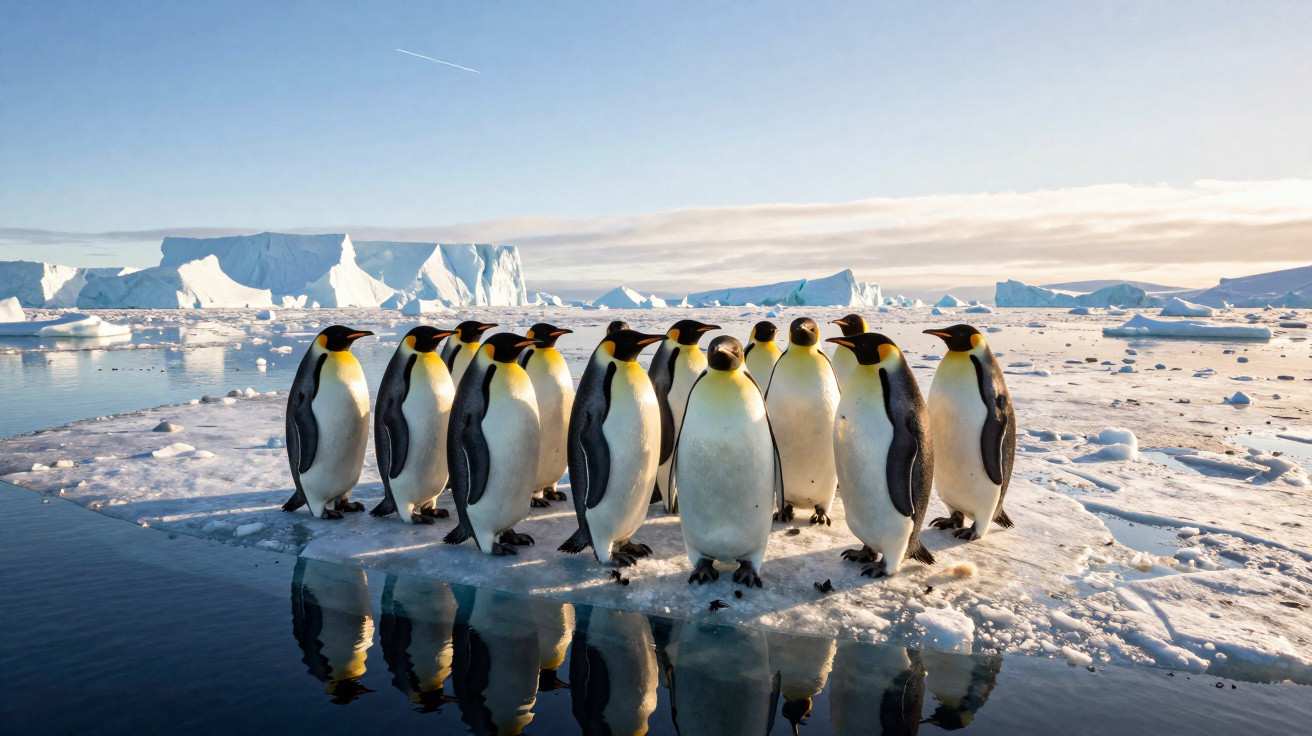
Scientists have uncovered a previously unseen summer phase in the emperor penguin life cycle, during which hundreds of moulting groups assemble on sea ice in West Antarctica.
The finding identifies a further risk for adult birds: the ice beneath them may fracture before they have regrown the waterproof plumage required to enter the sea safely.
Signs on the sea ice
On an isolated section of Marie Byrd Land in West Antarctica, brown patches repeatedly appeared on summer sea ice in an area where emperor penguin moulting had never previously been recorded.
Peter Fretwell of the British Antarctic Survey (BAS) compared these marks with clearer satellite imagery and demonstrated that they represented groups of moulting penguins, rather than discoloured or fractured ice.
Over the period covered by the study, the distribution of the groups shifted with the condition of the ice: they dispersed when stable habitat was available and became concentrated when it was scarce.
The work therefore provided more than a record of the birds' location, revealing how rapidly this refuge can become hazardous.
Why the timing of emperor penguin moulting matters
During the moult, a period of several weeks in which penguins replace all their feathers, adults lose the waterproof layer that usually shields them.
They cannot feed at sea during this time, instead fasting on the ice as replacement feathers emerge and their energy reserves gradually decline.
Entering freezing water before the process is complete increases heat loss, exposure to predators and the likelihood of a delayed recovery before breeding.
Disruption at this point is especially severe, as adults need to restore their physical condition before returning to their colonies.
A disappearing ice platform
For penguins in the Ross Sea, south of New Zealand, coastal fast ice - sea ice attached to the shore - is generally the safest summer platform.
Tracking data showed that some adults travel roughly 1,000 kilometres in each direction between breeding colonies and these moulting areas.
In years with more extensive ice, birds occupied large platforms and formed smaller groups separated by greater distances.
When summer ice becomes thinner, however, that room vanishes rapidly and many birds are pushed towards the same surviving margins.
Searching satellite images for moulting groups
On a single day in 2024, medium-resolution imagery identified 16 brown marks over approximately 47 square kilometres of sea ice.
Higher-resolution commercial images detected 18 groups within the same area, with 15 corresponding to the lower-resolution observations.
The missed detections were largely very small clusters or patches beside cracks, where broken ice obscured the distinctive staining pattern.
This comparison gave the researchers sufficient confidence to examine imagery from seven complete summers for moulting groups.
When the ice retreated
As summer ice collapsed between 2022 and 2024, the pattern of penguin groups along this coast altered quickly.
Near Marie Byrd Land, late-summer ice coverage dropped from around 500,000 square kilometres to 100,000 square kilometres in 2023.
With only about 2,000 square kilometres of coastal ice remaining, groups clustered more closely, with some likely containing several thousand birds.
Ice breakup began before moulting was finished, changing overcrowding from a difficulty into an immediate threat to survival.
A further threat to emperor penguins
When coastal ice broke into fragments, some penguins briefly remained on drifting floes, although these ice rafts often broke apart within days or weeks.
At this stage, contact with water can cause hypothermia - a dangerously low body temperature resulting from excessive heat loss - because partially grown feathers still allow warmth to escape.
Birds that survive may nevertheless reach their breeding colonies late and in poor condition, potentially reducing both mating success and winter survival.
“Emperor penguins already faced a myriad of threats, and the loss of molting sites is yet another pressure,” said Dr. Fretwell.
The 2025 disappearance
By 2025, the satellite images suggested something more unusual than crowding: most birds had apparently vanished.
That year, researchers recorded only 25 small groups, compared with 247 in 2023, despite the return of suitable ice.
Some birds were seen farther east on more stable ice, extending an already demanding journey by around 150 kilometres.
It remains unknown whether the absent groups moved elsewhere, died or dispersed across sites too small to be detected.
The wider effects of losing adults
Seven Ross Sea colonies contain as much as 40 percent of the global population, so adult losses in this area could have effects far beyond a single coastline.
Elsewhere in Antarctica, early sea-ice loss caused breeding failure at four of five colonies during the 2022 season, according to satellite imagery.
Figures from another sector subsequently indicated a 22 percent regional decline since 2009.
Those previous alerts focused on breeding, yet adult survival is even more significant because emperor penguins are long-lived and reproduce slowly.
What satellites can track
From space, moulting emperor penguins create a staining pattern that reveals a stage of life scientists seldom observe directly.
The same high-resolution images also identified hundreds of seals near ice cracks, suggesting the area may be a broader moulting hotspot.
Small penguin groups can still be missed in lower-resolution imagery, while these images cannot provide a count of every individual bird.
More detailed imagery or surveys from aircraft could establish whether this coastal strip contains most Ross Sea adults or only a proportion of them.
Rather than simply exposing a hidden emperor penguin stopover, satellites showed that shrinking ice may affect adults during their most vulnerable weeks.
Future counts at breeding colonies may establish whether the missing moulting birds reappeared elsewhere or failed to return altogether.















Comments
No comments yet. Be the first to comment!
Leave a Comment