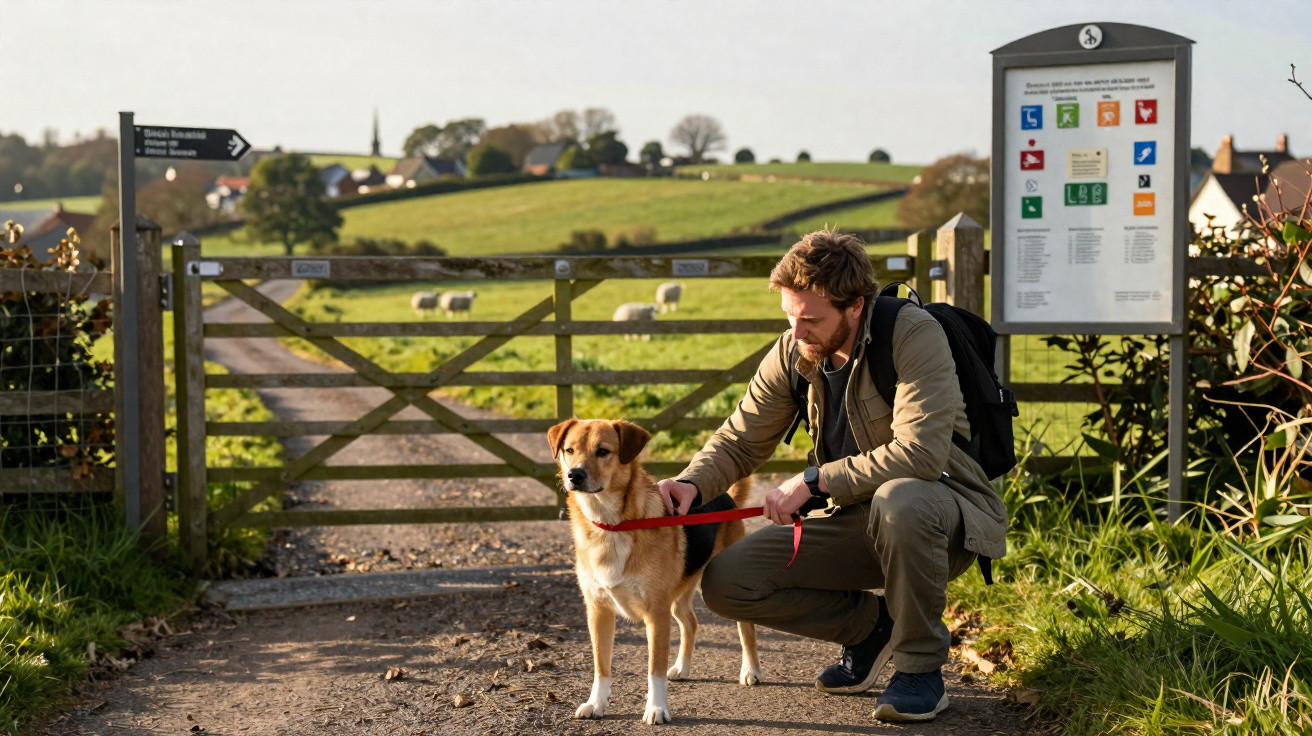
Anyone holidaying in England or Wales with a dog, visiting relatives or living there should take particular care. From mid-March 2026, substantially stricter rules will apply to walks in the countryside. They particularly affect routes across rural tracks, past sheep grazing land or alongside cattle herds – and a mistake could have painful financial consequences.
What exactly is changing under the new dog law
The Dogs (Protection of Livestock) (Amendment) Act 2025 will come into force on 18 March 2026. It updates legislation dating back to 1953, when far fewer people spent their leisure time in the countryside and dog ownership looked very different.
At its heart, the legislation significantly tightens the rules for dogs near livestock and raises the penalties considerably. The UK Government aims to relieve pressure on farmers and prevent animal suffering, while still allowing people to enjoy walks – provided they show greater consideration.
The legislature makes one thing clear: anyone who cannot control their dog near livestock faces an enormous financial risk.
When your dog may already be breaking the law
Perhaps the most important point for all owners is this: a dog does not have to bite a sheep before it causes legal trouble. The law can apply much earlier.
- It is enough for a dog to chase sheep, cattle or other livestock.
- Even simply frightening or disturbing animals can constitute an offence.
- A brief sprint by a dog towards a herd may be regarded as “worrying”.
In other words, even a friendly family dog that “just wants to have a look” can create a problem. Animals may become stressed, pregnant sheep can miscarry, and cattle herds may panic and bolt. These are precisely the consequences targeted by the new rules.
Does it apply only in fields? Not at all
The new law is not restricted to traditional arable fields or remote rural grazing land. Its scope extends much further:
- Paths and roads running alongside grazing land are included.
- Publicly accessible footpaths at the edge of fields are also covered.
- Protection applies not only to sheep and cattle, but also to llamas, alpacas and other camelids.
So, anyone walking a popular long-distance trail at the weekend, or stopping briefly while driving along country roads, may be directly within the scope of the new requirements.
Livestock protection will now apply wherever dogs can come close to animals – no longer only in the everyday setting of a farm.
Unlimited fines: what could happen in a serious case?
Until now, the maximum fine for “worrying” livestock was £1,000. That ceiling will disappear entirely. In future, courts will theoretically be able to impose any amount they consider appropriate.
There may also be further consequences:
- Liability for the costs of catching and keeping the dog.
- Wider police powers, including the ability to enter private property.
- Seizure of the dog where there is a risk of further incidents.
The message is clear: the authorities mean business. Dog owners are expected to think twice before allowing their four-legged companion to run free near grazing animals.
Why the penalties are so severe
Reports of sheep being killed and calves injured by loose dogs have been increasing in England and Wales for years. For farmers, this brings not only emotional distress but genuine financial loss. An attack on pregnant animals can cost several unborn lambs at once. Often, the owner cannot be traced, or the previous penalty has had little deterrent effect.
The new provisions are intended to draw a firm line: anyone who fails to control their dog should feel the consequences clearly in their wallet.
What visitors and families with dogs should now consider
Although the law applies to England and Wales, it affects many visitors from German-speaking countries. Whether taking a city break with a trip into the countryside, staying in a coastal holiday cottage or hiking through national parks, people often bring their dog with them.
Anyone travelling to Great Britain with a dog should make using a lead a fixed habit as soon as livestock is in sight.
Practical tips for safe walks in everyday British life:
- Keep your dog on a lead as soon as sheep, cattle, llamas or alpacas can be seen in the distance.
- Do not let it off “just for a moment”, even by a fence or gate – one sudden dash is enough.
- Where hill crests and hedges obstruct the view, use a lead as a precaution.
- Explain to children that throwing sticks towards grazing land is off limits, so dogs are not tempted.
For extra reassurance, practise recall and walking on a loose lead before travelling. Reliability is invaluable in an unfamiliar country with unknown paths.
A new protection clause for responsible dog owners
Among the tougher measures, the law also offers a clear concession to responsible dog owners. It provides a possible defence if, for example, the dog escaped without the owner’s knowledge or was stolen. If it can be shown that the dog was in someone else’s possession during the incident, the actual owner is not automatically held directly responsible.
Those who secure their dog carefully, have it microchipped and remain vigilant should not have to suffer because of someone else’s criminal conduct. The new rules therefore seek to penalise recklessness without placing every dog owner under general suspicion.
What this could mean for handling dogs in Germany
While the legislation applies only in England and Wales, it highlights a trend gathering pace in many countries: greater owner responsibility, stronger livestock protection and stricter sanctions for carelessness.
Germany already has a range of rules designed to protect grazing animals. Breaches generally fall under animal welfare law or regulatory offences. Yet distressing images of sheep killed after dog attacks still appear repeatedly. The tougher British approach could prompt debate in Germany over whether penalties are high enough and whether police need comparable powers.
Why even “well-behaved” dogs can pose a risk
Many owners say: “My dog would never do that.” The difficulty arises when instinct takes over. The scent of a flock of sheep, lambs running about or one animal fleeing can all trigger chasing behaviour, even in family dogs that are otherwise exceptionally calm. A single thoughtless moment is enough.
In England and Wales, the law will no longer act only once a sheep is bleeding. Chasing, driving or scattering a herd in panic is already relevant, because animals can be harmed or injured as a result.
Key terms relating to the new law explained
To make the rules easier to understand, here are several key terms in plain English:
| Term | Meaning in context |
|---|---|
| Livestock | Farm animals such as sheep, cattle, goats, pigs, llamas and alpacas |
| Worrying | Disturbing, chasing or pursuing livestock – even without a bite |
| Unlimited fine | A financial penalty with no fixed statutory upper limit |
| Seizing a dog | Authorities taking possession of a dog to prevent further incidents |
Keeping these points in mind makes it easier to assess how serious the new situation is – and which situations with a dog in England and Wales should be avoided at all costs.
Dog walks can remain a highlight for families, couples and solo travellers, including in Britain. With a little more attention, a reliable lead and respect for livestock, they can stay that way – without a hefty fine landing on the doormat in the end.














Comments
No comments yet. Be the first to comment!
Leave a Comment