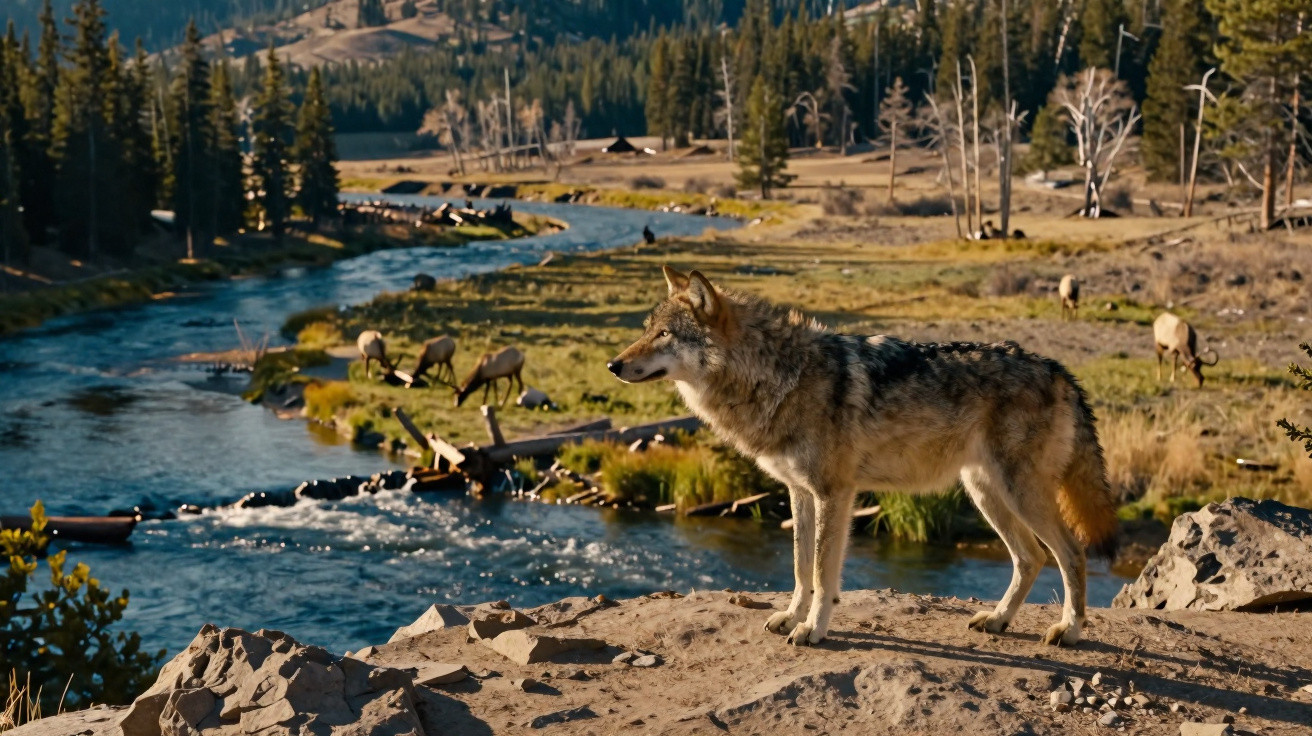
In a frozen valley in the western United States, an old protagonist has returned to the spotlight as the unexpected focus of scientific debate.
Since wolves were reintroduced to Yellowstone in the 1990s, it has become almost conventional wisdom that they saved the park. The appealing story goes like this: the top predator returns, controls the elk, trees recover, beavers come back and the rivers “fix themselves”. Yet a closer examination of the evidence, alongside the views of field researchers, makes that account more complicated. Wolves remain a key part of the picture, but are far less heroic than many reports have implied.
From villain to symbol of ecological balance
Yellowstone, which stretches across Wyoming, Montana and Idaho, saw wolves subjected to intense persecution throughout the 20th century. Eradication campaigns, bounties and poison all but removed the predator from the landscape. As a result, elk populations - a large deer species - increased sharply and grazed unchecked in sensitive locations.
The resulting pressure on vegetation, especially along riverbanks and in marshes, depleted willows, poplars and other young trees. With less plant cover, whole habitats became poorer. Broadly speaking, this version of events is well supported by the historical record.
In the 1990s, US environmental agencies brought wolves from Canada and released several packs in the park. Within a few years, the first images appeared to show an almost cinematic effect: fewer elk, more trees, and the return of beavers and birds associated with wetlands.
“The return of wolves was turned into a perfect storyline: one predator restoring an entire ecosystem, almost like nature’s reset button.”
The account became a textbook example in documentaries, biology lessons and reports about “ecological cascades” - where change at one level of the food chain spreads through the others. Gradually, however, further studies began to suggest that the story was not so straightforward.
When the evidence challenges the Yellowstone wolf narrative
In more recent assessments, ecologists have revisited the figures underpinning Yellowstone’s “wolf revolution”. The central criticism does not deny that environmental changes occurred, but questions how those changes were measured and understood.
Several studies used the height of willows and poplars as a marker of vegetation recovery. In some cases, however, comparisons were made between different sites rather than within the same plot over a number of years. That makes it difficult to establish whether there was truly a sharp increase in growth, or simply a selection of more favourable places for measurement.
Another concern is the conversion of straightforward data into complex indices without independent validation. When height, diameter and plant-density measurements are combined into a single figure, small inaccuracies can create the appearance of enormous changes.
“Researchers warn that, if the method overstates the scale of recovery, wolves may receive credit that should perhaps be shared with other factors.”
Climate also plays a part. Milder winters, shifts in rainfall and snowfall, and changes to river regimes affect plant growth and food availability. Untangling the impact of wolves from this natural variability is a considerable challenge.
Elk decline: wolves, hunters, climate and more
A central element of the narrative is the fall in elk numbers. The logic appears simple: predators return, prey populations decline and plants recover. Field counts, though, point to a broader set of influences.
- Wolf predation: wolves mainly kill weaker or younger animals, affecting the behaviour and movement of herds;
- Human hunting outside park boundaries: this reduces herds that cross Yellowstone’s borders;
- Other predators: bears and cougars also hunt elk, particularly calves;
- Harsh weather in some years: this raises winter mortality and reduces food supplies;
- Habitat changes: fires, forest management and hydrology alter where and how much elk can graze.
Once all these variables are considered, wolves still have a relevant effect, but are no longer the sole explanation. Some models indicate that, during certain periods, human hunting and severe winters influenced herd size as much as - or even more than - wolves did.
Beavers, trees and rivers: uneven recovery
Beavers became an emblem of Yellowstone’s “ecological revolution” because they rely on willows and poplars to build dams. With more trees along riverbanks, the animals were expected to return in large numbers, recreating ponds and wetlands.
More recent field research presents a patchier picture. In some stretches, particularly where water levels stay higher throughout the year, vegetation has genuinely become stronger and beaver numbers have increased. Elsewhere, the effect has been far more modest.
Some of this variation is explained by local conditions, including stream depth, soil compaction and fire history. In many locations, wolf numbers do little to change plant availability if rivers fall too low in summer or banks were already severely eroded in the past.
| Component | Wolf-related factor | Other relevant factors |
|---|---|---|
| Elk population | Direct predation and altered behaviour | Hunting, climate, other predators |
| Riverside vegetation | Less grazing in high-risk areas | River levels, soil, fires |
| Beavers | More willows in some stretches | Water depth, severe cold, disease |
Heroes? Symbolic, not miraculous
Most scientists who have reassessed the Yellowstone wolf story agree on one point: the predator matters, but it is not magical. Wolves redistribute fear and risk across the landscape. Elk avoid open valleys at certain times, herds move around more, and places that were once overgrazed may get some respite.
At the same time, there is no evidence that the park has undergone a simple “before and after” transformation. In many areas, trees remain short, beavers are still scarce and rivers follow courses similar to those seen in the wolf-free era. In others, change is clear, but it has unfolded over decades and is intertwined with management policies, climate variation and human influence beyond the park.
“Wolves help stitch balance together, but the fabric of the ecosystem is made from many threads, including human political and economic decisions.”
This more cautious perspective also changes how conservation stories are presented to the public. Relying on a single “saviour” oversimplifies problems that are often structural: land use, tourism pressure, legal and illegal hunting, and climate change.
What the debate teaches us about conservation
Yellowstone has become an open-air laboratory for a question relevant to managers around the world: how far can the reintroduction of large predators repair past damage? On one hand, cases such as the wolves show that restoring a key species can trigger meaningful adjustments, including economic ones such as wildlife-watching tourism.
On the other, the experience highlights several practical risks:
- creating expectations of rapid outcomes in ecosystems that may take decades to respond;
- overlooking local communities, such as cattle farmers, and creating conflicts that undermine future projects;
- focusing resources almost entirely on one charismatic species while neglecting less visible processes, including soil and water quality.
For Brazilian readers, the debate echoes discussions about jaguars in livestock areas, sharks on reefs and even caimans in wetlands. In each case, a large predator becomes a political and media symbol, while genuine recovery depends on a broad package of measures: ecological corridors, hunting controls, enforcement, compensation for producers and careful monitoring.
Terms worth noting
Two concepts occur frequently in research on Yellowstone and can help make the debate clearer:
Trophic cascade is the term for a chain effect that begins at one feeding level and extends to others. A classic example is when predators reduce herbivore numbers, relieving plants from feeding pressure and, in turn, changing shelter and food availability for other species.
Keystone species describes a species whose presence or absence has a disproportionate effect on an ecosystem. It is not necessarily the most abundant species, but it is often one that drives numerous interactions. In Yellowstone, wolves are strong candidates for this label, although current research indicates that their impact is interwoven with many other factors.
When considering future scenarios, researchers are already modelling what might happen if further climate changes alter the duration of snow cover in the park or tourism pressure rises even more. In some models, wolf populations remain stable, but elk herds change their routes and move closer to areas outside the park where hunting is permitted. This could once again reduce the reach of the predator’s influence within Yellowstone.
These exercises show that, even when a large predator recovers, conservation work continues. Monitoring data, adapting management policies and keeping public debate open are the steps that determine whether a reintroduction is remembered as a story of balance or of quiet frustration.









Comments
No comments yet. Be the first to comment!
Leave a Comment