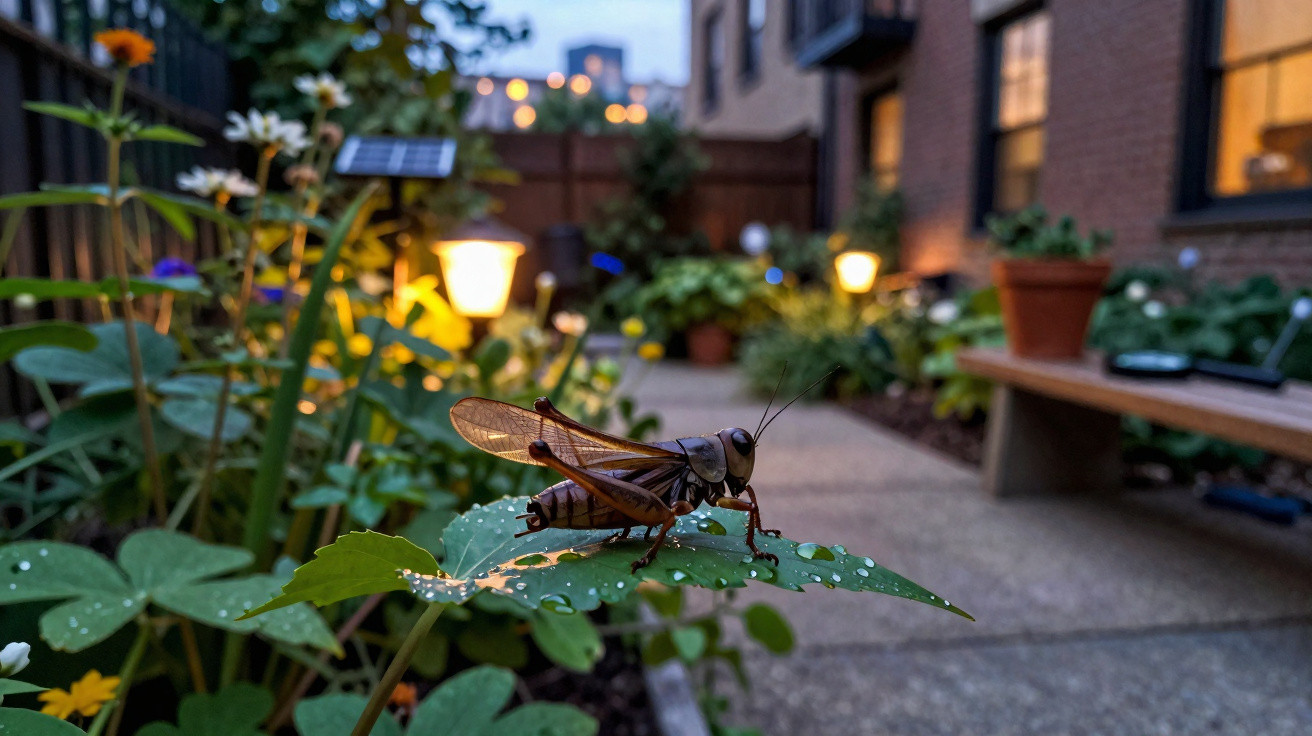
The steady sound of crickets on warm nights suggests that your garden has an excellent environmental balance. These small insects act as genuine guardians of urban biodiversity, showing that nature is operating healthily in your garden.
Why do crickets sing at night?
For the Gryllidae family, the familiar nighttime cricket song is an essential means of communication and reproduction. Males use this rhythmic chirping to draw the attention of females, acting as a real romantic advertisement within the ecosystem.
The constant noise heard in the grass signals that the surrounding area provides ideal conditions for these creatures to survive. When insects find secure shelter, they display their natural behaviour through this distinctive call of nature.
Here are some of the main features of these animals' behaviour:
- Stridulation: The mechanical process used to create the melody.
- Habits: Sound-making activity occurs mainly at night.
- Attraction: The song's principal purpose is to attract reproductive partners.
- Environment: It shows that the garden has healthy, protected vegetation.
- Territory: It also warns other males to keep their distance.
How do crickets produce their distinctive sound?
Contrary to popular belief, crickets do not use their voices to sing. Males rub their forewings together to create stridulation, producing remarkable sound vibrations that travel very easily throughout their private green space.
On the underside of the wings is a row of microscopic teeth known as a file. Sound is made when the hard edge of the other wing, called the scraper, moves rapidly across this structure, forming a highly efficient biological percussion mechanism.
To see in detail how this microscopic process takes place in the insect's wings, you can watch the explanatory video published on the Deep Look YouTube channel:
How do female crickets respond to this nighttime song?
Female crickets do not have the musical structures on their wings and are therefore entirely silent. They are attracted by the strength of the melody, using specialised hearing organs in their front legs to find their way to a mate.
Unique hearing
Tympana in the legs
Unlike vertebrates, females hear through structures called tympana, located below their front knees.
This distinctive anatomy enables them to tune precisely into the frequency of the male's song in the darkness.
As the female approaches, the male changes the musical tone to a far gentler courtship melody. This subtle whisper reassures the mate and provides the final confirmation needed for successful mating on the lawn.
Following a successful approach, the reproductive cycle proceeds through these natural stages:
- Quiet sounds: The song becomes softer to preserve the pair's privacy.
- Egg laying: The female uses her long ovipositor to place eggs in the soil.
- Natural wear: Over time, the male's wings wear down and his sound becomes hoarse.
What are the different types of cricket songs?
Scientists have found that crickets have a varied musical repertoire for dealing with different everyday situations. Beyond the familiar courtship call, these small creatures can produce complex sound signals according to the presence of other individuals in their shared territory.
When two males encounter one another on the same shrub, their tone shifts to a loud, aggressive rivalry song. This display warns the intruder and protects the space, demonstrating that sound communication is a vital survival strategy.
The species' principal mechanical vocalisations can be grouped into the following categories:
- Calling song: Used to attract distant females on warm nights.
- Rivalry song: Produced to drive away competing males and defend the area.
- Courtship song: A soft, whispered melody performed close to the mate.
Why is the presence of crickets positive for your home?
Hearing these insects near the patio suggests that the residential environment is free from harmful chemical pesticides. They serve as bioindicators of ecological quality, confirming that the garden's plants and soil provide excellent sustainability for wildlife.
They also help control pests by eating small larvae and organic debris. Understanding this phenomenon makes it easier to appreciate nature's small signs, confirming that hearing this nighttime sound represents an excellent balance in your urban garden.

















Comments
No comments yet. Be the first to comment!
Leave a Comment