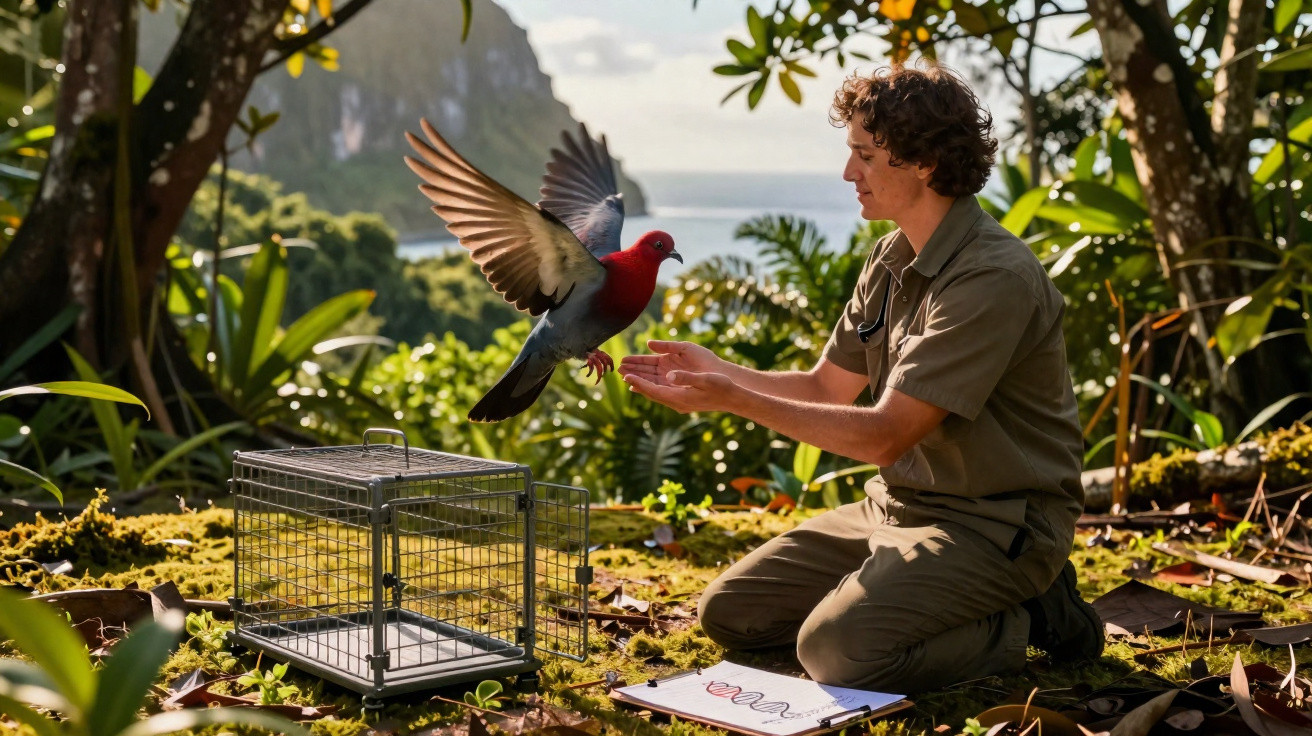
More than 1,000 kilometres south of Tokyo, far from the main tourist routes, a small miracle has unfolded within only a few years. A pigeon species that was close to being wiped out is returning to the forest canopy because people have consistently kept another domestic animal out of the wild. This conservation success is not solely the result of determined protection efforts: it also rests on a remarkable genetic trait.
A remote paradise thrown out of balance
The Ogasawara Islands sit in the middle of the Pacific, a long way from mainland Japan. Their nickname, the “Galapagos of Japan”, is well earned: the archipelago supports numerous animal and plant species found nowhere else. Among them is the red-headed pigeon, a subspecies of the Japanese wood pigeon, recognisable by its vivid red head and grey body.
For thousands of years, these birds lived largely undisturbed in the dense evergreen forests. That changed when settlers arrived during the 19th century. Forests were cleared, settlements were established and domestic animals were introduced. What initially seemed harmless - a few cats here and several dogs there - gradually became disastrous for species that nest close to the ground.
Some of the introduced cats became feral, hunted independently and found the pigeons easy prey. Across their evolutionary history, the birds had never learned how to deal with such capable predators. Their escape responses were inadequate, while their nests were all too accessible.
On Chichijima Island, the red-headed pigeon population fell to only around 80 birds - a collapse that brought it to the brink of extinction.
131 cats captured - and the population turns around
By the early 2000s, biologists had reached a bleak assessment. The pigeon population had become so small that recovery barely seemed possible. Every additional cat and every breeding bird lost could have pushed the species beyond the point of recovery.
The turning point came in 2010. Japanese authorities launched a large-scale programme to control feral cats on Chichijima. Teams systematically located the animals using traps, bait and night-vision equipment.
- Period of the operation: 2010 to 2013
- Cats captured and removed: 131 animals
- Island focus: chiefly Chichijima in the Ogasawara archipelago
Only a few years after the campaign began, the trend reversed - this time in the pigeons’ favour. According to a study published in Japan, researchers had counted 966 adult red-headed pigeons and 189 young birds by the end of 2013. In a short period, a handful of survivors had once again become a stable population.
That a species under such severe threat could almost increase tenfold in little more than a decade is considered exceptional in conservation biology.
Why the red-headed pigeon is genetically unusual
However, cat trapping explains only half the story. Extremely small populations are normally regarded as genetically risky: extensive relatedness often leads to inherited disorders, lower fitness and a vicious circle of inbreeding followed by further decline.
Researchers at Kyoto University therefore closely examined blood and tissue samples from red-headed pigeons. Their DNA analyses produced a surprising finding: more than 80 per cent of the genetic material is homozygous, meaning it is identical on both chromosomes. This points to a long period of mating between closely related individuals - a nightmare for many species.
For this pigeon, the opposite appeared to be true. In a study published in 2025, scientists found substantially fewer harmful mutations than in closely related pigeon species with wider distributions. Over many generations, a process of “genetic purging” seems to have occurred: debilitating mutations gradually disappeared from the gene pool because affected animals reproduced successfully less often.
What the “purging effect” means in practice
Put simply, the population was small but genetically strikingly robust. Crucial functions - including the immune system, fertility and life expectancy - remained intact. Tests on captive red-headed pigeons revealed neither shortened lifespans nor an unusual susceptibility to disease, both of which would be expected with severe inbreeding.
The species passed through an extremely narrow bottleneck without losing its basic vitality - an evolutionary high-wire act without a fall.
What this case means for conservation worldwide
Many conservation programmes follow a rule of thumb: a small population means high risk, while genetic impoverishment means red alert. The red-headed pigeon case requires specialists to view that rule with greater nuance.
On islands that have remained isolated for long periods, species may adapt over millennia to living in small populations. Researchers have already identified similar patterns in the island fox of California and the Seychelles magpie-robin. Despite their low numbers, these animals appear remarkably resistant to inherited damage.
The picture is different for Mauritius’s pink pigeon. It originally possessed far greater genetic diversity, yet despite intensive care it continues to struggle with health problems and fluctuating population levels. The comparison demonstrates how important it is to examine a species’ genetic history closely.
- Historical population size
- Length of isolation
- Severity of earlier bottlenecks
- Number and type of harmful mutations
Anyone managing threatened species must now give these factors greater weight. There is no universal formula. In some cases, strictly controlled and slightly increased relatedness may even help to remove harmful genes more quickly. In other circumstances, it would be extremely dangerous.
Targeted action rather than blanket intervention
The Ogasawara Islands example also demonstrates how effective relatively limited interventions can be when they address precisely the right pressure point. Authorities did not set up an expensive breeding programme or begin large-scale relocations. Instead, they primarily removed an outside disruptive factor - the feral cat - from the system.
Such measures are naturally controversial. Many people feel emotionally attached to cats, whether they are pets or strays. In some countries, fierce debates have continued for years over how far the reduction of free-roaming cats may go in order to protect threatened bird species.
The Japanese case provides a strong argument for acting early: the sooner invasive predators are contained, the less drastic the intervention needs to be. If action is delayed until a species is on the threshold of extinction, the usual choice is between severe measures and permanent loss.
What non-specialists can take from this story
Many of the terms used in this context initially sound highly technical. Here is a brief explanation:
- Inbreeding: Mating between closely related animals. It can work in the short term, but creates a high long-term risk of inherited disorders.
- Genetic diversity: Variation within a species’ genetic material. It helps species adapt to changing environmental conditions.
- Genetic purging: A process in which harmful mutations are filtered out over many generations.
- Bottleneck: A period in which a species has very few individuals. Those that survive this phase have a major influence on its future genetic makeup.
This also matters in everyday life with our pets. Pedigree dogs with an extremely narrow breeding base show what can go wrong when inbreeding takes place without natural selection: hip damage, heart defects and eye problems. The red-headed pigeon represents, in a sense, the opposite example - millennia of selection in the wild, without human ideals of appearance or behaviour.
For the protection of other species, Ogasawara therefore offers two clear lessons. First, it is worth examining genetics before launching large-scale programmes. Second, relatively small and clearly defined interventions in the relationship between prey and predator can have an enormous impact - if the species concerned has sufficient hidden resilience in the background.









Comments
No comments yet. Be the first to comment!
Leave a Comment