Many owners are startled when their cat appears about to be sick, then deposits a compact, often furry clump on the carpet. These incidents become especially common in spring. Such unusual ‘packages’ are caused by a very typical feline process – yet the digestive tract does not always cope smoothly. Understanding what happens inside a cat’s abdomen makes it possible to take targeted action and avoid serious complications.
What really happens inside your cat’s abdomen
Cats are champions of grooming, often spending several hours a day caring for their coats. Their rough tongues comb through every hair, and they inevitably swallow some fur in the process. Under normal circumstances, it passes through the intestines with food and ends up in the litter tray.
The picture changes considerably in spring. As the days become longer and brighter, the major shedding season begins. The winter coat loosens, leaving loose hairs throughout the fur. During grooming, these hairs enter the mouth, are swallowed and accumulate in the stomach.
During the shedding season, a cat can swallow several grams of hair each day – considerably more than the intestines can eliminate without difficulty.
If the intestines can no longer cope with this amount, the hairs clump together into dense masses. Specialists refer to them as ‘trichobezoars’; more commonly, they are simply called hairballs. These clumps irritate the stomach and are eventually retched up and expelled.
When hairballs are normal – and when they are not
For many cats, bringing up an occasional hairball is part of everyday life, particularly in spring. It becomes a concern when this stops being an exception and becomes routine. This may mean that the digestive tract is overloaded or that a problem is already developing.
- Once or twice a month: usually harmless, especially during shedding season
- Several times a week: a warning sign; preventive measures are needed
- Frequent retching without producing anything: a possible indication of constipation or a blockage
If hairballs become lodged in the intestines, they can cause painful constipation and, in extreme cases, a complete obstruction. What seems like a harmless grooming issue can then become an emergency.
Warning signs: symptoms that must not be ignored
Before hairballs cause significant trouble, they often reveal themselves through subtle changes. Owners who know their cat well will usually spot these signs quickly.
Common warning signs in daily life
- Vomiting episodes occurring more often than before
- Retching without anything coming up
- Constipation, or very hard and infrequent stools
- Noticeably little faeces in the litter tray
- Dull behaviour, withdrawal and little interest in play
- Poor appetite or refusing food
- A sensitive abdomen or a defensive reaction when touched
A cat should see a vet at the latest when several of these signs occur at once, or when its condition worsens within a day or two. Particularly at risk are young, very affectionate long-haired cats that groom constantly, as well as older cats whose digestion is already slow.
Those who act early not only spare their cat pain, but may also prevent an expensive operation.
Brush instead of tummy trouble: coat care as the key prevention
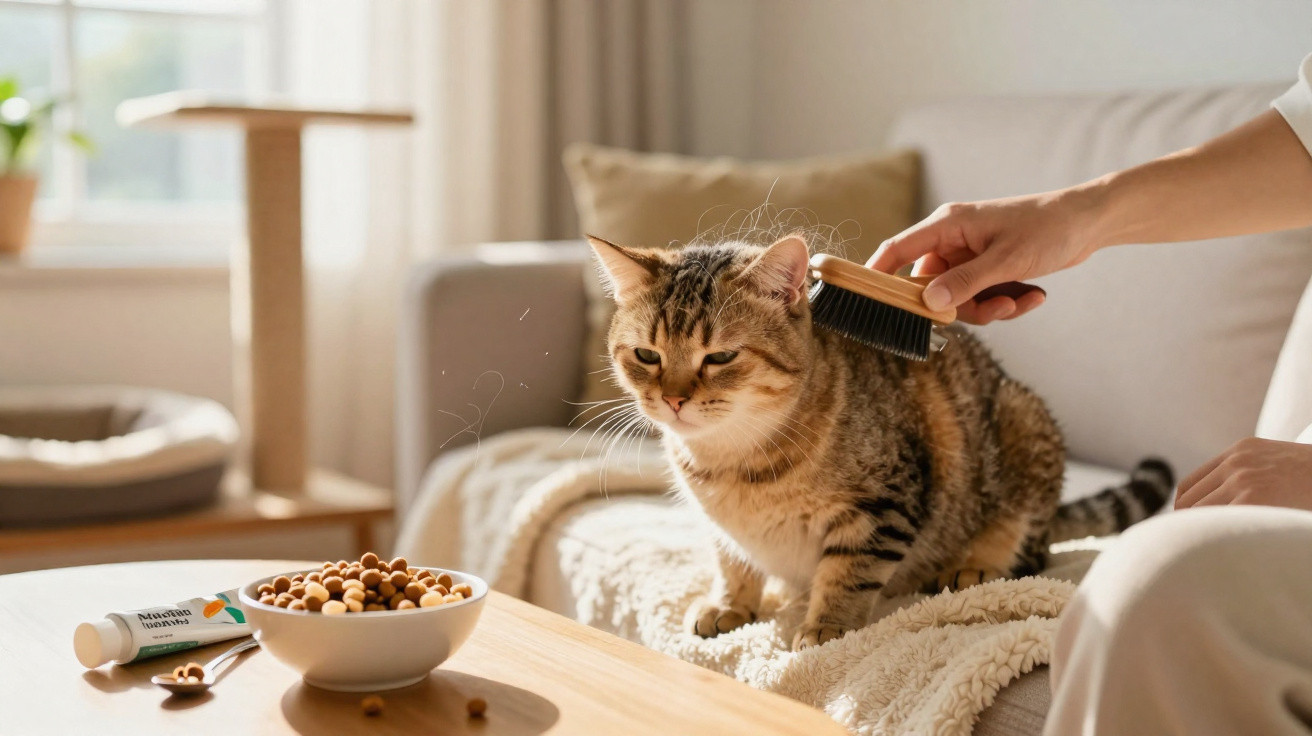
The simplest way to prevent hairballs is quite literally in your hands: regular brushing. The more loose fur ends up on the brush, the less reaches the stomach.
How often should a cat be brushed?
Most owners underestimate how frequently brushing is needed. During shedding season, once a week is generally not enough.
- Short-haired cats: at least three brushing sessions a week in spring
- Long-haired cats: brief daily brushing where possible, especially on the chest, belly and hind legs
- Senior cats: brush more often but very gently, as they may be less able to groom themselves
Each session does not need to take long. Five to ten minutes is enough if you keep to a routine. Consistency matters more than a marathon grooming session once a month.
The right tools for gentle coat care
Not every brush suits every cat. Many cats dislike hard metal combs but readily tolerate softer alternatives.
- Rubber brushes remove loose hairs from short coats without scratching the skin.
- Grooming gloves can be used like stroking, making them ideal for wary cats.
- Fine undercoat rakes for long-haired breeds loosen the undercoat, provided only gentle pressure is used.
Always brush in the direction of the coat, never against it. Pairing brushing with treats and praise helps establish a positive routine. Some cats eventually start asking for the brush themselves.
Food as support: how diet helps digestion
It is impossible to stop a cat swallowing hair entirely. However, the digestive tract can be supported so that hairs move through more easily and quickly instead of building up.
How malt paste and fibre work
Malt paste, available from pet shops, coats the intestinal contents like a lubricating film. Hair passes through more easily, and hairballs are more likely to break down before becoming too large.
Fibre such as psyllium husks swells in the intestines. This increases stool volume and stimulates bowel movement. Swallowed hairs are therefore effectively carried along and end up where they belong: in the litter tray rather than the stomach.
Combining malt paste with fibre supports the entire digestive tract – from the stomach outlet to the large intestine.
Practical ways to add them to the food bowl
Many cats are suspicious of anything unfamiliar. With a little strategy, these aids can usually be introduced without difficulty.
- Offer malt paste two to three times a week, in an amount roughly the size of a pea.
- Spread the paste onto a front paw – the grooming reflex does the rest.
- Stir a small pinch of psyllium into wet food and allow it to swell for a few minutes.
- Begin with a very small amount, around a quarter of a teaspoon for average-sized cats, then increase slowly if needed.
If you are unsure, seek advice from a veterinary practice or pet nutrition adviser, especially for cats with chronic conditions such as kidney problems or a sensitive gut.
Timing: why mid-March is the ideal time to start
Shedding is strongly influenced by daylight. Even before temperatures properly rise outdoors, a cat’s body begins to ‘change over’ its coat. Indoor cats in particular are often exposed to artificial light, and their coats may react even earlier.
Act early instead of treating problems afterwards
For most cats, the second half of March is a good time to begin an anti-hairball routine. It is worth making several small adjustments at the same time:
- Increase the brushing routine substantially
- Introduce malt paste gradually into the daily routine
- Test a small amount of fibre
- Monitor water intake, for example by offering more wet food or a drinking fountain
Those who begin in late winter will find spring far more relaxed, with less retching at night and fewer brown surprises on carpets and sofas.
Background: why cats are so prone to hairballs
A cat’s tongue has tiny keratin hooks that act like a built-in comb. In the wild, this is beneficial: dirt, parasites and loose undercoat are removed reliably. Indoors, where food is constantly available and coats are often fuller, this system can easily become unbalanced.
In addition, many cats naturally drink rather little because their ancestors lived in desert environments. Dry intestinal contents combined with large amounts of hair are an unfavourable mix. Wet food and sufficient water intake can make a considerable difference here.
Everyday examples
A typical case is a young long-haired cat that suddenly starts retching almost every day during its first spring. There is usually no serious illness behind it; the cat simply has not encountered such an extreme amount of loose fur before. With consistent brushing and a little malt paste, the situation generally settles quickly.
The situation differs for an older indoor cat that grooms itself less and less while shedding heavily at the same time. Areas of fur become matted, the skin receives less blood flow, and digestion slows down. In such cases, a combination of a gentle brush, regular professional trimming and an adapted diet can often work like a small fountain of youth.
Anyone who understands the processes in their cat’s digestive system will see a retched-up clump as more than just an annoyance: it is a warning sign. With a little routine, a brush and a few dietary tricks, the stomach can stay clear – and so can the carpet.















Comments
No comments yet. Be the first to comment!
Leave a Comment