Many people want to be “kind” – and end up getting it completely wrong.
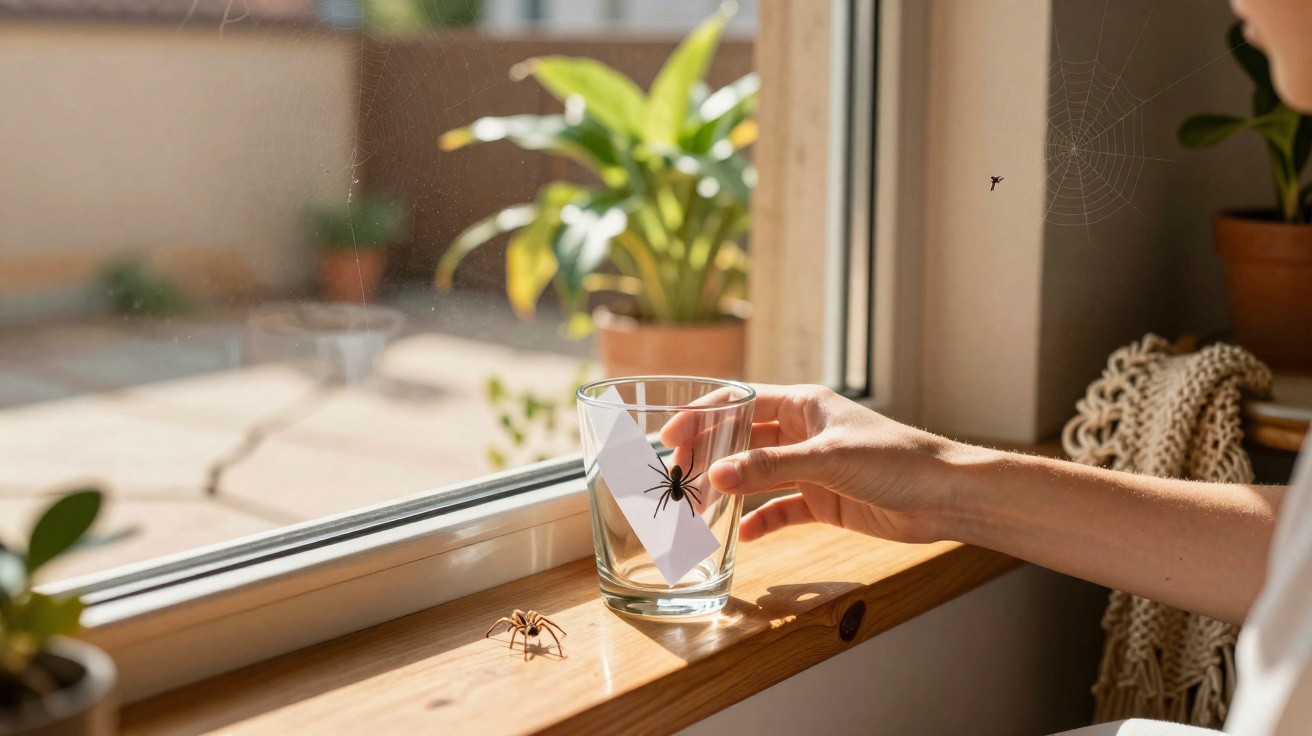
When someone spots a spider in their home, they often instinctively reach for a glass and a sheet of paper, carry it outside and feel like an animal-loving hero. It sounds sensible and seems morally beyond reproach: after all, the animal has not been killed. Yet for many house spiders, this very “rescue mission” is the worst possible outcome. At the same time, the household loses a quiet ally in the fight against irritating insects.
Why typical house spiders have little chance outdoors
Most spiders appearing in living rooms, hallways or bathrooms have long adapted to life inside buildings. They benefit from conditions that do not exist in the same way outdoors:
- relatively stable temperatures
- plenty of hiding places and dark corners
- dry areas protected from draughts
- a reliable supply of small insects to catch
Behind skirting boards, in cracks, in cellars or storage cupboards, they find a kind of miniature habitat. This is where they build their webs, wait for prey and remain largely undisturbed. The common idea that every spider secretly longs for a “free life in nature” is misleading. Many house species exist in this form only because human buildings exist.
If one of these spiders is suddenly placed on a patio, in grass or against an exterior wall, it encounters an entirely unfamiliar habitat. Sudden drops in temperature, direct sunlight, rain, wind and a lack of shelter make survival difficult. The animal knows none of the safe corners, existing structures or established webs there.
For typical house spiders, the indoors is not a prison but their natural habitat – the garden is often a high-risk zone.
There is also a tendency to confuse them with genuine garden spiders. Spiders that live outside are adapted to dampness, fluctuating temperatures and predators. House spiders depend on stability and hiding places. Treating both groups in the same way may be well intentioned, but it puts at risk precisely those animals that have adapted to human homes.
The well-meant mistake: catching a spider and putting it outside
In practice, it usually happens like this: spider spotted, glass placed over it, paper slipped underneath, taken out to the balcony, glass lifted – job done. It appears to be the gentlest solution. For the animal, however, the situation is considerably more precarious.
Outside, the spider is often:
- disorientated – with no familiar hiding places or hunting grounds
- unprotected – with no gaps to shelter in and no warm retreats
- exposed to predators – such as birds, lizards or larger insects
Depending on the season, further difficulties arise.
Spring and winter: a cold start into danger
In late winter and spring, nights are often still cool and rain is common. A house spider accustomed to a comfortable 18–22 degrees indoors can quickly suffer temperature shock outside. It has to find shelter within a very short time, yet does not know the terrain.
Summer: heat, dryness and no shade
At the height of summer, a patio can become a heat trap. Concrete slabs heat up, while balconies remain in direct sun for hours. Such surfaces offer no hiding place, and the animals also dehydrate rapidly. A hand movement intended to “save” the spider from a human perspective places it in an environment where it simply cannot live.
The journey itself is also extremely stressful for spiders. When someone hurriedly handles a glass, tissue or broom, they can easily lose one or more legs, fall or become trapped. The intention is to be gentle – but in the worst case, the effort results in injuries and a considerably shorter lifespan.
An underestimated ally: what house spiders do for us indoors
However unpleasant many people find the sight of them, spiders quietly perform a useful service indoors. They eat exactly the creatures we do not really want in the bedroom.
Typical prey includes:
- mosquitoes and biting mosquitoes
- fruit flies and other small flies
- mosquito swarms from plant pots












Comments
No comments yet. Be the first to comment!
Leave a Comment