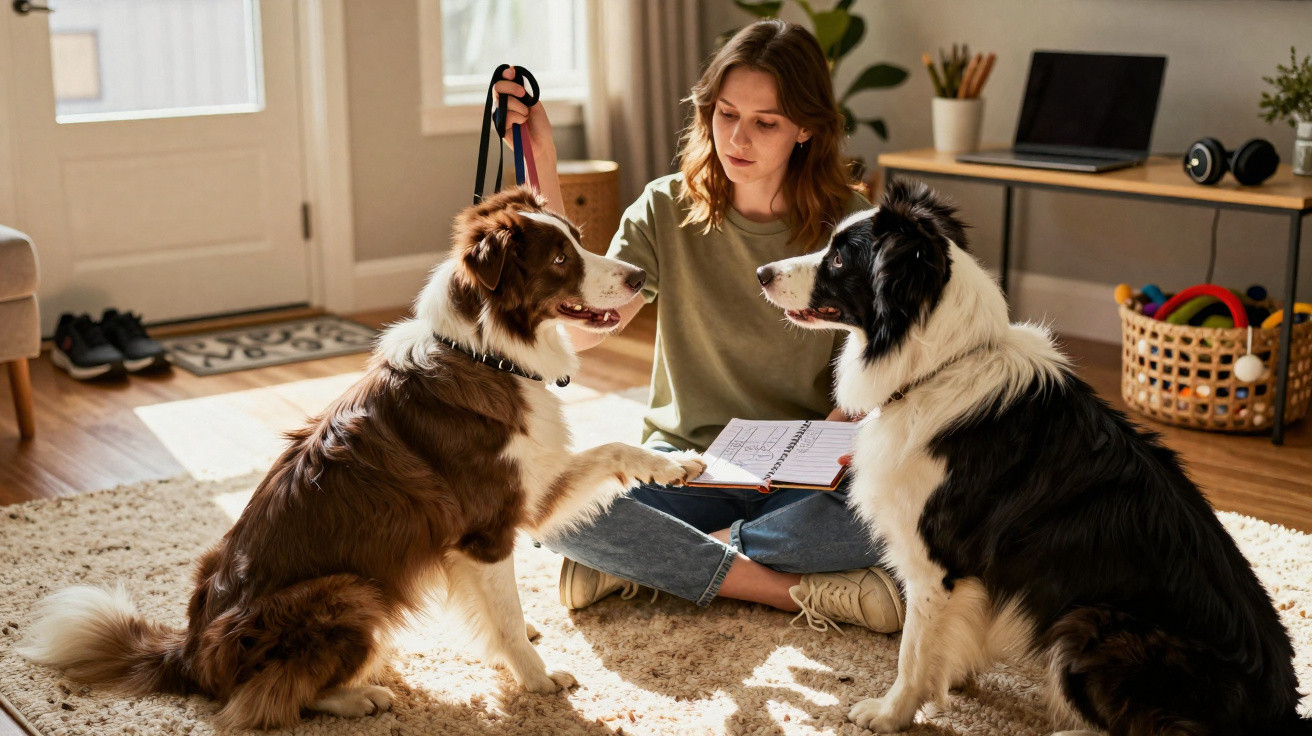
On the left stands a blue-merle Australian Shepherd, complete with copper eyebrows and a tail that seems unable to stop wagging. On the right is a black-and-white Border Collie, looking straight through them with its head slightly cocked, seemingly decoding every movement they make.
The volunteer asks, “What’s your lifestyle like?”
They look at one another, suddenly far less certain. This is not simply a case of deciding which dog looks sweetest. It means years of early mornings, late evenings, trips away, guilt, muddy footwear and chewed charging cables.
On screen, Australian Shepherds and Border Collies can appear almost interchangeable: clever herding breeds, athletic, photogenic and “great with families”. In day-to-day life, though, those broad labels unravel into countless little differences that can alter everything.
One apparently minor decision can gradually reshape their whole routine.
They do not realise it yet, but they are not only picking a dog.
They are selecting a way of life.
Australian Shepherd vs Border Collie: similar feel, different engine
At first, these breeds can seem like relatives meeting at the same family gathering. They are both herding dogs, both remarkably alert, and both appear to have built-in Wi-Fi for interpreting human feelings. But the engine beneath the coat is calibrated differently.
The Australian Shepherd is commonly seen as a little more easy-going and more willing to join in with anything, provided people are involved. The Border Collie tends to be intensely focused, task-driven and shaped by instincts developed on sheep farms and trial fields.
Seen from the outside, that may simply look like high energy. Experienced from within, it can feel more like pressure - or a working partnership.
A UK survey of working breeds found that Border Collies were the breed most often rehomed for “too intense” behaviour. That description appears repeatedly: intense gaze, intense mind, intense need to do work that feels purposeful.
Speak to shepherds or agility trainers and a familiar point emerges: a bored Border Collie will create its own job. That might involve herding children, bicycles, shadows or an unfortunate cat. Australian Shepherds can behave this way as well, but many direct more of their drive into games, social connection and clownish behaviour.
Imagine a Saturday. An Aussie may be delighted to come hiking, sit with you at a café terrace and make an unplanned visit to friends. A Border Collie often truly switches on when there is a defined task: obedience practice, agility, scentwork or structured training. Both are rewarding, but they give weekends very different shapes.
This difference ultimately comes back to the work each breed was developed for. The Border Collie is a specialist, bred for eye-stalking, gathering and precise livestock control. The Australian Shepherd is closer to an all-purpose ranch worker: handling several tasks, checking boundary fences and remaining devoted to “their” people.
So the meaningful question is not “Which is smarter?” It is: What sort of intelligence can fit into your life without overloading the fuse box?
Many new owners believe they will “work it out over time”. That can be true with more laid-back breeds. With Aussies and Borders, however, poorly matched expectations can become guilt, frustration and a dog that shows stress through destruction or compulsive behaviour.
Choose for your real life, not your ideal self
A useful starting point is to write down what a normal weekday genuinely involves. Leave out the aspirational version and include the untidy reality. Then place the dog into precisely that schedule.
Picture the alarm on a wet Tuesday morning in February. Will you honestly rise 40 minutes earlier for focused training or a long, brisk walk? Or is a proper 20-minute play session, along with a few mental games, the commitment your future self can actually sustain?
If you are drawn towards a Border Collie, arrange specific “jobs” beforehand: an agility club, regular herding sessions, search-and-rescue training or planned trick training. An Aussie also needs dependable activity, but the plan can leave more space for social contact, hikes and busy family life.
On a Paris adoption forum, a moderator said that nearly half the posts about these breeds beginning with “help, my dog is crazy” follow the same pattern: “We chose him because we love hiking… on weekends.” During the rest of the week, the dog gets eight hours alone, a brief pavement walk and a guilty, hurried game of fetch after dark.
The result can look like this: the Border Collie begins chasing lights, cars or children, sometimes nipping at heels. The Aussie may bark at every sound in the block of flats, follow its owner from room to room and erupt with excitement the moment the lead comes out.
Both responses are often mistaken for “naughtiness”. They are really messages: this mind has no outlet, and this energy has nowhere to go. The dog is not faulty - the routine is.
Conversely, city-dwelling Aussies and Border Collies in flats can live exceptionally balanced lives. Their advantage is not a garden or hills outside the door. It is reliable engagement: daily sniffing walks, training games, puzzle toys and short yet concentrated periods of genuine interaction.
Once you look at it this way, the breed decision becomes less mysterious. It is rather like choosing an exercise partner. Would you prefer one that gets you to CrossFit at 6 a.m. regardless, or one that says, “Let’s move, but also, let’s chill on the sofa afterward”?
Avoiding the usual Australian Shepherd and Border Collie mistakes
There is a straightforward approach that can prevent a great deal of upset. Before making a decision, spend three separate days trialling the routine an Aussie or Border would require. Do it before bringing any dog home - it is just you.
On day one, live as though you already have a Border Collie. Get up early. Spend 20 minutes on concentrated mental work, whether that means studying, reading, coding or something else that requires effort. Later, take a long, purposeful walk or run rather than wandering while looking at your phone. Plan one meaningful “job” session for yourself, such as a class, a demanding project or sport.
On day two, repeat the exercise through an “Aussie lens”. Keep moving, but combine brisk walks with playful exercise and perhaps a social get-together. There is less emphasis on precision and more on shared time. Pay attention to which day feels more natural for your body and your diary.
Let us be honest: nobody truly manages that every day. Even so, this small experiment offers an unfiltered sense of which dog’s lifestyle is more likely to suit yours, including on exhausted days when motivation is low.
Another common mistake is choosing purely on appearance or viral clips. There is the blue-merle Aussie with striking eyes, or the Border Collie flying through agility poles at remarkable speed. Such snapshots leave out the less appealing elements: adolescent periods spent chewing walls, phases of reactivity, sensitivity to noise and the endless need for something to do.
For parents, think about homework time. A Border Collie in a home that offers too little stimulation may pace, stare at the children, nudge their hands and attempt to turn maths worksheets into a herding exercise. An Aussie may position itself between everyone, vocalise and demand involvement.
There is no disgrace in admitting, “My capacity is limited right now.” The genuine error is acting otherwise because you believe you “should” be an ultra-active person who is always outdoors. Dogs do not share a home with our Instagram selves. They live with the person who returns tired from work and only wants pasta and Netflix.
One trainer I spoke with put it bluntly:
“The Border Collie asks: ‘What’s the plan today?’ The Aussie asks: ‘What are we doing together today?’ Both questions are beautiful. The wrong one, in the wrong home, becomes exhausting.”
If you are already favouring one breed, use this brief checklist to test that instinct:
- You enjoy structure, value precision and like teaching complicated tricks → a Border Collie may suit the way your mind works.
- You would like a velcro companion for mixed activities, social visits, children and road trips → an Australian Shepherd will often slot in more easily.
- You are regularly overwhelmed by noise, disorder and continual demands → reconsider both breeds, or be ready to invest seriously in training support.
We have all agreed to something that privately frightens us because refusing felt like failure. When dogs are involved, declining the unsuitable breed may be one of the most loving choices you make.
Living with your decision: the parts Instagram captions leave out
Over time, the quiet difference between thriving Aussie or Border households and struggling ones is not perfection. It is made up of micro-habits: small, repeatable actions that these dogs can depend upon.
Think in terms of anchors: the same 10-minute sniffing walk after breakfast, the same five-minute training game before dinner and the same calm sequence before bed. These patterns create a mental map for the dog: “This is how my day usually unfolds.” That reliability settles their high-powered nervous system.
For a Border Collie, set aside at least one mentally demanding activity, such as shaping games, scentwork or linked trick sequences. For an Aussie, include daily connection that is not merely physical exercise - grooming, quiet cuddles and relaxed handling on the sofa all count.
The other understated element is boundaries. Constant availability is often confused with affection. These dogs, particularly Aussies, can turn it into emotional dependency. Teaching them to settle in a crate or on a mat, and to cope with a little boredom, safeguards their mental wellbeing just as much as exercise does.
When difficulties develop, they seldom begin as a dramatic breakdown. They tend to creep in quietly: a little extra barking, slight resource guarding, obsessive ball fixation or mild lead reactivity. These are not “bad dog” episodes. They are warning lights on the dashboard.
The kindest response is to treat those early signs seriously without becoming alarmed. Make walks shorter but enrich them with sniffing. Cut back on ball throwing. Add scatter feeding in the grass. Book a session with a force-free trainer instead of watching fifteen YouTube videos at midnight.
As one behaviourist told me,
“With Aussies and Borders, prevention beats rehab every time. They’re so smart that they can learn the wrong lesson in two reps - and then repeat it perfectly.”
If you already live with one of these dogs and feel slightly exposed by this, you are not alone. Many owners acknowledge that they began with a fantasy, then hurried to catch up with reality. That is not a moral failing. It simply means there is a better choice available for tomorrow morning.
And when it does work - when the Border Collie settles into a flawless down-stay in a busy park, or when the Aussie curls at your feet after a day that genuinely suited you both - a gentle, quiet feeling settles in your chest.
It is the sense that two species have finally found the same rhythm.
The true magic is not selecting “the best breed”. It is choosing the dog whose needs you can realistically meet, even on your worst day, and then creating a life in which you can both breathe.
| Key point | Detail | Why it matters to the reader |
|---|---|---|
| Level of mental intensity | Border Collie more “mission-driven”, Aussie more relationship-focused and versatile | Helps you choose according to your energy and tolerance for stimulation |
| Ideal types of activity | Border: dog sports, structured work. Aussie: hikes, social life, varied activities | Makes it easier to picture your weekends and evenings with the dog |
| Risk of distress or behavioural problems | Both quickly suffer from boredom, especially without structure and a mental routine | Encourages you to anticipate real needs instead of reacting after problems arise |








Comments
No comments yet. Be the first to comment!
Leave a Comment