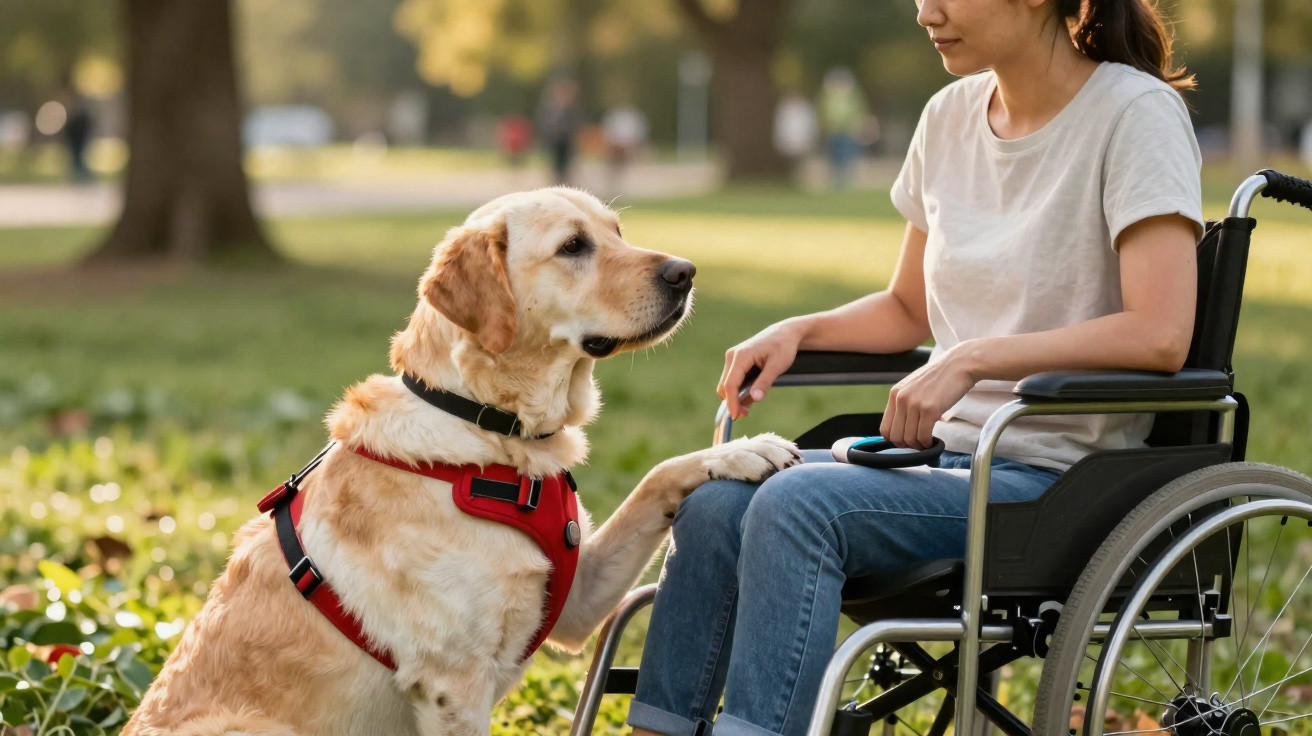
Assistance dogs are often seen in public as composed companions that guide or support their human partners. To many people, they are helpers taught to carry out particular tasks.
However, new research from Finland reveals a more complex picture. It suggests that these dogs are more than assistants: they participate actively and meaningfully in care, a role shaped by trust, shared experiences and continual attentiveness.
Researchers at the University of Turku and Aalto University examined the ways assistance dogs and people live and work alongside one another.
Based on real-world observations, interviews and ordinary daily interactions, the study portrays a bond that extends well beyond straightforward assistance.
Assistance dogs act as caregivers
The study presents assistance dogs as active caregivers, rather than merely passive helpers. Their role involves far more than obeying commands: they watch, react and take action according to their human partner's requirements.
They may recognise changes in health, help with mobility and offer emotional reassurance. Some dogs can even identify medical problems before the person becomes aware of them.
This form of care is not readily replaceable by either technology or other people.
Dogs are trained for care work
The research also emphasises that these dogs are trained professionals. They undergo organised training and are carefully paired with people according to their personalities and ways of life.
“Care work is the results of bodily interaction, meaning small gestures and the working dog’s sensitivity to interpreting people and responding to the needs of those who require assistance,” noted Suvi Satama, assistant professor at the University of Turku.
Dogs read human signals
Among the most notable findings is the non-verbal communication between people and dogs. With time, each learns to interpret subtle cues, including posture, movement and facial expressions.
The researchers describe this as a form of sensory “reading”. Dogs use scent, movement and close attention to detail, while humans learn to alter their behaviour in response.
This unspoken exchange enables them to respond rapidly when it matters. A dog might detect unease or stress before its person fully recognises it, and the person learns to place confidence in those signals.
The connection demonstrates that care does not always need words. Often, it is expressed through quiet and ongoing awareness.
Humans learn to trust dogs
Trust is central to this partnership, but it is not immediate. Instead, it is built gradually through experiences shared together.
Initially, many people struggle to depend on a dog. Some have not previously lived with animals, while others find it hard to accept that a dog can influence their decisions. In time, this can change.
“For example, a person with diabetes must rely on the dog when the dog detects changes in blood sugar,” said Satama.
“When the person responds to the dog’s signal and checks their blood sugar or follows the dog’s alert to take the necessary medication in time, serious situations can be avoided.”
Trust changes human decisions
The findings indicate that such trust can mean relinquishing some control. People need to acknowledge that a dog might recognise something that they themselves do not.
That change reshapes the conventional understanding of care, making it a mutual process in which both partners rely on one another.
Human-assistance dog relationships are not one-way arrangements. Each partner provides and receives care in distinct ways.
“Assistance dogs care for humans, and humans also do their best to care for their assistance dogs. In this way, vulnerability becomes relational, and both parties give and receive care”, said Satama.
Care roles change over time
The study finds that caring roles are fluid rather than permanent. In one situation, a dog may be the caregiver, and in another it may need care itself.
For instance, a dog might lead someone through a crowded street, while the person is responsible for ensuring the dog has rest, food and emotional comfort. This produces a balance.
Often, a dog is providing care for nearly the entire time. Certain medical alert dogs stay watchful throughout the day and night, prepared to react whenever necessary.
For people, this continuous care may also carry an emotional burden. “He gives me everything all the time. I feel bad that I can’t even throw him the ball,” a human participant noted.
Assistance dogs act beyond training
The researchers also question the notion that animals are passive members of society. Their observations indicate that assistance dogs possess awareness, preferences and their own ways of making decisions.
Dogs sometimes behave independently, perhaps briefly disregarding an instruction or acting on instinct. Such instances suggest they are individuals with agency, not simply trained instruments.
“For example, I was observing a meeting of people with visual impairments, at which their assistance dogs were also present,” noted Satama.
“The dogs had been told to stay on the floor next to their people. Suddenly, one of the assistance dogs started crawling towards another dog and some scents, and the person did not notice this due to their visual impairment. I thought that the dog was carrying out their own agency.”
The research further highlights an important issue: although dogs care for people, they have not freely chosen this role. They are trained for and assigned these responsibilities.
This raises ethical concerns about their welfare, opportunities for rest and freedom.
Care goes beyond humans
The study encourages a wider change in how care is understood. It moves beyond a human-only perspective and draws attention to responsibility shared between species.
“When we recognize animals as agential caregivers, we can also better understand the care work between humans and its various dimensions,” said Satama.
This perspective could support improvements to care systems and to the treatment of working animals.
Assistance dogs illustrate that care involves more than completing tasks. It also depends on trust and attentiveness. As people and dogs work together, they develop care jointly over time.






Comments
No comments yet. Be the first to comment!
Leave a Comment