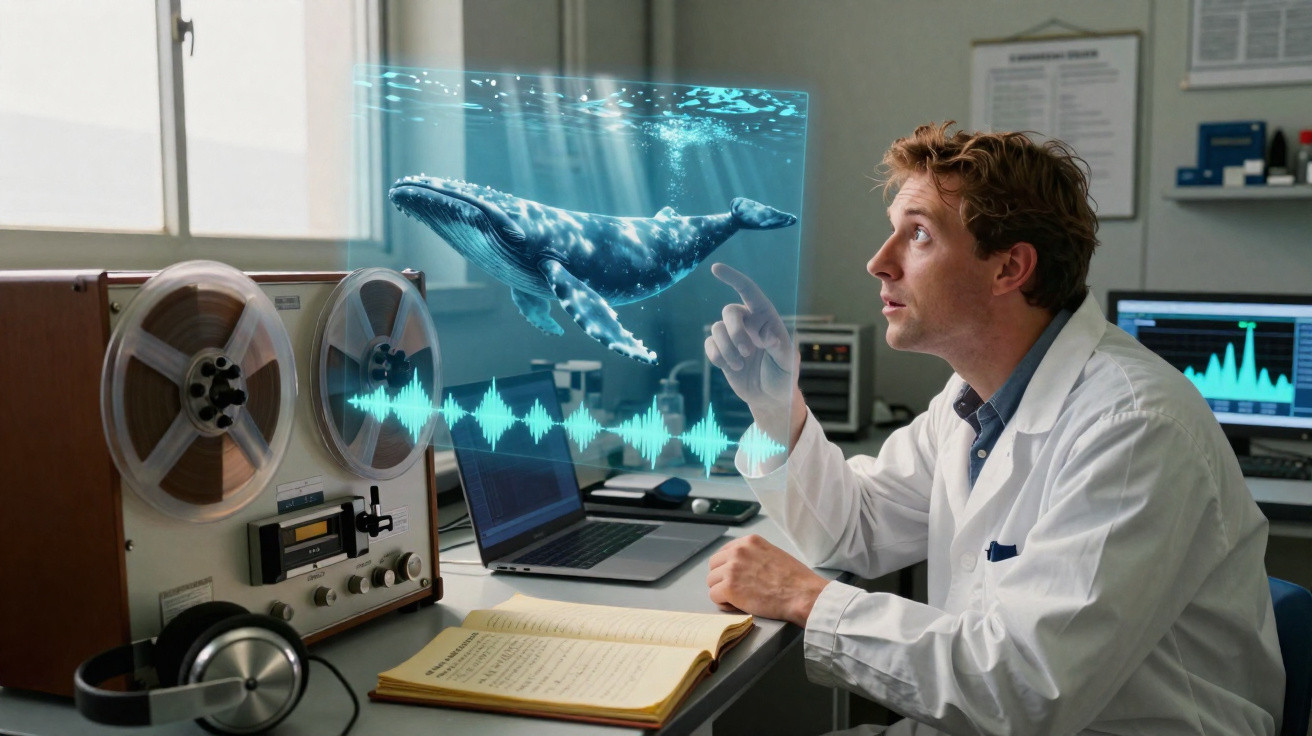
On a shelf deep within the archive of a US research institution, an unremarkable plastic disc sat for decades. It carried no label and offered no indication of its value. Only now has it become clear that it most likely contains the oldest known recording of whale song – an acoustic window onto an underwater world that no longer exists in this form.
A song from the past
The story starts in March 1949. A research team aboard a vessel off Bermuda was testing new sonar equipment. Their actual purpose was submarine surveillance and echo sounding. Then the underwater microphone picked up something nobody could identify: low, drawn-out sounds, almost eerie, like a slow song rising from the depths.
The sounds were captured on what was then a modern plastic disc, using an Audograph – a type of dictation machine intended for office use. Although the researchers preserved the recording, they could not properly interpret it. In the 1940s, science knew very little about the fact that whales could “sing” at all.
Researchers now believe that this recording from 7 March 1949 is the oldest humpback whale song ever documented.
The disc was placed in the archive of the respected Woods Hole Oceanographic Institution (WHOI) in Massachusetts, USA. There it was forgotten, until decades later a team of archivists, biologists and acoustic specialists came across it again.
How a chance discovery became a scientific goldmine
It is remarkably fortunate that the disc survived the decades. Most audio recordings from that era were made on magnetic tape, much of which has since been damaged, demagnetised or simply lost. By contrast, the old plastic disc can be cleaned, digitised and examined with modern technology.
Once the specialists decoded the audio, its importance became apparent. They were hearing more than the song of a single humpback whale. They were also hearing the ocean itself as it sounded nearly 80 years ago, at a time when engine noise, container ships and offshore industry had not yet come to dominate the underwater soundscape.
The recording reveals two things at once:
- What humpback whales sounded like at the time.
- How much quieter and more “orderly” the acoustic environment of the sea was.
For modern marine research, this is an exceptional stroke of luck, as comparable reference data from that period are extremely rare.
Why whale song is more than just “beautiful sounds”
Humpback whales are the “singers” among the ocean giants. Males in particular produce complex, melodic songs that can travel through the water for many kilometres. Their sounds vary in pitch, duration and rhythm. Some phrases are repeated, while others shift over time – almost like musical trends.
Their songs serve several purposes:
- Finding mates: Males use songs to attract females.
- Marking territory: The sounds signal presence and strength.
- Co-ordination: Vocalisations help organise groups and hunt together.
When the acoustic setting of a marine area changes, this communication inevitably changes too. This is precisely where the new analysis of the 1949 recording begins.
Comparison with today: how loud the ocean has become
Today’s oceans sound different from those of the mid-20th century. In many areas, the following are now constantly present:
- Engine noise from merchant vessels and cruise ships
- Impact noise from construction work, such as harbour or wind farm projects
- Seismic surveys conducted by the oil and gas industry
- Military sonar signals
Together, these sound sources create continual background noise. Whales and other marine animals find it harder to hear one another, a problem researchers describe as “acoustic pollution”.
The 1949 soundtrack reveals an ocean in which whale songs stood out far more clearly – without today’s backdrop of engine noise.
By comparing the historic recording with present-day measurements, the team can estimate:
- How much has background noise in the sea increased?
- In which frequency ranges does technical noise particularly mask whale song?
- How do whales respond – for example, by singing more loudly or altering their melodies?
Comparisons of this kind can support better planning of protected areas and shipping routes. The aim is to reduce acoustic pressure on sensitive regions where whales rest or breed.
An archive as a time machine
WHOI archivist Ashley Jester describes a “chain of curiosity and care” extending from the engineers and researchers of the 1940s to today’s teams. At the time, they stored sounds whose significance they did not yet understand. Today, those very records provide answers to questions nobody was asking then.
This illustrates how valuable old research data can be, even when they initially appear insignificant. Many archives contain:
- Notebooks recording measurements from expeditions long ago
- Films and photographs showing species that have since become rare
- Analogue audio documents such as this whale recording
Modern digitisation and new analytical methods now allow such treasures to be assessed in entirely different ways. Sometimes the crucial clue is found not in new measurements, but in a forgotten file from the past.
What the recording reveals about humpback whales
For marine biologists, the 1949 disc is more than a historical curiosity. It provides clues about how flexibly humpback whales adapt their songs. Researchers can investigate:
- Which sound sequences were typical at the time
- Whether certain phrases still occur today
- Which frequency range the animals used – and whether they have shifted that range
If it emerges that whales have moved their songs over time into quieter or louder ranges, this could directly indicate adaptation to human-made noise. Another question is equally compelling: do they respond primarily by increasing volume, creating new melodies, or avoiding particularly noisy areas?
Noise at sea: risks for ocean giants
Sound travels much more effectively through water than through air. As a result, acoustics matter more to marine life than sight. When the underwater “soundscape” falls out of balance, the consequences include:
- Whales are less able to locate other members of their species.
- Disorientation increases the risk of collisions with ships.
- Intense noise can cause stress and alter behaviour.
Long-term stress weakens the immune system and can impair reproduction. This places even greater pressure on species already affected by a history of hunting, climate change and food shortages.
What can be learned from a 77-year-old song
For readers wondering how these findings can be put to practical use, there are several approaches:
- Shipping companies can alter routes and speeds to reduce acoustic pressure in sensitive areas.
- When ports or offshore facilities are expanded, protected periods can help ensure that particularly sound-sensitive species are not present locally.
- Policymakers can establish limits for underwater noise, similar to road-noise controls.
At the same time, the recording strengthens awareness of the value of historic environmental archives. Anyone holding old audio tapes, films or measurement series may possess data that could play a key role in future research.
Terms that are often misunderstood
A number of technical terms repeatedly arise in discussions of underwater noise and can be confusing:
- Sonar: A technology that emits sound waves and evaluates the returning echo to locate objects in water.
- Sound pressure level: A measure of loudness, often considerably higher at sea than on land because water conducts sound more effectively.
- Acoustic pollution: The term for human-made noise that masks natural channels of communication in the sea.
The rediscovered whale recording makes these abstract terms tangible. It allows us to hear how “clear” the acoustic landscape once was – and why today’s underwater soundscape has become a problem for marine animals.
The fragile disc from 1949 therefore acts almost like a conversation with an eyewitness from the ocean. It shows how profoundly humans have altered the soundscape of the seas within only a few decades – and how urgently data are needed to understand and limit that impact more effectively.













Comments
No comments yet. Be the first to comment!
Leave a Comment