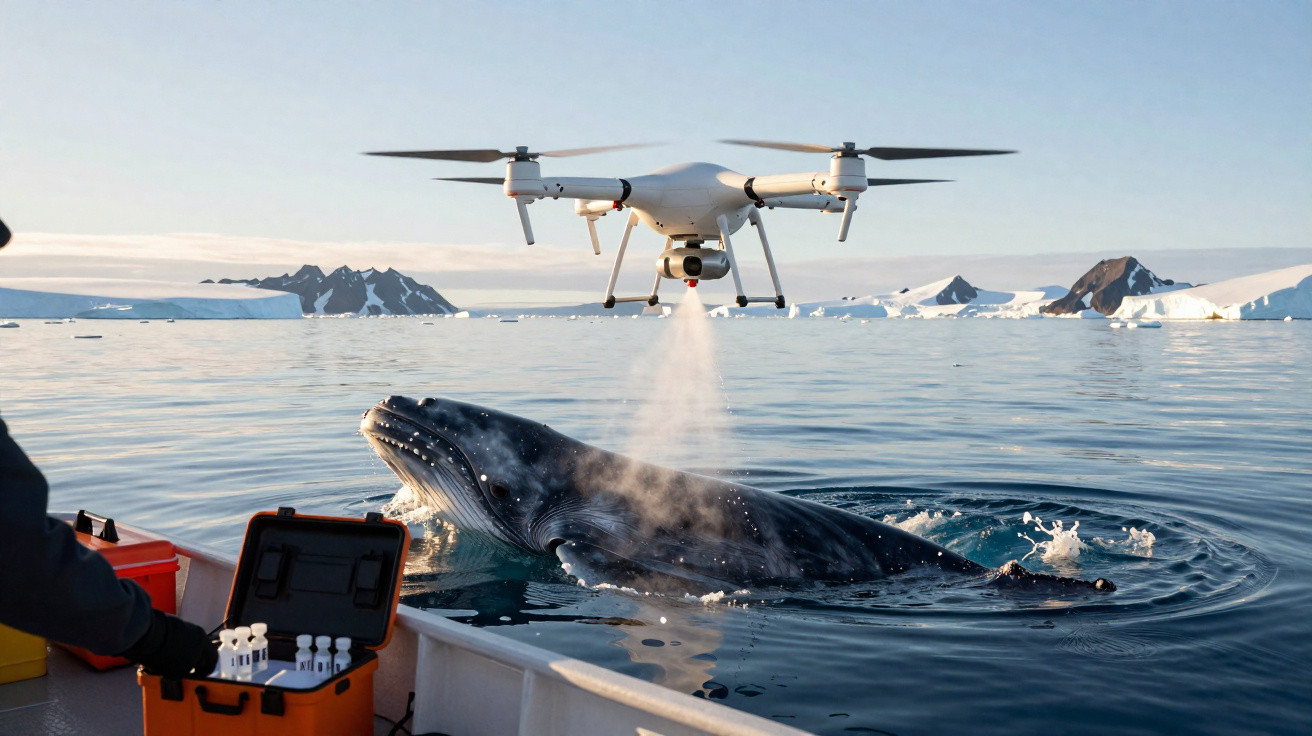
Already weakened by human activity and climate disruption, the giants of the sea that live beyond the Arctic Circle are now confronting a new threat. These isolated whale populations, exposed to this virus, are alarming scientists, who fear that mounting environmental pressures could trigger a mass die-off.
Monitoring the health of the largest members of marine megafauna has always posed a formidable challenge for biologists and oceanographers. How can they examine animals weighing several dozen tonnes, which spend 90% of their lives underwater and travel thousands of kilometres each year? Although cetaceans are not especially fearful of people, approaching them requires highly complex operations: any handling or sedation is exceptionally dangerous because, unlike land mammals, these animals breathe only through a strictly voluntary action.
To avoid such hazardous procedures, researchers now favour non-invasive approaches, including drones that can gather health data from a distance. By analysing the exhaled breath of whales living beyond the Arctic Circle, a team of scientists made a troubling discovery: several animals were infected with a pathogen feared in marine environments, morbillivirus. Their study of this contamination was published on 18 December in the journal BMC Veterinary Research: an observation never previously recorded at these latitudes.
The drone: a new stethoscope for the oceans
The sampling was carried out using ordinary commercial drones. Researchers flew them above the whales as they surfaced to breathe. Fitted with sterile collection plates, the devices could be placed within the plume of vapour expelled from the animal’s blowhole. This “cloud” is actually condensed water vapour; expelled at an astonishing speed, between 400 and 700 km/h, it enables whales to eject mucus.
It is a valuable biological deposit containing cells, microbes and viral genetic material straight from the cetacean’s respiratory system. “Drone sampling is a game changer,” says Terry Dawson, a co-author of the study. “It allows us to monitor pathogens in living whales without causing them any stress, while providing critical information about Arctic ecosystems undergoing rapid change.”
From 2016 to 2025, this technique enabled the team to assess the health of numerous individuals: humpback whales (Megaptera novaeangliae), sperm whales (Physeter macrocephalus) and fin whales (Balaenoptera physalus) throughout the North Atlantic, from Iceland to the coast of northern Norway.
A dangerous pathogen where nobody expected it
After samples were analysed in the laboratory using techniques comparable to those used for monitoring human diseases, the findings were clear. Researchers detected genetic signatures of cetacean morbillivirus (CeMV), a highly aggressive, so-called multisystemic virus that causes pneumonia and brain diseases, including encephalitis, and can even completely destroy the immune system of infected cetaceans.
It is one of the most destructive pathogens affecting marine mammal populations worldwide. Spread through the respiratory route, it has previously caused major mortality events among dolphins and whales.
The discovery is particularly bad news because it confirms, for the first time, that the virus is circulating among these cetacean populations - some individuals showed signs of weakness - at latitudes where it had never previously been detected.
As ocean waters warm and sea ice declines, whales tend to gather more densely than before during winter feeding seasons. For Helena Costa, the study’s lead author, this is probably one reason for the circulation of CeMV. “These gatherings, combined with environmental stress and increased proximity to other species or human activities, create fertile conditions for disease transmission,” she says.
“The challenge now is to maintain this monitoring over time, so that we can better understand how the accumulation of environmental pressures affects whale health,” the researcher continues. Without this surveillance, it will be very difficult to determine whether this is merely a temporary epidemic peak or a genuine rise in the prevalence of this virus among these cetaceans. It should also be remembered that the animals studied are already closely monitored by conservation bodies, with some of them considered highly vulnerable, including sperm whales and fin whales. Should an inadequately anticipated outbreak occur, losses could swiftly reach hundreds of individuals: a bleak illustration of our glaring inability to foresee the consequences of our own activities.















Comments
No comments yet. Be the first to comment!
Leave a Comment