
For years, countless owners have said that their dog instantly knows when they are not feeling well. A recent study now offers the clearest scientific evidence yet: dogs can tell from our scent whether we are relaxed or under pressure – with a remarkably high level of accuracy.
How researchers tested what dogs may already know
In everyday life, it can seem almost magical. You are sitting at your laptop with your heart racing, your to-do list keeps growing and your eyes dart around – then, without a sound, your dog settles beside your feet. Until now, it was uncertain whether dogs respond to our body language, voice or genuinely to scent.
A team at the University of Belfast investigated this question in a systematic way. They wanted to find out whether a dog's nose alone can detect stress in people, or whether eye contact and other cues are required.
The researchers' answer is clear: human scent changes in measurable ways during stress – and dogs can detect precisely that.
The experiment: timed arithmetic and sweaty hands
For the study, the scientists recruited 36 adult participants. Each person provided samples of their breath and sweat in two very different settings.
- Phase 1: a resting state, sitting calmly and breathing normally.
- Phase 2: a mentally demanding arithmetic test completed under time pressure and deliberately designed to cause stress.
At the same time, the researchers recorded heart rate and blood pressure, while questionnaires assessed how stressed participants felt. A moment counted as “real stress” for the study only when all three indicators rose clearly.
The samples were then frozen, numbered and prepared so that neither the researchers present in the room nor the dog trainers knew which situation each sample came from. This so-called double-blind design prevents unconscious influence.
Four expert noses in the laboratory: dogs as stress detectors
The four animal stars of the study were then brought in. All of the dogs had been trained to search specifically for a particular smell and to “report” it by giving a calm indication – much like explosives detection dogs or diabetic alert dogs.
In the test room, the researchers showed the dogs three samples at a time:
- one sample from the stressful situation;
- one neutral sample from the same person during the resting phase;
- one empty container containing no human scent.
The dogs were allowed to sniff at their own pace before indicating which sample they believed matched the stress scent they had previously been trained to recognise. Every correct choice was rewarded.
The result: dogs are correct more than 93 per cent of the time
The figures from the published study are strikingly clear: on average, the dogs correctly identified the stress sample in more than 93 per cent of trials. Individual dogs even came close to 97 per cent.
By chance alone, a dog would have been correct in only around one in three attempts. The actual success rate is almost three times higher.
The researchers conclude that a stressed human body releases different molecules through sweat and breath than it does in a relaxed state. These chemical signals alone allow dogs to identify stress reliably.
This makes it clear that the animals are not guessing, nor are they relying solely on gestures or tone of voice. They can distinguish whether someone is internally tense or relaxed by their scent profile.
What this means for everyday life with a dog
For owners, the findings have several intriguing implications. Many familiar situations now have a sound explanation:
- A dog becomes restless even though the living room seems quiet and peaceful.
- It seeks closeness, rests its head on a leg or sighs conspicuously.
- It suddenly avoids a person and prefers to keep its distance.
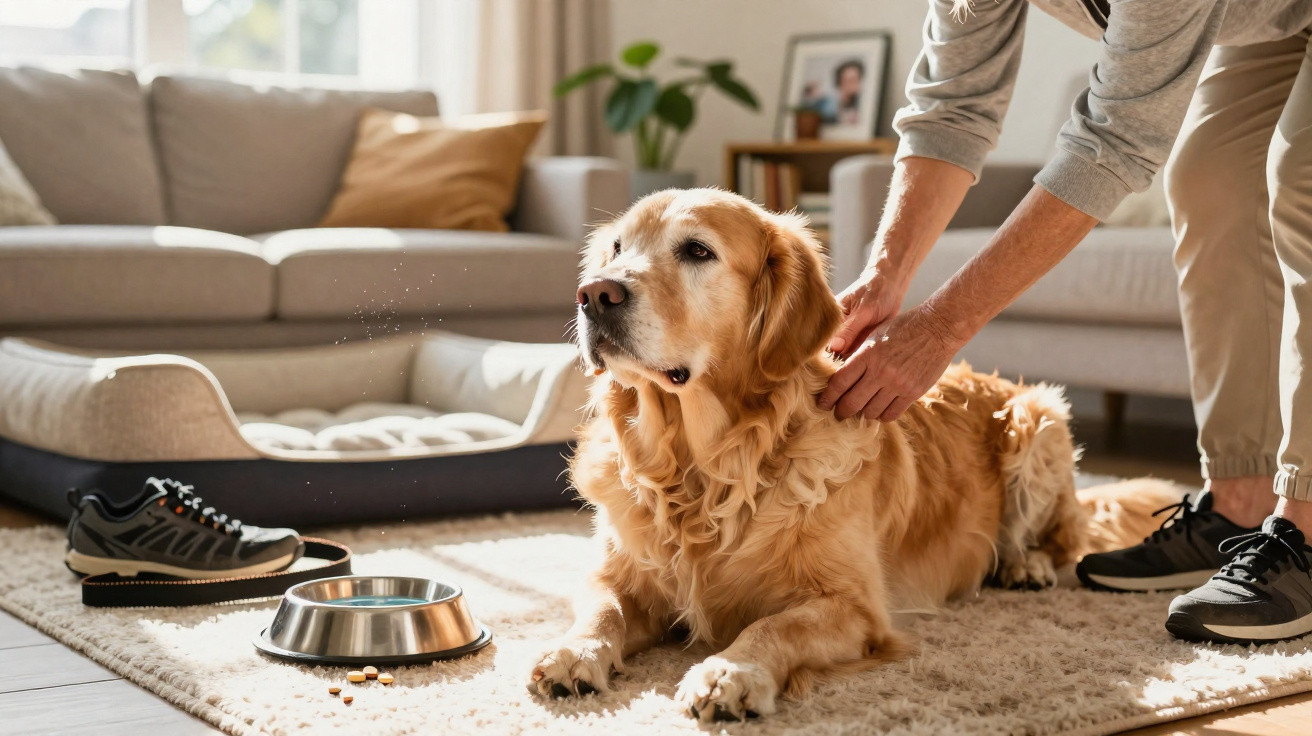
All of this may be linked to a dog detecting tiny changes in its person's scent. The animal is therefore responding to something humans can neither see nor consciously notice.
Anyone who watches their dog carefully gains, in a sense, an emotional mirror. At times, the dog may notice before its owner does that their pulse has been elevated for too long or that their mind is failing to settle.
How dogs process our stress signals
Dogs have an extraordinary sensory tool at work behind the scenes. Their sense of smell is many times more sensitive than ours and, according to some estimates, can be up to several tens of thousands of times more sensitive. They also have a specialised organ in the roof of the mouth that detects certain chemical substances with particular precision.
When people become stressed, the body releases hormones such as adrenaline and cortisol. These cause slight metabolic changes. Sweat alters in composition and exhaled breath contains different molecules – forming a pattern that dogs can clearly recognise.
To the human nose, a stressed person often smells “completely normal”. To a dog, however, every breath carries distinct additional information.
More than scent: communication within the human-dog partnership
Naturally, dogs do not depend on their noses alone. At the same time, they read our facial expressions, posture and voices. The study shows, however, that scent remains a powerful cue even if all of these other channels are unavailable.
The bond between people and dogs is therefore built not only on eye contact and affection, but also on continuous, silent chemical communication. Whether we intend to or not, we constantly send signals – and dogs respond to them.
Practical implications for therapy dogs and assistance dogs
The findings open up new possibilities for training dogs that support people in everyday life. There is growing interest in specially trained animals, particularly in the field of mental health.
- Anxiety disorders: Dogs could be taught to respond early to rising stress levels and gently interrupt a person before a panic attack fully develops.
- Post-traumatic stress: For veterans or people who have experienced accidents, dogs could learn to use typical stress scents as a warning signal and offer closeness or distraction.
- Working life: In particularly demanding occupations, office dogs or therapy dogs could indicate when breaks are urgently needed.
In some countries, assistance dogs already use scent to predict low blood sugar or epileptic seizures. The new study gives added momentum to programmes aiming to develop similar support for mental health.
What owners can learn about managing stress
People living with a dog affect its wellbeing more than many realise. If stress is detectable in scent, it inevitably reaches a dog's highly sensitive nose too. Persistent pressure in a person may, over time, unsettle or make their dog tense as well.
A few practical considerations for daily life:
- Build in deliberate calm periods with the dog, such as lying quietly together without a phone.
- Establish routines: set walking times give both sides structure, which can reduce stress.
- Take your own tension seriously if your dog reacts noticeably – it can sometimes be an early warning sign.
Anyone who notices their dog becoming nervous repeatedly in particular situations can consider whether this coincides with their own stressful periods: before exams, during arguments or amid financial worries. Many owners are surprised by how closely their dog reflects these phases.
When a dog knows more about us than we do
The study suggests that dogs register a layer of our emotional state that we ourselves often perceive only vaguely. We feel that there is “some sort of pressure”; the dog smells a clear chemical pattern. To the dog, this is not a mystery but everyday information.
This gives the phrase “man's best friend” new depth. Dogs do not simply accompany their people: they constantly register their inner state and adapt their behaviour – sometimes by seeking closeness, sometimes by withdrawing, and occasionally through apparently unprompted playfulness.
Taking these signals seriously can greatly deepen the relationship with your own dog. Paying conscious attention to an animal's reaction can offer clues about your own level of strain. In practical terms, a dog can become a living stress barometer in the home.
For researchers, the subject is far from settled. Future work will need to establish which individual substances in sweat or exhaled breath are especially informative to dogs, and how early they can detect changes in stress levels. One point is already clear: our dogs can smell more about us than we imagine, and they respond with a sensitivity that human medicine is increasingly taking seriously.













Comments
No comments yet. Be the first to comment!
Leave a Comment