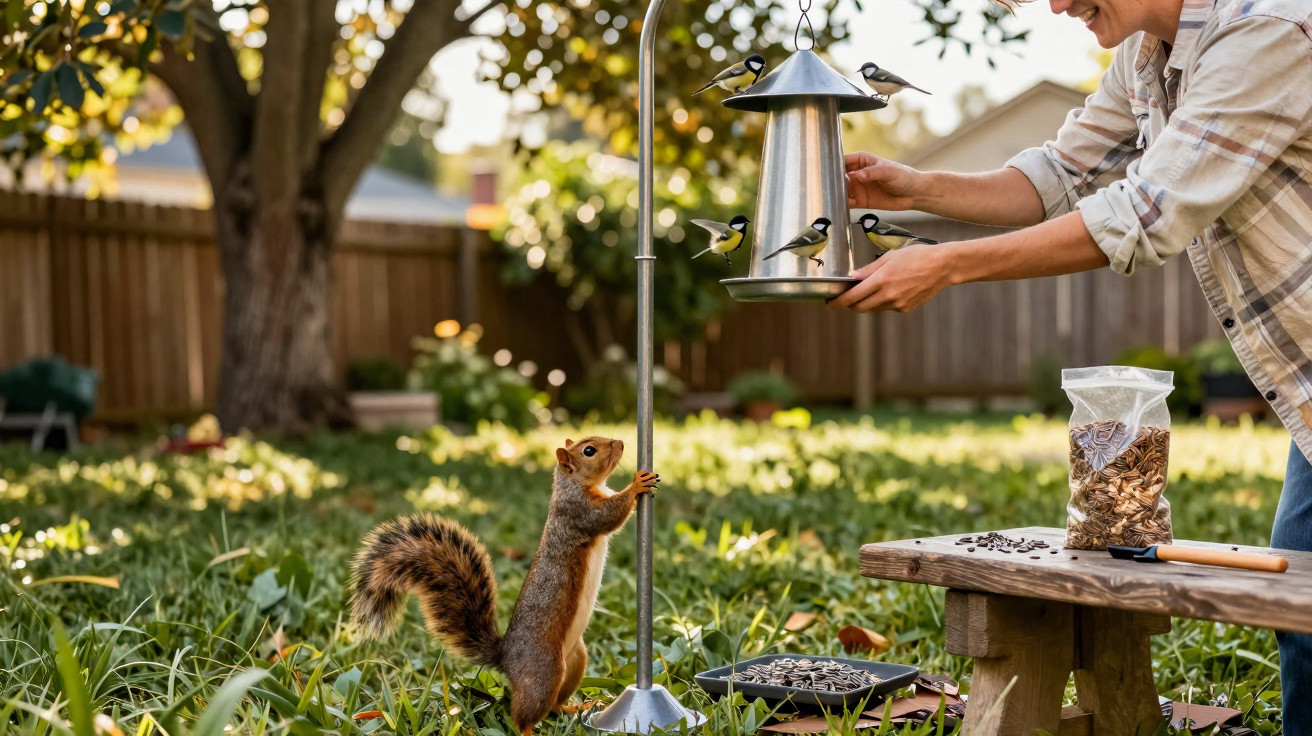
…feed them – only to end up with a squirrel buffet after all. A few smart measures can change that.
Anyone with a bird feeder in the garden or on a balcony will know the issue: no sooner has the food been topped up than the first squirrel is scrambling over it. These acrobatic rodents quickly become regular visitors, leaving the birds with nothing. Thoughtful positioning, clever equipment and a few straightforward tactics can keep the problem largely under control.
Positioning: where a bird feeder is genuinely safe
The location often determines whether the birds or squirrels get the snack. Squirrels can jump impressively far and accurately: on average, around 1.5 metres sideways and more than 3 metres downwards. Mount the feeding station in the wrong place and you make their job very easy.
The ideal position for a bird feeder is:
- at least 3 to 4 metres away from trees, fences, walls and sheds
- in an open part of the garden, rather than directly beneath overhanging branches
- on a smooth metal pole at least 1.80 metres high
Squirrels can climb wooden and plastic poles with little effort. A smooth metal pole, kept clear of anything that could act as a launching point, puts them at a disadvantage. If there is an orchard or densely planted beds nearby, make sure that no branches or shrubs reach close to the feeder.
Wind matters too. In strong gusts, a feeder that swings vigorously may inadvertently move within reach of a branch. Ideally, it should be placed or hung where it is easy to watch from indoors, but where it will not sway back and forth like a pendulum.
The key rule is this: the bird feeder needs a kind of “safety zone” – with as little as possible around it for squirrels to jump from.
Barriers that stop squirrels climbing
The traditional answer to squirrels is a so-called baffle: a protective fitting that blocks their ascent. Looking like large cones or cylinders, these are fitted either to the pole or above a hanging feeder.
Types of squirrel baffle
- Pole baffles: Fitted to a smooth metal pole at roughly 1 metre above the ground. The squirrel slips off and cannot climb any further.
- Hanging baffles: Suspended above a feeder to stop rodents attempting to jump down from above.
- Full-wrap baffles: Enclose the pole completely, leaving no gap through which an animal can squeeze past.
- Torpedo models: Streamlined versions that are especially suitable for hanging bird feeders.
It is worth investing in good materials. Thin plastic can become brittle in summer heat or split during winter. Strong metal models or thick polycarbonate versions are durable choices that can withstand years outdoors.
Another option is a caged feeder. Here, a metal mesh cage surrounds the actual seed tube, with openings narrow enough for small songbirds to pass through easily while keeping squirrels outside. This is particularly useful in wildlife-friendly gardens where many different animals are active.
Squirrel-proof bird feeders with built-in technology
In recent years, an increasing number of “squirrel-proof” feeders have reached the market. They rely on weight, movement or specialised construction. Here is an overview:
| Bird feeder type | How it works | Effectiveness | Suitable for |
|---|---|---|---|
| Weight-activated | Feeding ports close when a heavier animal sits on it | Very high | Most garden birds |
| Caged feeder | Metal mesh keeps larger animals away | High | Small songbirds |
| Spinning feeder | A motor rotates the perch when a squirrel lands | Good | Anyone who enjoys garden scenes |
| Upside-down feeder | Birds feed while hanging upside down, which is difficult for squirrels | Medium | Species such as tits and nuthatches |
Weight-activated feeders are particularly popular. Birds are light enough not to trigger the mechanism. When a squirrel or pigeon settles on the feeder, a ring or flap closes the feeding ports. With no reward available, the animal soon loses interest and moves on.
Spinning feeders offer an extra dose of entertainment. As soon as a heavier animal jumps on, a small motor starts and turns the perch until the unwanted visitor loses its grip. It looks amusing, but does not harm the animal – and the seed remains reserved for the birds.
With traditional tube feeders, it pays to inspect the components closely. Models with metal ports and metal perches last substantially longer because rodents will readily gnaw through plastic. Buying a high-quality feeder saves money over time, as it will not need frequent replacement.
Distraction: when extra food eases the problem
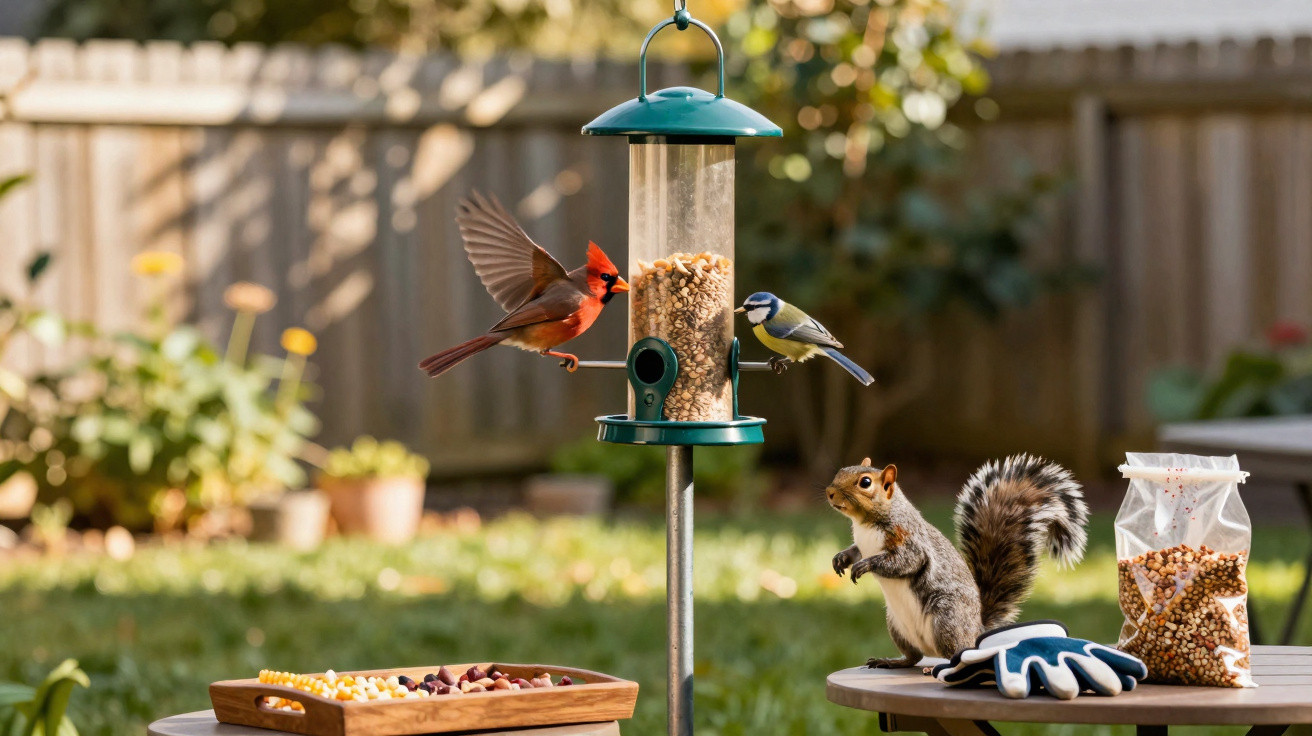
Sometimes a small attempt at “bribery” works better than any barrier. If space allows, set up a separate feeding area for rodents as far from the bird feeder as possible. In it, you could offer inexpensive maize, peanuts in their shells or old walnuts.
Treating the rodents in one spot diverts them from the actual bird buffet – while still allowing you to watch them up close.
The food chosen for the bird feeder is equally important. Some mixes are highly appealing to squirrels, whereas others attract far less interest.
Which seeds attract squirrels – and which usually do not
- Very attractive to squirrels: sunflower seeds, peanuts, maize and high-fat nut mixes
- Considerably less interesting: safflower seed, nyjer and white proso millet
Many songbirds do very well with these less rodent-attractive varieties. Goldfinches, finches and cardinals (the related German species is the bullfinch) readily accept nyjer and safflower seed once they have become accustomed to them. Adjusting the mix slightly can therefore reduce the appeal for squirrels significantly.
Hot additives are another possibility. Mammals have receptors for capsaicin, the compound that makes chilli hot, while birds barely react to it. Ready-made seed mixes and powders are available that coat food with capsaicin. For squirrels, every mouthful becomes unpleasant, whereas birds can continue pecking undisturbed.
Season, behaviour and safety: often-overlooked factors
Squirrel behaviour changes over the course of the year. As natural stores decline in autumn and winter, pressure on feeding sites rises sharply. At this time, several measures are often needed at once: a secure position, a baffle, an adapted seed mix and, where appropriate, a separate feeding area for rodents.
At the same time, deterrence must not create a hazard. Traps, sticky surfaces and poisonous substances have no place around a bird feeder. Children, pets and other wildlife may come into contact with them. Mechanical obstacles, well-designed feeders and thoughtful feeding strategies are always preferable.
It is also sensible to assess the immediate surroundings. Open bins, overflowing compost heaps and leftover food beneath the feeder attract additional rodents. Cleaning up regularly can often noticeably reduce the population around the home.
Everyday tips for a bird feeder
For anyone who does not want to keep making changes, a staged approach works well:
- Move the bird feeder to an open spot that is difficult to reach.
- Install a smooth metal pole with a baffle, or choose a caged feeder.
- Adapt the seed mix and offer fewer of the rodents’ favourite snacks.
- Optionally, create a separate feeding station for squirrels.
- During periods of heavy rodent activity, switch to weight-activated or spinning models.
Each measure helps to some extent on its own. Together, they form a kind of protective shield: the animals have to jump further, encounter less appealing seeds and find it mechanically harder to reach what remains. Many eventually give up and look for easier feeding spots.
Learning a little about the species visiting the feeder allows the measures to be tailored more precisely. Nuthatches and tits readily use hanging, relatively narrow feeding stations, while blackbirds and thrushes pick food up from the ground. A combination of a tube feeder, ground food and a separate rodent area can organise the garden so that everyone has a place – just not all at the same bowl.






Comments
No comments yet. Be the first to comment!
Leave a Comment