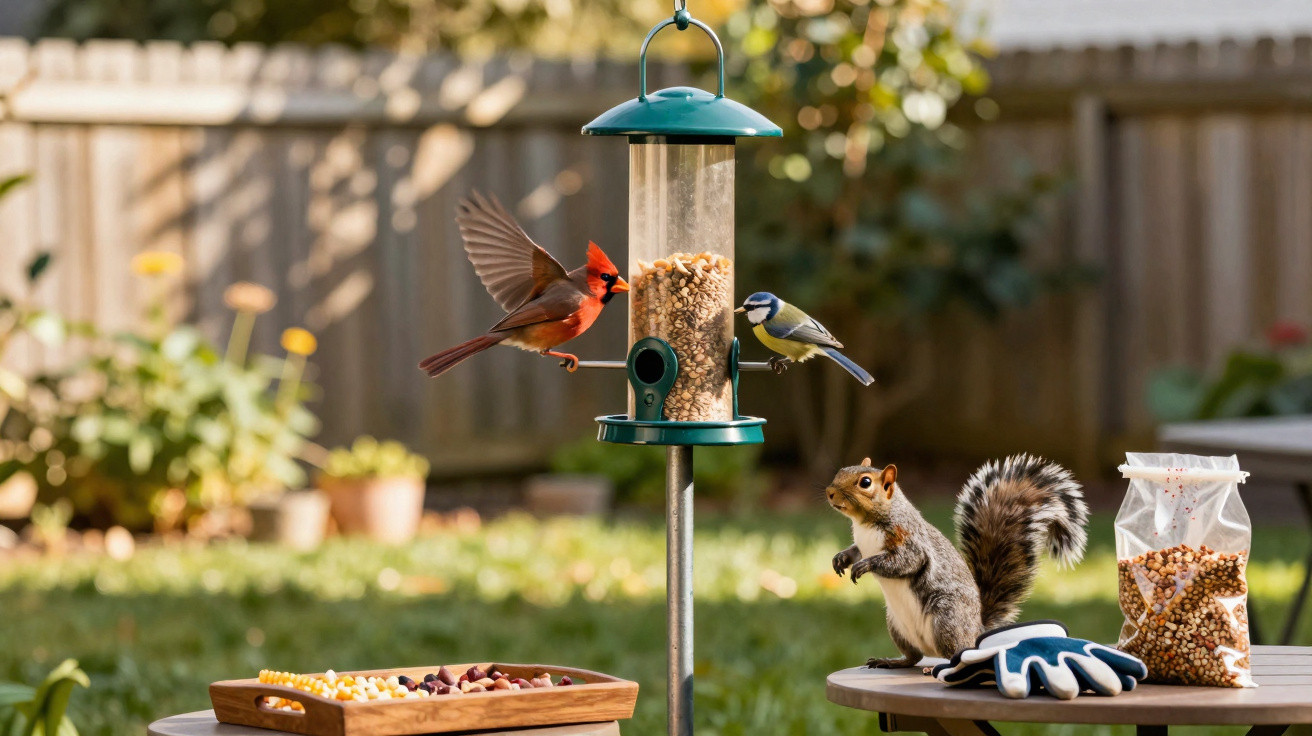
Anyone who puts up a bird feeder in the garden or on a balcony will know the problem: no sooner has the food gone in than the first squirrel performs an acrobatic approach and empties it. Good intentions for tits, finches and robins turn into an all-you-can-eat buffet for rodents. A few well-chosen measures can prevent this very reliably, without harming the animals.
The most important factor: where to position the bird feeder
In many cases, the location determines whether squirrels have any chance of reaching the food at all. They can leap around 1.5 metres, sometimes even farther, and can launch themselves in a controlled way from heights of more than three metres. Ignore that, and you are effectively building a launch ramp for these small climbing experts.
- Keep at least three to four metres away from trees, fences and sheds
- Do not place the bird feeder directly beneath balconies or roof overhangs
- Choose an open, freestanding spot with no branches hanging above it
A bird feeder mounted on a metal pole is ideal. The pole should be about 1.80 metres tall. Squirrels can scale wooden or plastic posts with ease, whereas smooth steel or aluminium makes the task far more difficult.
If fruit trees, flower beds or tall shrubs are already nearby, check whether branches or plant supports could act as a “bridge”. Often, pruning alone is enough to prevent a direct jump.
Wind also matters. If the bird feeder is hanging from a branch or hook, it must not swing so far in gusts that squirrels can reach it from a nearby branch. A good view from the window, but no natural “launch point” within range: that is the combination that works over the long term.
“Anyone who plans the location cleverly from the outset has already won half the battle against squirrels.”
Mechanical barriers: baffles, cages and more
The second major element is a physical barrier. Retailers often use terms such as “baffle” or “protective shield” for these products. They generally refer to funnel-, cone- or cylinder-shaped components that stop squirrels from climbing upwards.
How pole baffles work on a bird feeder
A traditional system is fitted to the metal pole below the bird feeder. The baffle is smooth, reasonably large and shaped so that the rodent either slides off or simply cannot get around it.
- Pole baffles: Attached to the pole around one metre above ground level, they prevent climbing attempts from below.
- Hanging baffles: Suspended above the bird feeder, they block approaches from above, such as from a branch.
- Full-wrap baffles: Enclose the pole completely, leaving no gap to exploit.
Cheap plastic versions can tear quickly, become brittle and lose their effectiveness. Models made from metal or sturdy polycarbonate are a better choice. They cost more, but withstand frost, sunshine and rodents’ powerful teeth for much longer.
Caged bird feeders: a VIP area for birds only
Bird feeders surrounded by metal mesh are particularly useful. The openings are sized so that small songbirds can pass through comfortably, while squirrels remain outside. Such a model is especially worthwhile in gardens with plenty of other wildlife that would also like to help itself to the food.
“Caged bird feeders let birds eat in peace – while the rodents watch in frustration from outside.”
Squirrel-proof bird feeder technology compared
There is now a wide range of “squirrel-proof” bird feeders on the market, using weight, shape or even motors. Here is an overview of several common types:
| Type | How it works | Effectiveness | Suitable for |
|---|---|---|---|
| Weight-operated | Openings close when a heavier weight is applied | Very high | Mixed songbird species |
| Caged bird feeder | Metal mesh stops larger animals | High | Small birds such as tits and sparrows |
| Spinning bird feeder | A motor briefly rotates the perch | Good | Those who also enjoy watching the action |
| Upside-down bird feeder | Only birds able to feed while hanging can manage it | Medium | Woodpeckers, nuthatches and climbers |
Weight-operated models are especially practical in everyday use: lightweight birds land and the feeding ports remain open. When a squirrel jumps on, a cover closes in front of the feeding holes. The animal does not fall, but it can no longer reach the food.
Spinning bird feeders go one step further. As soon as a certain weight rests on the perch, a motor activates the rotation. The squirrel loses its grip and lands on the lawn – unhurt, but confused. Many gardeners regard these moments as a daily comedy show.
With every model, the key point is to choose metal rather than plastic for the critical components. Otherwise, squirrels may eventually chew through thin plastic parts and destroy the entire system.
Distraction rather than conflict: food for squirrels
Sometimes a simple tactic works better than any deterrent: provide a separate feeding spot for the rodents. Position it some distance from the bird feeder, make it easy to access, and stock it with inexpensive food such as maize or plain peanuts.
The experience of many garden enthusiasts is that squirrels lose much of their interest in a more complicated, protected bird feeder when they have an easy and consistently available food source of their own.
- Set up the separate feeding spot at least five metres from the bird feeder
- Use basic rodent food rather than expensive bird food
- Refill it regularly, otherwise the squirrels will return to the bird feeder
“Distracting rodents with their own buffet often eases the situation at the bird feeder almost immediately.”
Food choices: what birds enjoy and squirrels avoid
Not every seed mix is equally tempting to squirrels. They are particularly fond of sunflower seeds, peanuts and maize. Using mainly these mixes is practically an invitation to the rodents.
The following are much less appealing:
- Nyjer seed, for example for goldfinches
- Safflower seed
- Millet, especially white millet
Many finch and cardinal species readily eat these seeds, whereas squirrels find them considerably less interesting. Changing the feed can therefore be the decisive step in keeping rodents away.
Adding heat: capsaicin as a legal secret weapon
One rather surprising approach comes from the kitchen: heat. Capsaicin, the compound found in chilli, irritates mammals’ mucous membranes. Birds do not have these receptors, so they simply do not detect the heat.
Retailers sell coated bird food and liquid additives that can be applied to seed. The food remains neutral for birds, but squirrels find it unpleasant and tend to avoid it after only a few attempts.
Important: use only products explicitly approved for bird food and follow the dosage instructions. Experimenting at home with a homemade chilli mixture risks messy hands, irritated eyes and potentially excessive concentrations.
Season, behaviour and a realistic perspective
In autumn and winter, when less food is available in nature, pressure on every bird feeder increases. This is the time to be especially consistent: inspect baffles, adjust the choice of food and keep the squirrel distraction feeding spot well stocked.
Squirrels are not “bad”; they are simply extremely adaptable. Anyone trying to ban them from the garden entirely will usually fail. A more realistic aim is to manage them enough that birds still get sufficient food, without creating a constant conflict.
A practical example is a freestanding metal pole with a baffle and a weight-operated bird feeder, filled with a less popular seed mix and paired with a separate maize-and-peanut station for rodents. Eventually, those spectacular jumping attempts become a case of “tried it once, not worth it” – and the birds can feed peacefully again.
Anyone who becomes familiar with a few retail terms, from “baffle” to “Nyjer”, and assesses their own garden conditions realistically can create a small bird oasis with manageable effort. Squirrels are welcome to remain in the garden, just not as permanent uninvited guests at the bird buffet.










Comments
No comments yet. Be the first to comment!
Leave a Comment