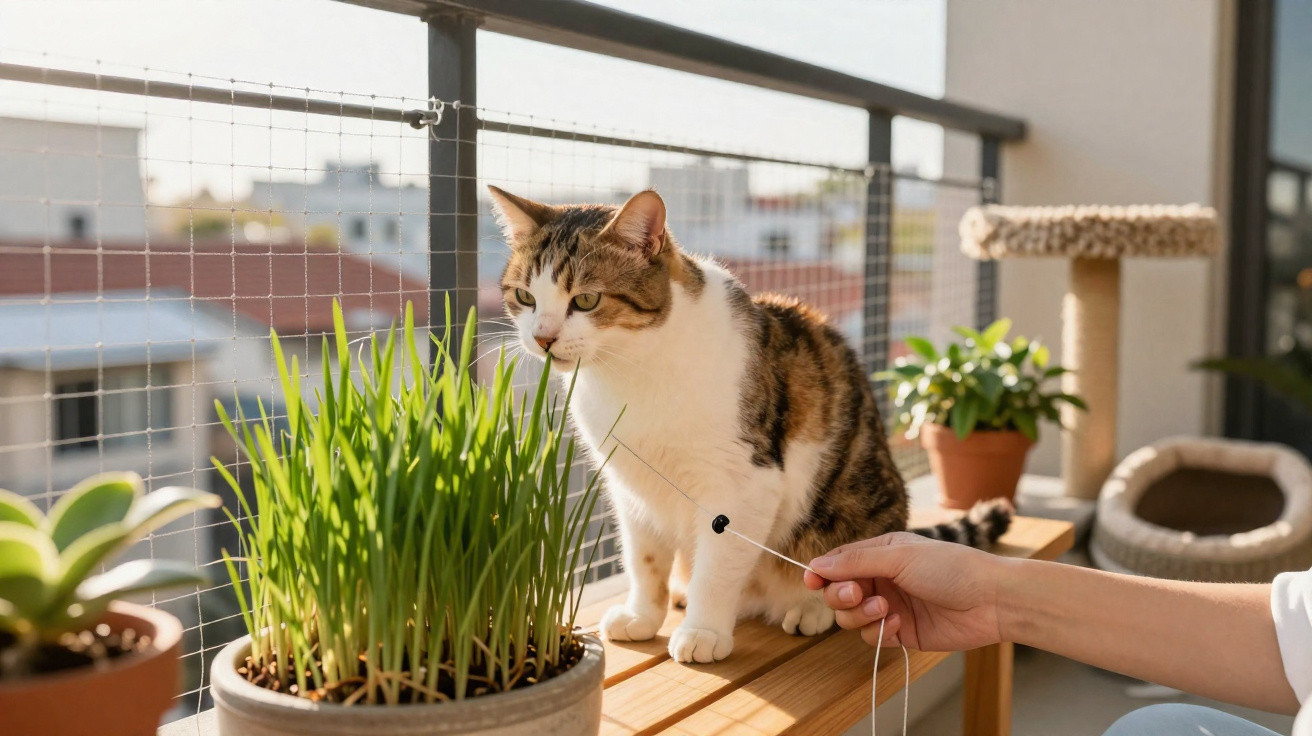
Many owners assume their cat can effortlessly handle any height – until a fall from the balcony changes everything and the veterinary clinic becomes an emergency destination.
Anyone with an indoor cat and a balcony will eventually face the same question: does the balcony genuinely need securing, or is that an overreaction? There is a wide gap between tales of seemingly indestructible cats and accounts from veterinary surgeries. That is precisely why it is worth taking a clear-eyed look at the risks, myths and practical options.
The myth that cats always land on their feet
Almost everyone knows the saying that a cat always lands on its feet. There is some truth behind it: a specialised righting reflex, made possible by an exceptionally flexible spine and the sensitive balance system in the inner ear, allows the animal to turn its body in mid-air to land as well as possible.
However, this biomechanical feat has distinct limits. A cat needs a minimum falling distance to complete the turn at all. If it falls from a low level, for instance from a first-floor balcony, it will often simply not have enough time.
Short falls are deceptive: the cat cannot position itself properly, so the impact catches it unprepared.
When the fall is from a considerably greater height, the righting reflex usually works. The cat may then land on all four paws, but the force of impact remains enormous. Hard or sloping ground makes the consequences worse, particularly if the body slips on landing or the head strikes the surface afterwards.
Why many owners underestimate the danger
Similar arguments repeatedly arise during consultations with vets as to why a balcony is supposedly safe enough. Many sound convincing at first, but rarely stand up to reality.
- “My cat is old and calm.”
Older animals in particular often contend with balance problems, dizziness or deteriorating eyesight. A cat that likes dozing on the balustrade is therefore especially vulnerable – a brief fright or an insect can be enough. - “The balcony has a wide ledge, so nothing can happen.”
Wide edges offer only a false sense of safety. A wet surface, smooth metal or one clumsy step may be enough to cause a slip. - “I keep an eye on my cat when it is outside.”
No one can watch their cat without interruption. A bird flies past, a motorbike roars by or the phone rings, and within seconds the cat is standing on top of the balustrade.
There is another important consideration: cats do not deliberately jump into the void. They fall because they are in hunting mode or are suddenly startled. For a few seconds, their hunter’s instinct overrides every precaution.
What lies behind high-rise syndrome
Veterinary medicine has established its own term for falls from balconies and windows: so-called “high-rise syndrome”. It describes cats that fall from a significant height from a flat and are brought to a surgery or clinic with sometimes severe injuries.
Visible damage tells only half the story. Vets report a whole range of common injuries:
- fractures of the limbs, pelvis or lower jaw;
- internal injuries, including bleeding in the chest or abdomen, lung bruising and ruptures of the bladder;
- traumatic brain injuries, which may initially seem unremarkable but can develop dramatically later;
- long-term damage, such as paralysis or chronic pain, even where the animal survives the fall.
Many injuries remain invisible at first – what appears to be a “minor” fall may prove life-threatening only hours later.
Studies in small-animal medicine do indicate that a large proportion of affected cats survive. Yet that statistic offers little comfort when an owner must choose between high surgical costs, lengthy aftercare and an uncertain outcome, or a few hours of work fitting protection that prevents the fall in the first place.
Making a balcony safe: solutions that genuinely work
Anyone looking into the issue soon discovers that there is no single perfect solution. Different approaches suit different homes, budgets and levels of DIY confidence.
Safety netting – the flexible standard option
In many cities, safety netting has become the classic choice. It is usually made from robust polyethylene, sometimes with reinforced threads so that even cats keen on chewing cannot simply bite through it.
- relatively low purchase costs;
- hardly obstructs the view from indoors;
- transparent versions are unobtrusive from outside;
- straightforward installation using hooks or telescopic poles, often without drilling.
Such nets are particularly appealing for tenants because the building fabric usually does not need altering. With telescopic poles, the structure is simply wedged between the floor and ceiling or between side walls.
Grilles and trellises for particularly adventurous cats
For highly agile cats or especially determined climbers, some owners prefer grilles or sturdy trellises. These options act like an additional enclosure barrier and prevent even acrobatic escape attempts.
The downside is that metal grilles are far more noticeable visually and often require drilling or permanently screwed brackets. In owner-occupied developments, rules set by the residents’ association may also apply to protect the building façade’s overall appearance.
If you rent your home, choose systems that do not require drill holes – this protects not only the wall but often your deposit as well.
Legal and practical pitfalls
Many building rules specify how extensively balconies may be altered. Conspicuous structures or brightly coloured covers often meet resistance. Discreet safety nets in stone-coloured or transparent finishes, by contrast, are frequently accepted provided they do not significantly disrupt the overall appearance.
Before installation, it is worth checking the tenancy agreement or building rules. Disputes with a landlord or neighbours are easier to avoid by choosing reversible systems that can be removed without leaving traces.
Caution remains essential – even with protection in place
A secured balcony can easily tempt owners to leave everything to the equipment. It is not quite that simple. Owners remain responsible, especially when doors are open and during energetic play sessions.
- Avoid leaving the balcony door open unattended when nobody is at home.
- Do not encourage wild hunting games right beside the balustrade, especially with teaser wands or laser pointers.
- Do not place stools, tables or plant shelves directly beside the balustrade – they act like springboards to greater heights.
- Inspect the netting, knots and fixing points regularly, especially after storms or heavy snowfall.
Creating a cat-friendly balcony
Once fall protection is sorted, the balcony can become a small paradise. For indoor cats, a safe outdoor space provides not only more variety but also mental stimulation.
What cats genuinely enjoy on the balcony
A few carefully selected additions can quickly turn the balcony into a favourite spot:
- A sturdy scratching post or climbing tree from which the cat can watch the street.
- A pot of cat grass, which supports digestion and is regularly eaten by many cats anyway.
- A sheltered shaded area, perhaps created with a small sun sail or a partly open box.
- A weatherproof resting place, such as a cushion in a crate or a raised board.
- In summer, possibly the litter tray, if the cat tolerates a change of location – ideal in small flats.
- Seating for people to spend time outdoors together.
The more appealing the secure balcony is, the less likely a cat is to press towards risky edges and balustrades.
Heat, draughts and stimuli: further balcony risks
The climate matters alongside the danger of falling. On south- or west-facing balconies, the air can become intensely hot in summer. Cats cannot sweat effectively and can overheat more quickly than many people realise. Shade, fresh water and somewhere to retreat are therefore essential basics.
Plants also deserve attention. Many popular balcony plants are toxic to cats, including oleander, certain types of lily and some ornamental plants. Those wishing to play it safe can opt for non-toxic alternatives such as lavender, calendula or specialist cat-garden mixes.
When a safety plan is urgently needed
A secured balcony is worthwhile for virtually every indoor cat. It is especially urgent for:
- young tomcats and young cats with a strong urge to play and hunt;
- anxious animals prone to panicked escape attempts;
- rescue cats whose behaviour cannot yet be assessed accurately;
- senior cats with reduced mobility or eyesight.
Anyone wanting to compare the costs can look at it the other way around: what do netting and a few poles cost, and what would a single veterinary-clinic emergency involving diagnostics, surgery and aftercare cost? That comparison usually makes the decision very easy.
Ultimately, this is not about taking something “away” from the cat, but about giving it safe freedom. A well-secured, thoughtfully designed balcony offers fresh air, interesting scents and new views – without every visiting bird becoming a gamble with its life.








Comments
No comments yet. Be the first to comment!
Leave a Comment