Many people act on impulse – and that is often when they make the crucial mistake.
Anyone who comes across a stray or clearly lost dog usually has good intentions. Some food, somewhere warm, perhaps even keeping it straight away – after all, it can appear that nobody cares. Yet that gut reaction can create legal and practical difficulties, particularly if the dog has no microchip or the chip has not been scanned.
Why a dog microchip is more than bureaucracy
A dog's microchip is not an optional gadget; it is the animal's official identification. It works like an identity document placed beneath the skin. About the size of a grain of rice, the small capsule is implanted under the skin around the neck by a vet and can be read permanently.
The chip performs several important roles:
- it clearly links the dog to the person responsible for it
- it enables lost animals to be returned quickly to their owners
- it helps authorities tackle abandonment, illegal trading and stray dogs
- it makes it possible to identify owners after a biting incident or accident
Across many European countries, including Germany, registration and identification requirements apply depending on the region. Anyone who does not have puppies or dogs microchipped and registered within the required period may face fines. Matters become even more uncomfortable when there is a dispute: without a chip and an entry in a register, proving ownership is extremely difficult – especially when several people claim the same dog.
"A dog without a microchip is legally a nobody – and that is precisely what makes every found-dog case so sensitive."
Found a dog: make safety the first step, not a selfie
Whether you find it in woodland, beside a country road or outside your front door, your first priority when encountering a dog that appears to have no owner should be safety – for both people and the animal.
- If the dog seems frightened or aggressive, keep your distance and contact the police or local authority.
- If it appears friendly, secure it where possible with a lead or a makeshift loop.
- Take it somewhere calm and safe, away from traffic.
- Offer water and, if necessary, a little food – but do not overdo it if the dog is highly stressed.
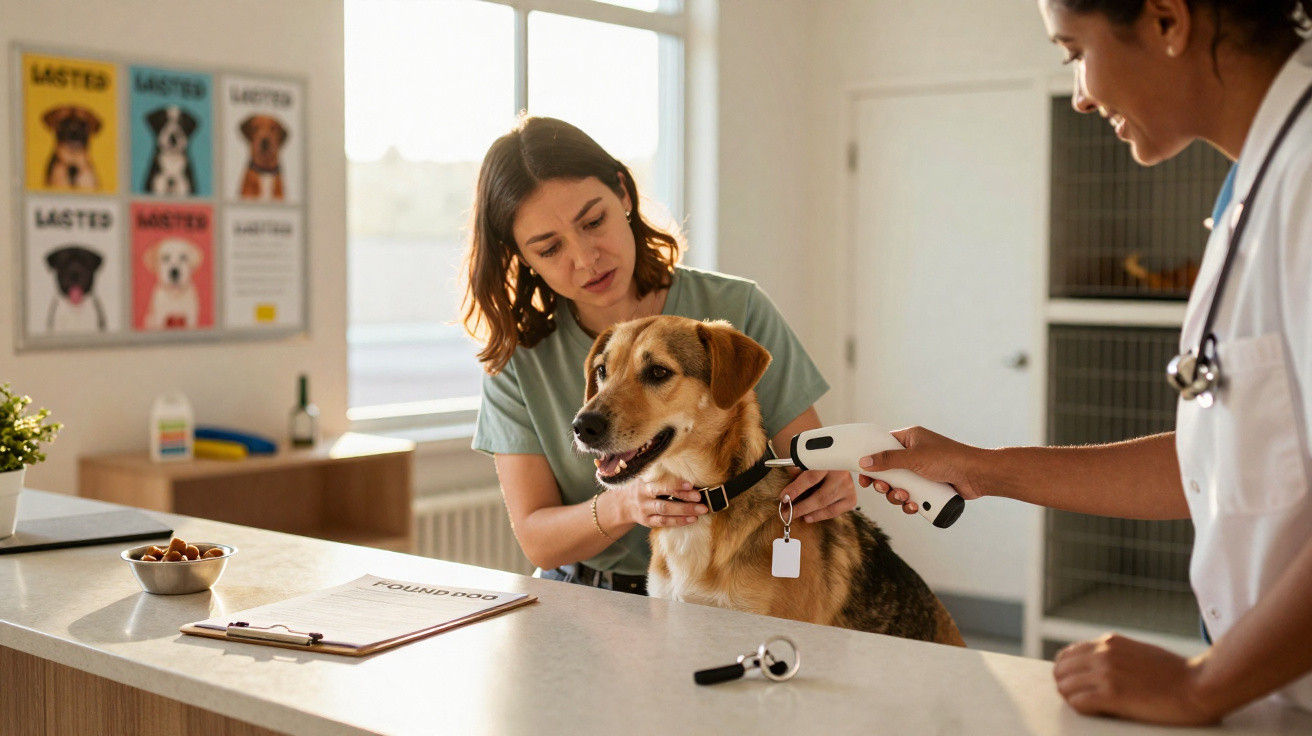
If you have a local vet, you can call and ask whether the dog’s chip can be scanned at short notice. Many practices provide this as an emergency service.
Scanning the microchip: how to trace the legal owner
In practice, the process usually works like this: a vet or public veterinary service scans the dog with a reader. There are three possible outcomes.
The dog is microchipped and registered
When a number is found, the owner can be traced through the relevant pet register. Often, a few phone calls are all it takes: the dog has gone missing, its person is desperately looking for it, and the reunion happens quickly.
Importantly, anyone who finds a microchipped dog must not simply keep it. In legal terms, this can often amount to retaining someone else’s property.
The dog is microchipped but poorly registered, or not registered at all
Sometimes the reader detects a microchip, but the associated details are missing or incomplete. Authorities, vets or animal welfare organisations must then investigate more thoroughly, for example by checking countries of origin, breeding paperwork or earlier records. This can take time and often results in a formal procedure.
The dog has no microchip
In this situation, the dog is unidentified and, depending on the circumstances, is effectively treated as a found animal or stray dog. This is exactly where many mistakes occur, because finders automatically assume: “No microchip means it belongs to nobody, so I can simply take it.”
"The biggest misconception is that a dog without a microchip is ownerless and immediately free to take. It is not that simple."
The legally correct route: inform the authorities
Anyone finding an unidentified dog must not bypass the official channels. The local authority, police or municipal veterinary service will generally be responsible. Depending on the area, they will arrange for a collection or animal-catching service.
The typical process is as follows:
- the dog is taken to an animal reception centre or rescue shelter
- it receives a health check and is checked again for identification marks, such as a tattoo, microchip or tag
- it is formally recorded as a found animal and microchipped if no chip is present
Many local authorities impose a form of “administrative quarantine”, usually lasting several weeks. During this period, a possible owner has the opportunity to report the dog and prove that it is genuinely theirs – with photographs, vaccination records or previous veterinary invoices, for example.
What you should never do
Good intentions do not prevent trouble. Finders should make sure they avoid several actions:
- keeping a microchipped dog without reporting that it has been found
- having a new microchip registered in their own name without involving the responsible authorities
- arranging for an existing microchip to be removed or tampered with
- passing the dog on “unofficially” without making a formal report
Such actions may have criminal consequences, including misappropriation or criminal damage. In individual cases, courts have recognised the good faith of finders who demonstrably cared for a completely unmarked animal for months. Even then, the only safe and stress-free approach is to follow every reporting step properly.
When your heart decides: adopting a found dog properly
Many people fall in love with a dog they have found within only a few hours. Anyone wishing to give it a permanent home will need some patience and willingness to deal with administration.
Where the dog is placed with a local authority facility, the usual steps are:
- the dog remains at the shelter or reception centre as a found animal for the required period
- it undergoes a medical assessment, is microchipped and registered
- once the period ends, it can be rehomed if nobody has come forward
The person who found the dog can often register their interest first. Many organisations use questionnaires, brief interviews and sometimes a preliminary home visit. The aim is to establish whether the living arrangements, available time and experience are right for that particular animal.
A temporary option: fostering instead of immediate transfer of ownership
In some areas, it is possible to foster a found animal during the holding period. The dog then already lives with the prospective family, but legally still belongs to the local authority or to the previously unidentified owner. If that person later appears and can prove their entitlement, the dog must be returned. If the period passes without a claim, the dog moves into the standard adoption process.
If the previous owner wants to give up the dog
There is one special case: someone wants to surrender their own dog, which has never been microchipped. Legally, transferring the dog without identification is usually not permitted. The dog must first be registered to its current owner, after which an official change of ownership can take place. Anyone attempting to report an adult animal later as “only just acquired” risks a fine for the earlier failure to comply.
How owners can genuinely protect their dog
Anyone who already has a dog should take identification seriously. A few basic measures provide a great deal of security:
- have a vet implant a microchip and register it in a central database
- keep the address and telephone number up to date, particularly after moving home or changing number
- also use a collar with a clearly readable tag and telephone number
- strengthen recall training and introduce the dog gradually to new environments
"A microchip, registration and a simple tag on the collar can be the difference between ‘gone forever’ and ‘back home that same evening’."
What finders often do not realise – and why doing things properly matters
Many people avoid contacting the authorities because they fear paperwork or costs. In reality, rescue shelters and public bodies are often grateful to work with finders, especially when they are prepared to take the animal on later. Following the official route not only protects you from problems, but also protects dogs that may genuinely have been stolen or illegally traded.
There is another important consideration: a dog without a microchip may be ill, abused or part of a wider problem – for instance, it may have come from an illegal transport operation. These networks can only be identified and pursued when vets and authorities are involved.
So, anyone finding a dog without a microchip is effectively holding a small emergency in their hands, one that requires both heart and common sense. Care, food and a warm place are the emotional part. Reporting the dog, checking for a microchip and keeping proper records are the practical part. Only the combination of both gives the animal a genuinely fair chance of a safe home – whether with its original person or with someone who has newly fallen in love with it.
















Comments
No comments yet. Be the first to comment!
Leave a Comment