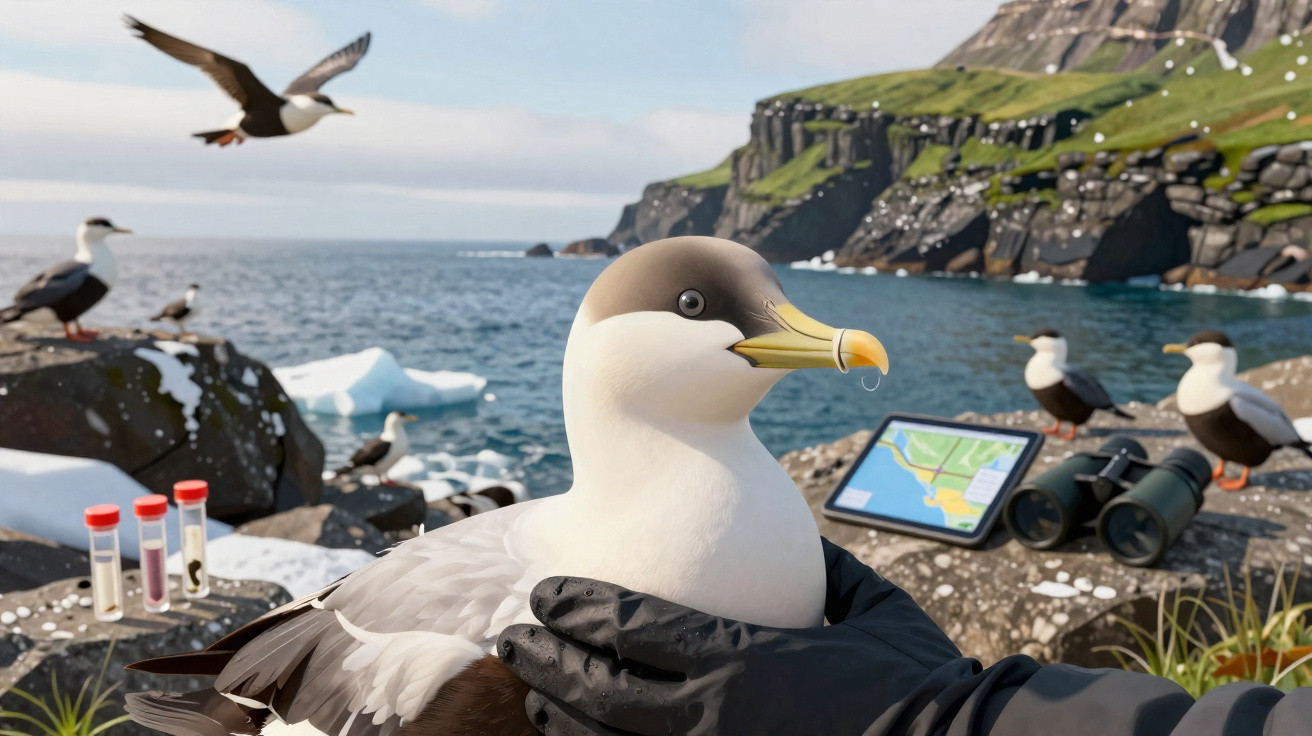
Migratory birds cross the North Atlantic each year, connecting cold, isolated islands that might otherwise remain separated by the ocean.
A red-throated diver, for example, may breed on a lake in West Greenland before spending winter on western Europe’s coast, travelling thousands of miles between the two.
For years, biologists assumed that such long-distance travellers were carrying something else on these journeys: passengers too small to notice.
The idea was that parasites could hitch a lift inside a bird before being deposited in a pond far from their original home. On the face of it, the reasoning is convincing.
A host capable of moving vast distances ought to distribute its parasites widely. A new study set out to test that assumption, but its results did not fit the neat explanation researchers expected.
Why birds should spread Diplostomum parasites
The parasites examined in the study belong to Diplostomum, a genus of eye flukes. These flatworms follow an unusual life cycle involving three stages.
They begin in freshwater snails, then enter fish eyes, before completing their development in fish-eating birds.
Since birds can travel so far, the assumption was that the parasites would travel with them. This was the central hypothesis at the start of the research.
Scientists from the Estonian University of Life Sciences investigated whether parasite communities on islands became more alike, as frequent movements by birds might imply.
Testing two North Atlantic islands
The researchers studied two locations. In Greenland, they sampled Arctic char and juvenile Atlantic salmon from six rivers near Nuuk, processing the fish at the Greenland Institute of Natural Resources.
In the Faroe Islands, they gathered brown trout and salmon from sixteen streams spread across four islands, in collaboration with the Faroe Islands National Museum.
They then analysed the DNA. Rather than relying on microscopic examination of larvae, which seldom identifies the species reliably, they used metabarcoding.
This approach reads short fragments of genetic material, allowing an entire parasite community to be identified at the same time.
Greenland was full of parasites
The Greenland samples contained many parasites. Infections were detected at four of the six locations, and at some sites every fish examined was infected.
DNA analysis identified four separate parasite lineages in the char and salmon. Several individual fish hosted more than one lineage.
A small number carried three lineages simultaneously, while one particularly unfortunate char was infected with all four.
The Faroe Islands had none
The Faroes produced the reverse result. The researchers detected nothing among 161 brown trout and three salmon.
There was not a single sign of eye fluke, and that complete absence is the unexpected finding.
The Faroe Islands contain suitable snails, including the same types that act as hosts for these parasites in Iceland. They also have brown trout, a recognised carrier.
On paper, the islands should have been full of Diplostomum. In reality, they were not.
A possible new species
The Greenland results contained an additional surprise. One of the four lineages did not correspond to anything in global genetic databases.
It stood separate from every described species, sharing only about 93 per cent of its genetic code with its nearest known relatives. Nor was it uncommon.
Almost a third of the fish studied carried this lineage, making a laboratory error highly improbable. It may well be a species unknown to science, living undetected in Arctic rivers.
Greenland’s parasites came from America
The team also investigated the genetic origins of Greenland’s parasites. The evidence pointed westwards rather than eastwards.
These lineages were much more closely related to North American counterparts than to parasites from Iceland or Norway, despite the constant passage of European birds through the area.
That pattern offers a clue to their arrival. The parasites appear to have moved north from North America via the American Atlantic Flyway, before their progress stopped.
The ocean between Greenland and Iceland seems to function as a barrier.
A narrow window for infection
Why, then, might a parasite travel with a bird to Greenland but fail to continue onwards to Iceland or the Faroes? The researchers believe the answer lies in timing.
Diplostomum can complete its life cycle only under tightly limited conditions. Its eggs stop developing in cold water.
Its free-swimming stage has very little movement below about 6°C. Meanwhile, the adult worm can survive inside a bird for only roughly three weeks.
Together, these constraints create a very narrow seasonal opportunity.
Transmission takes place mainly in Arctic breeding areas during the short northern summer, when water temperatures are sufficiently high and suitable snails are present.
In wintering regions, that opportunity disappears. A bird may still be carrying the parasite, but cannot pass it on.
Why the Faroes stay parasite-free
The Faroe Islands face a different form of the same constraint. Few of the fish-eating birds that visit the islands actually breed in their freshwater habitats.
Divers and mergansers, which are the typical hosts, are uncommon there. Terns and gulls do occur, but they spend their time at sea rather than in the lakes and streams where the parasite’s life cycle must be completed.
Birds may therefore deliver the parasite, but they do not remain in the necessary location at the necessary time to transfer it to a local snail.
What the findings tell us
Lead author and postdoctoral researcher Alfonso Díaz-Suarez said the team had expected substantial overlap between parasite communities on the islands.
“Instead, we found striking differences between regions, indicating that Diplostomum parasites have a more limited distribution despite the presence of highly mobile hosts,” added Alfonso Díaz-Suarez.
His colleague, Professor Anti Vasemägi of the Swedish University of Agricultural Sciences, challenged the widely held belief that migratory birds freely transport parasites over long distances.
“Our findings suggest that successful parasite dispersal is much more restricted and depends on a combination of host movements, environmental conditions, and the complex life cycles of the parasites themselves,” noted Professor Anti Vasemägi.
Why the finding matters
The implications extend beyond eye flukes. Mobility by itself does not ensure that a species will spread.
For a parasite, or any organism travelling with a host, to become established, an entire sequence of conditions must align at its destination.
The study also highlights how much remains unseen. A widespread and possibly undescribed species had been present in Greenland’s rivers all along, awaiting the appropriate DNA test.
More may be concealed in these remote waters, which are warming rapidly.












Comments
No comments yet. Be the first to comment!
Leave a Comment